

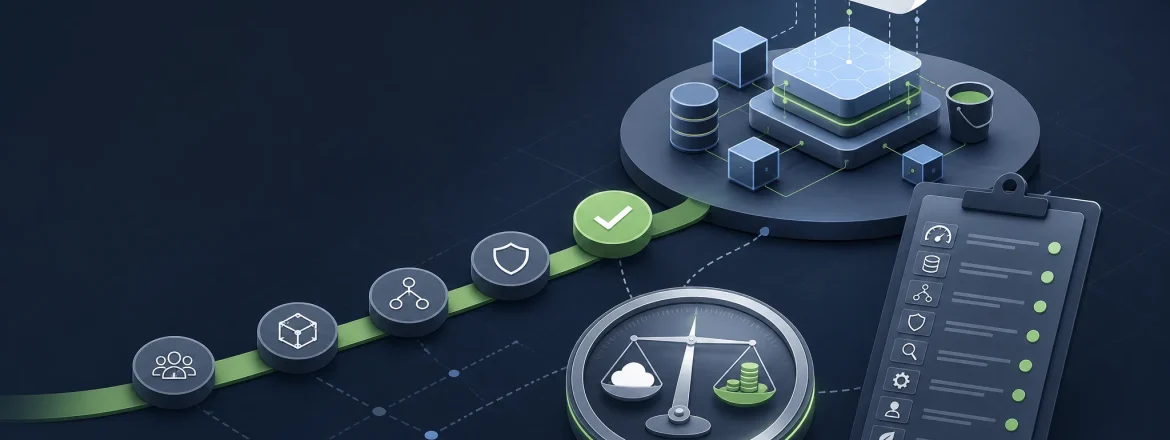
Cost-aware architecture review is a design-time practice for making cloud economics tradeoffs explicit—before capacity, data retention, observability volume, topology, or managed-service coupling harden into costly, hard-to-reverse system defaults.
Cloud cost pressure often arrives through architecture artifacts that don’t look like “cost decisions”: retention defaults, always-on environments, observability cardinality, autoscaling buffers, managed-service choices, and multi-region assumptions. When those decisions are made without an explicit cost reasoning step, they later become expensive to change—creating operational drag and an “infrastructure tax.”
This guide gives you a cost-aware architecture review framework you can use in design reviews: a trigger rule, an eight-area checklist, a decision record template, and an operating loop that connects design assumptions to post-deployment signals.
What this cost-aware architecture review guide is (and isn’t)
| This guide is | This guide is not |
|---|---|
| A practical framework to review cloud economics tradeoffs alongside latency, reliability, security, compliance, and operability. | A case study, migration story, or “before/after” quantified ROI report. |
| A checklist and operating model that helps teams decide when cost reasoning belongs in design review. | A claim that cost should override reliability, security, compliance, or delivery speed. |
| A way to produce durable decision records (assumptions, owners, revisit signals) that reduce repeated debates. | A finance approval workflow that blocks every design change. |
The problem: cost review often comes after the expensive decision is already embedded
Late cost review tends to discover symptoms. Those symptoms usually map back to early design choices that were treated as “defaults” rather than explicit tradeoffs:
- Persistent idle baseline capacity → always-on replicas, dedicated clusters, non-expiring environments.
- Rapid storage growth → broad retention, unbounded event storage, overly permissive indexing.
- Noisy observability spend → high-cardinality metrics, verbose logs, unsampled traces.
- Unexpected network/egress cost → cross-region calls, NAT-heavy paths, centralized export pipelines.
- Expensive managed-service usage → pricing dimension mismatch to workload shape (requests vs throughput vs partitions vs scans vs replicas).
- Reliability topology that’s hard to change → multi-region assumptions, active-active/warm standby baked in.
The system isn’t “wrong” for costing money—cost may be justified by product requirements, latency, security, compliance, reliability, or operational simplicity. The issue is that the assumption behind the cost driver was rarely reviewed as an architecture decision.
Once a workload is live, changing these assumptions often becomes a migration project: retention may require legal/compliance involvement, topology changes can affect incident response, telemetry changes can impact debugging/forensics, and moving off a managed service can demand operational capability the team doesn’t currently have.
Infrastructure tax (mental model)
“Infrastructure tax” is a mental model for recurring cost and operational drag caused by infrastructure decisions that become hard to revisit. You don’t need a measured finding to use the concept—just the shared engineering experience that defaults can outlive the design conversation.

The constraint: don’t turn cost-aware architecture review into a finance gate
Every decision doesn’t need a cost review. If you demand explicit cloud economics reasoning for everything, you create noise, delays routine work, and can accidentally teach teams to treat FinOps as compliance instead of a shared design discipline.
A cost-aware architecture review should focus on decisions that are:
- Durable (persist beyond the initial rollout),
- Multiplicative (tend to grow with usage, tenants, data, regions, environments, or adoption), or
- Hard to reverse (later changes require migration, compliance review, operational redesign, or broad coordination).
Finance partners still matter. They can help with forecasting assumptions, allocation/chargeback, amortization thinking, and business context. But the ownership for technical tradeoffs should remain with engineering: failure modes, reliability posture, operational complexity, migration risk, and remediation options.
Better review question
The review question is not “Is this cheap?” The review question is:
What cost commitment are we making, what assumption drives it, what engineering tradeoff are we accepting, and what signal tells us to revisit it?
This framing keeps cloud economics inside architecture review without turning architecture review into a budget gate.
For a related perspective on why tools alone don’t solve architectural tradeoffs, see Why FinOps Tools Don’t Actually Reduce Cloud Spend (And What Does).
The trigger rule: when cost-aware architecture review should happen
Before applying any detailed checklist, use this trigger rule:
A cloud architecture decision deserves explicit cost-aware architecture review when it is persistent, multiplicative, or hard to reverse.

Here’s a practical decision tree you can paste into a design template.
Start
 |
 |-- Does the design create an ongoing baseline commitment?
 |     Examples: always-on capacity, provisioned throughput, baseline replicas,
 |     warm standby, long-lived environments, reserved/committed capacity, dedicated clusters.
 |        |-- Yes -> Trigger cost-aware architecture review.
 |
 |-- Does the cost grow with a multiplier (adoption or usage)?
 |     Examples: tenants, requests, events, metric cardinality, traces,
 |     data volume, regions, environments, accounts/projects, or team adoption.
 |        |-- Yes -> Trigger cost-aware architecture review.
 |
 |-- Would changing it later require migration, compliance review, operational redesign,
 |   or broad coordination?
 |     Examples: retention policy, storage layout, topology, managed-service coupling,
 |     network boundaries, compliance zones, observability schema, ownership model.
 |        |-- Yes -> Trigger cost-aware architecture review.
 |
 |-- Is it low-volume, reversible, short-lived, and covered by a platform default?
 |        |-- Yes -> Use the platform default; keep review lightweight.
 |
 `-- If security, compliance, privacy, or reliability risk is material,
     route to the appropriate review even when the cost trigger is low.
Persistent decisions create an ongoing baseline commitment
These are decisions that typically remain active regardless of workload intensity:
- Always-on compute
- Provisioned capacity
- Baseline replicas
- Dedicated clusters
- Long-lived environments
- Warm standby capacity
- Shared services that run continuously
Trigger question: What baseline are we committing to, and what signal tells us we should revisit it?
Multiplicative decisions grow with adoption or usage
Costs rise faster because the decision repeats across a workload growth dimension:
- Tenants
- Requests
- Events
- Data volume
- Regions and availability zones
- Environments and accounts/projects
- Metrics/log labels cardinality
- Trace volume and sampling choices
- Team adoption of a platform default
Trigger question: What is the growth dimension, and does the design remain sensible if growth is faster than expected?
Hard-to-reverse decisions become migration projects later
These decisions later require rework because they touch foundational shape:
- Storage layout and indexing strategy
- Data model and schema
- Retention policy and legal holds
- Regional topology
- Managed-service coupling
- Network boundaries
- Compliance zone boundaries
- Observability schema and telemetry policies
- Ownership model and attribution requirements
Trigger question: If this decision is wrong, what would it take to unwind it?
Cost-aware architecture review: the eight areas to check
A design review should only use the areas that are material to the decision. A simple stateless internal tool may only need capacity, observability, operations, and ownership. A regulated data service may need deep review across all eight areas.
| Area | Questions to ask (cost-aware) | Typical caveat |
|---|---|---|
| Capacity | What is always-on vs burst? Which scaling mode applies? What SLO/failure mode justifies headroom? | Keep reliability/security requirements explicit; don’t trade them away silently. |
| Data | What is retained, where, and why? What lifecycle tiers apply? What backup/restore and retention controls exist? | Regulated or audit data may require legal/compliance/security review. |
| Traffic | Where does traffic cross regions/zones/accounts/providers/CDNs? What multiplies movement? What is synchronous vs async behavior? | Network charge-bearing boundaries depend on provider and path direction. |
| Reliability | Which failure mode does the spend mitigate? What recovery objectives drive topology? What complexity does the posture add? | Reliability/security/compliance requirements come first; tie cost choices to them. |
| Managed services | Which pricing dimension scales (requests, connections, throughput, partitions, scans, storage, replicas, transfer)? What coupling is created? | Managed services may reduce operational burden even if unit cost differs; focus on tradeoffs. |
| Observability | What is each signal for? What retention/sampling policy applies? Are cardinality/labels bounded? Are sensitive fields redacted? | Security/privacy review may be required for telemetry content. |
| Operations | What platform default/IaC template/service catalog entry/policy is used? Is this an exception? Is there an escape hatch? | Too many tribal exceptions reduce consistency and attribution quality. |
| Ownership | Who owns the assumption? What signal triggers review? Where is the decision recorded and auditable? | Attribution can touch sensitive finance/security/privacy details—publish carefully. |
For each material decision, answer four questions:
- What drives cost?
- What assumption are we making?
- What default are we inheriting (or overriding)?
- What would tell us to revisit this later?
Capacity: separate baseline commitments from elastic demand
Direct answer: In cost-aware architecture review, capacity starts by splitting baseline capacity (paid because the system exists) from burst capacity (paid because demand arrives).
Baseline capacity examples:
- Minimum replicas
- Provisioned throughput
- Dedicated clusters
- Warm standby capacity
- Non-production environments that run continuously
- Shared platform components that run regardless of demand
Burst capacity examples:
- Autoscaling reactions to load
- Queue workers that scale to backlog
- Scheduled scaling for known demand windows
- Serverless concurrency for event-driven peaks
- Interruption-tolerant capacity for workloads that can handle variance
If you treat baseline and burst as the same problem, you lose the ability to reason about what is persistently committed versus what is responding to demand.
Capacity review questions
- Does the workload need provisioned capacity, autoscaling, scheduled scaling, queue-based smoothing, serverless execution, shared platform capacity, or interruption-tolerant capacity?
- What request shape do we expect: steady, spiky, seasonal, batch-windowed, tenant-driven, or event-driven?
- What headroom is required by the SLO or failure mode?
- What cold-start tolerance exists (if serverless or scale-to-zero is involved)?
- How many environments need to run continuously?
- Can queueing smooth burst demand without violating user expectations?
- What happens during failover?
- What signal indicates the baseline is wrong (utilization drift, persistent idle, repeated scaling events, queue growth, throttling, or latency degradation)?
Common capacity options and tradeoffs
| Capacity option | Where it fits well | Main tradeoff to make explicit in cost-aware architecture review |
|---|---|---|
| Provisioned capacity | Predictable performance needs, latency-sensitive systems, stateful workloads | More predictability, but creates baseline commitment |
| Autoscaling | Variable request-driven workloads | Requires good scaling signals and safe limits; baseline still exists |
| Scheduled scaling | Predictable time-based demand | Can underperform when demand patterns shift |
| Queue-based workers | Asynchronous processing and batch workloads | Introduces queue latency and backlog management complexity |
| Serverless execution | Intermittent or event-driven workloads | May introduce cold starts, concurrency constraints, and provider coupling |
| Spot/preemptible/interruption-tolerant capacity | Workloads that can handle interruptions or degrade gracefully | Needs interruption handling, fallback capacity, and workload suitability |
Reliability buffers should be tied to actual workload tiers and failure modes, not inherited automatically. For more on shaping the review process around operating model decisions, you may also find Platform Engineering vs DevOps: Pick the Right Operating Model helpful.
Data: retention and growth policies are architecture decisions
Direct answer: In cost-aware architecture review, data cost isn’t only “storage.” It includes reads, writes, indexing, compaction, backup/restore, replication, query scanning patterns, and operational complexity.
Before high-volume data enters production, require an explicit data lifecycle story:
ingest
  -> hot path
  -> warm retention
  -> cold/archive retention
  -> delete or legal hold
  -> restore path
Data review questions
- What data must be retained? Which fields and event types?
- For how long (and under which policy tier)?
- At what access frequency (hot queries vs occasional restore vs forensic lookups)?
- Under which compliance/audit/product/operational requirement?
- Who owns that requirement?
- What can be aggregated, downsampled, archived, or deleted?
- What restore objective applies (RTO/RPO intent in plain language)?
- What backup frequency is required?
- What replication factor is justified?
- Which indexes are actually needed for production access patterns?
- What tenant-level growth pattern do we expect?
Practical design categories (helps teams avoid vague defaults)
| Data class | Typical review question | Who to involve |
|---|---|---|
| Hot operational data | Does production require low-latency access? | Service owner |
| Warm analytical data | How often is it queried, and by whom? | Data/platform owner |
| Cold archive | What restore time is acceptable? | Business/data owner |
| Audit/regulated data | What retention and access controls are required? | Legal/compliance/security |
| Ephemeral/debug data | When does it expire? | Service/platform owner |
Common data pitfalls in cost-aware architecture review
- “Keep everything indefinitely” because storage feels cheap early. The downstream impacts often show up later: indexing costs, backup/restore time, compliance complexity, and operational burden.
- Unclear delete vs legal hold policy for regulated data. Engineering cost reasoning must align with compliance requirements.
- Index sprawl where every possible query gets an index “just in case.” Indexes can become a persistent multiplier for data growth.
- No restore thinking (backup configured, but restore objectives and testing aren’t part of the design story).
Traffic: make egress and boundary crossings visible in the design
Direct answer: In a cost-aware architecture review, traffic planning begins with mapping where data moves across boundaries—not after billing exports arrive.
Boundary mapping checklist
- Regions
- Availability zones
- VPCs/VNETs
- Accounts/projects/subscriptions
- Cloud providers
- CDNs
- NAT gateways / egress gateways
- Managed-service boundaries
- Third-party APIs
- Centralized logging and analytics pipelines
Portable review question: Where does data move, why does it move there, and what multiplies that movement?
Review synchronous call chains (not just throughput)
A design that appears cheap per request can become expensive when retries, fanout, cross-region calls, large payloads, or incident-time behavior multiplies traffic.
| Traffic pattern | Cost and reliability concern | Design question for cost-aware architecture review |
|---|---|---|
| Cross-region synchronous calls | Egress/transfer, latency, cascading failure amplification | Can compute move closer to data, or can the call chain become asynchronous with bounded retry budgets? |
| Centralized export pipeline | Shared bottleneck and shared cost ownership | Who owns the gateway/pipeline cost, and what happens during pipeline slowdowns? |
| Retry-heavy service paths | Amplified traffic during incidents | Are retry budgets and circuit breakers bounded, and do they align with SLO intent? |
| Analytics pulling production data | Repeated scans/transfers | Should data be aggregated/cached/replicated intentionally for analytics use cases? |
| Third-party API integrations | External variable cost and failure coupling | What rate limits, caching, and fallback behaviors are required? |
Boundary ownership is also platform design. Shared gateways, interconnects, service meshes, and pipeline exports need clear attribution so teams know what to change when costs or failure modes shift. For boundary-first design thinking, see Boundaries are your friends.
Reliability: make the cost of the SLO visible
Direct answer: Reliability design drives topology, and topology drives recurring cost. A cost-aware architecture review ties reliability posture to explicit workload criticality and failure modes—without trading away security or compliance requirements.
Reliability review questions
- What SLO or recovery objective is the design trying to satisfy?
- What user/business impact exists when the workload fails?
- Which failure modes does the proposed spend mitigate?
- Which failure modes remain unmitigated (and are acceptable)?
- What operational complexity does the chosen reliability posture add?
- What would justify upgrading/downgrading the reliability tier later?
Workload tiering (helps teams stop arguing “cost vs reliability” in the abstract)
| Workload tier | Example posture | Cost drivers to review | Cost-aware architecture review scope |
|---|---|---|---|
| Critical user path | Strong availability posture with tested failover and on-call ownership | Replicas, redundancy, DR/backup readiness, observability coverage | Reliability + security + platform + finance visibility |
| Important internal dependency | Defined SLO, documented recovery path, backup/restore readiness | Baseline capacity, backup/restore capacity, monitoring coverage | Service owner + platform review |
| Batch/asynchronous processing | Queue-based recovery with delayed processing acceptable | Worker capacity, queue retention, retry behavior | Capacity + data review |
| Experimental environment | Time-bound lifecycle, reduced baseline, fast tear-down | Environment count, idle capacity, observability defaults | Prefer platform defaults unless persistent |
| Regulated data service | Retention/audit controls, access controls, restore objectives | Storage/replication/backup and audit logging | Legal/compliance/security review required |
Multi-region choices may be the right decision—but they should be explicit in your cost-aware architecture review, because they also create operational obligations that outlive the design conversation.
Managed services: compare operational load, coupling, and cost model
Direct answer: Managed services aren’t automatically cheaper or automatically more expensive. In a cost-aware architecture review, evaluate how the service’s scaling/cost dimensions match your workload shape, plus the coupling and migration implications.
Pricing dimension review list (choose the ones relevant to the service):
- Requests
- Connections
- Throughput
- Partitions/shards
- Storage
- Query scans
- Replicas
- Data transfer/egress related dimensions
- Provisioned capacity style dimensions
Managed service review questions
- Which pricing dimension grows with this workload?
- Does the workload shape match the service’s cost model?
- What responsibilities move to the provider (operational burden)?
- What responsibilities remain with the team?
- What quotas, throttling behaviors, and limits apply?
- If the choice becomes wrong, what is the migration path?
- Which APIs/data formats/operational semantics create coupling?
- Is there a platform-approved default for this workload class?
| Option | Potential benefits | Risks/cost review points |
|---|---|---|
| Managed service | Reduced infrastructure operation; provider-managed features | Usage-based surprises, quotas, export complexity, coupling |
| Self-managed service | More control over internal deployment and behavior | Operational burden, upgrade/reliability ownership |
| Shared platform service | Standardized operations and consistent defaults | Multi-tenant tradeoffs, platform dependency, exception handling |
Cost-aware architecture review tip: Prefer platform-blessed defaults when your organization has standardized operational patterns. That doesn’t mean forcing everything into one service. It means starting from known tradeoffs and documenting exceptions.
If you’re building the platform side of those defaults, you may also benefit from Cloud Economics During a Platform Hiring Gap: Keep Cost Decisions in the Engineering Loop and Platform Engineering Support During a Hiring Gap: Put Cloud Economics in the Delivery Loop.
Observability: cardinality, retention, and sampling are design choices
Direct answer: Observability is not free. In a cost-aware architecture review, treat logs/metrics/traces and audit events as production design: choose retention tiers, bound label cardinality, define sampling policies, and protect privacy/security through redaction.
Where observability costs come from
- Log volume
- Metric cardinality
- Trace sampling rate
- Event payload size
- Retention duration
- Number of environments
- Number of tenants
- Duplicated pipelines/exports
- Centralized export paths
Observability review questions
- What is each signal for: alerting, debugging, audit, product analytics, compliance, capacity planning, forensics?
- What retention tier applies to each signal type?
- What sampling policy applies (by workload tier and traffic shape)?
- Which labels/fields are bounded vs unbounded?
- Are sensitive fields excluded or redacted?
- Who owns the observability budget and quality for this service?
Cardinality: don’t accidentally create an infinite meter
High-cardinality labels can be valuable when chosen deliberately. They become a problem when unbounded identifiers (like raw user/session identifiers or raw request parameters with variable segments) get copied into metric labels, log dimensions, or trace attributes.
| Don’t copy this | Prefer instead |
|---|---|
| Put unbounded identifiers into metric labels (e.g., user_id, session_id) | Use bounded labels (endpoint templates, status class, workload tier, region class, stable service name) |
| Keep verbose logs indefinitely because storage is cheap early | Assign retention tiers by purpose: alerting, debugging, audit/compliance, forensics, analytics |
| Sample traces without knowing what incident questions they must answer | Define sampling by workload tier, traffic shape, and debugging requirements |
| Log payloads before privacy/security review | Redact or exclude secrets/credentials, customer identifiers, internal hostnames, and security-sensitive fields |
Privacy/security reminder: Any logging or telemetry approach must avoid private data, secrets, customer identifiers, credentials, internal hostnames, and security-sensitive fields. In practice, ensure security/privacy review is part of the design review path.
Example: bounded label pattern (illustrative)
The exact metric implementation varies by stack. The pattern you want is: use bounded, stable label values for metrics. Here’s a simplified conceptual example (illustrative only):
# Illustrative only: choose bounded labels and stable label values.
request_latency.labels(
    endpoint_template="/api/orders/{id}",
    status_class="2xx",
    workload_tier="interactive",
).observe(duration_ms)
Platform defaults can help by standardizing log levels, redaction libraries, sampling defaults, naming conventions, trace attribute policies, and retention tiers.
Operations: cost-aware defaults should live in platform standards
Direct answer: If every product team must rediscover the same cost questions, your process will feel like bureaucracy. Your cost-aware architecture review should connect to platform standards so repeatable decisions become defaults with documented exception paths.
Platform standards include:
- Default compute profiles and scaling policies
- Retention classes and lifecycle templates
- Backup tiers and restore testing expectations
- Environment lifecycles (including time-bound teardown)
- Tagging standards / service catalog metadata conventions
- Observability defaults (sampling, redaction, bounded labels)
- Service templates and infrastructure-as-code modules
- Policy-as-code checks for guardrails

Three guardrail categories
- Safe defaults: allowed without extra review.
- Exception paths: allowed with rationale and an accountable owner.
- Explicit review decisions: required when the trigger rule fires (persistent, multiplicative, hard to reverse) and when assumptions must be validated later.
For an operating-model lens on how decision rights and standards reduce bottlenecks, consider Agentic AI Operating Model: Assign Decision Rights Before You Add Autonomy. Even though it’s about agentic systems, the underlying principle—assign decision rights before you add automation—is the same.
Ownership: every durable cost decision needs an owner and a revisit signal
Direct answer: A cost-aware architecture review shouldn’t end with approval. It should end with a decision record that includes the owner and the revisit signal.
Use a consistent template so teams can audit and learn over time.
Decision record template (copy/paste)
### Cost decision record: [workload/service + decision name]

**Decision**
What architecture choice are we making?

**Cost driver**
What dimension drives recurring spend: capacity, retained data, traffic, observability ingest, reliability topology, managed-service usage, or another factor?

**Assumption**
What must remain true for this decision to remain reasonable?

**Accepted engineering tradeoff**
What are we paying for: latency, reliability, compliance/auditability, operability, delivery speed, isolation, or reduced operational burden?

**Alternatives considered**
What did we reject, and why?

**Default or exception**
Which platform standard applies? If this is an exception, what is the rationale?

**Owner**
Who is accountable for reviewing this after deployment?

**Revisit signal**
What tells the owner the assumption has changed?

**Review path**
What happens when the signal fires? Who is involved?
What counts as a revisit signal?
Revisit signals are the triggers that connect “assumption” to “action.” Examples include:
- Traffic changes (higher volume, different call chain patterns, new cross-boundary flows)
- Tenant growth or adoption beyond expected rollout assumptions
- Data growth beyond expected lifecycle tiers (hot vs warm vs cold)
- SLO changes (reliability tier upgrades/downgrades)
- Incident patterns that reveal observability gaps or incorrect failure-mode assumptions
- Utilization drift (baseline capacity stays idle or fails to meet demand)
- New compliance requirements
- Provider pricing/model changes
- Platform migration opportunities (when a standard improves and exceptions can be retired)
Ownership also requires attribution
To make a revisit action possible, you need attribution mechanisms: tagging, labeling, service catalog metadata, billing allocation, or equivalent mapping from spend to workload and owner.
Practice note: Tagging/allocation examples sometimes contain sensitive organizational or customer data. Treat any metadata you show publicly as sensitive and review before publishing.
Failure modes: what goes wrong when cost is reviewed too late or too aggressively
Direct answer: A cost-aware architecture review fails in predictable ways. Knowing the failure modes helps you implement the review without breaking reliability, observability, and developer experience.
| Pattern | Failure mode | What to do instead |
|---|---|---|
| Reactive billing cleanup only | Architecture changes become migrations after data/topology dependencies harden | Trigger review before deployment for durable decisions; record assumptions and revisit signals |
| Finance approval for every design | Architecture review becomes a bottleneck and may miss technical tradeoffs | Use the trigger rule so only persistent, multiplicative, or hard-to-reverse decisions get explicit cost review |
| Tool-only FinOps | Dashboards identify symptoms but don’t choose architecture tradeoffs | Connect billing/telemetry signals back to owners, assumptions, and remediation paths |
| Blanket cost reduction | Reliability, telemetry, restore capability, and developer experience can degrade | Treat cost as one dimension alongside latency, reliability, security, compliance, and operability |
| Platform defaults without escape hatches | Teams route around standards, reducing visibility and consistency | Provide safe defaults, documented exception paths, and a feedback loop back into standards |
| Unowned shared spend | Teams lack the authority to change behavior | Require workload ownership, metadata, tagging/allocation, and a revisit path |
Important: Some designs should cost more. Examples include regulated retention, low-latency user paths, disaster recovery readiness, multi-region availability for critical workloads, security monitoring, audit logging, operational simplicity, or provider-managed services that reduce operational burden.
The goal is not automatic reduction. The goal is explicit tradeoffs and durable ownership.
Operating models: where cost-aware architecture review fits
Direct answer: Cost-aware architecture review sits between several common approaches. It complements FinOps tools and finance processes by moving the most important decisions earlier—into architecture review—where tradeoffs can be made intentionally.
| Approach | Where it helps | Where it breaks |
|---|---|---|
| Reactive optimization after bills arrive | Experiments and early-stage prototypes; reversible choices | Finds symptoms after expensive decisions have compounded |
| Central finance approval | Budget forecasting, allocation, amortization, business-context review | Can become a gate and optimize line items rather than architecture tradeoffs |
| Tool-only FinOps | Reporting, anomaly detection, allocation, forecasting, trend visibility | Can’t decide retention, topology, reliability tier, telemetry policy, or managed-service fit by itself |
| Trigger-based architecture review + platform defaults | Durable, growing, or hard-to-reverse infrastructure decisions | Requires ownership discipline and feedback from production signals into standards |
This article is aligned with the trigger-based approach: use tools for visibility, but use cost-aware architecture review to decide which architecture assumptions must be recorded and revisited.
Implementation: add cost reasoning without creating a new bureaucracy
Direct answer: Roll out cost-aware architecture review in small increments. Start with one trigger question, then require a short decision-record section only when the trigger fires.
Lightweight rollout plan (step-by-step)
## Lightweight rollout plan for cost-aware architecture review

1. Add one trigger question to the design template:
   "Does this design include a decision that is persistent, multiplicative, or hard to reverse?"

2. If the answer is , require a short cost-aware tradeoff section:
   - primary cost driver
   - growth dimension
   - assumption
   - non-cost rationale (reliability/security/compliance/latency/etc.)
   - owner
   - revisit signal

3. If the answer is , require only the applicable platform default (or exception path if overriding defaults).

4. Create defaults for common workload classes:
   - stateless API
   - batch worker
   - event consumer
   - internal tool
   - analytics job
   - regulated data service
   - experimental environment

5. Feed repeated exceptions back into platform standards.

6. Review post-deployment signals only when they are tied to an owner and a remediation path.
Default contents for workload classes
Each workload default should specify:
- Expected capacity pattern
- Retention class and lifecycle behavior
- Observability profile (sampling, redaction, bounded labels)
- Reliability tier and failure-mode expectations
- Tagging and attribution requirements
- Exception path and who approves the exception
- Revisit signals (what metrics/events indicate assumption drift)
If many teams need the same exception, the default may be wrong. If exceptions are rare but justified, record the owner and revisit signal so the platform can improve over time.
Checklist: copy into your design review for cost-aware architecture review
Direct answer: Use this copy/paste checklist. Trigger it first. If triggered, complete the tradeoff section and produce a decision record.
## Cost-aware architecture review (copy/paste checklist)

### 1) Trigger
Does this design include a decision that is persistent, multiplicative, or hard to reverse?

- [ ] Persistent baseline capacity (always-on compute, warm standby, baseline replicas, dedicated clusters)
- [ ] Provisioned resources or throughput assumptions
- [ ] Warm standby / multi-region topology / standby replicas
- [ ] Long-lived environments (non-expiring dev/test/prod components)
- [ ] Data retention, backup, indexing, or replication policy
- [ ] Cross-boundary traffic: region, zone, account, provider, gateway, third party
- [ ] High-volume logs, metrics, traces, audit events, or analytics exports
- [ ] Managed-service coupling or workload-specific pricing dimension
- [ ] Shared platform/network dependency
- [ ] Ownership, tagging, allocation, or attribution requirement

If none apply, state which platform default covers the design.

### 2) Tradeoff (triggered decisions)
**Primary cost driver:**
Capacity / data / traffic / reliability / managed service / observability / operations / ownership

**Growth dimension:**
Requests / tenants / events / data volume / regions / environments / teams / other

**Assumption:**
What must remain true for this design to be reasonable?

**Non-cost rationale:**
What reliability, latency, security, compliance, operability, or delivery-speed requirement justifies the design?

**Default inherited or exception requested:**
Which standard applies? If overriding it, why?

**Owner:**
Who revisits this after deployment?

**Revisit signal:**
What metric, event, incident pattern, compliance change, pricing-model change, or usage shift triggers review?

### 3) Decision record
Write a short decision record entry for each material choice.
Validation: measure visibility and follow-through, not just “savings”
Direct answer: You can validate a cost-aware architecture review by measuring whether decision visibility and follow-through improve—not by expecting guaranteed savings.
Good validation focuses on whether assumptions are captured, owned, and revisited.
| Assumption type | Signals you can use | Where the data often comes from | Owner |
|---|---|---|---|
| Baseline capacity matches demand | Utilization drift, scaling events, throttling, queue growth, persistent idle | Metrics/inventory and cloud inventory | Service/platform owner |
| Retention policy matches requirement | Stored volume by class, lifecycle execution, restore outcomes | Storage telemetry + data catalog/lifecycle tooling | Data/service owner |
| Observability profile remains appropriate | Ingest volume growth, cardinality growth, sampling mismatch, incident usefulness | Observability platform | Service/platform owner |
| Traffic boundaries remain understood | Egress concentration, gateway usage trends, cross-region flows | Network telemetry and billing-related telemetry | Platform/network owner |
| Reliability tier matches workload criticality | SLO changes, incident patterns, tier exceptions, failover test outcomes | SRE/service review | Service owner |
| Managed-service choice still fits | Quota pressure, pricing-dimension growth, migration blockers | Cloud service metrics + billing | Service/platform owner |
| Ownership is clear and attribution is complete | Attribution coverage, orphaned resources, owner metadata coverage | Billing allocation + service catalog/tags | Engineering/platform/finance |
Important: A dashboard isn’t a decision record. Measurement only helps when it connects to an owner and a remediation path. Otherwise, it becomes another reporting artifact.
What this cost-aware architecture review framework can produce
- Clearer design records that state cost drivers, assumptions, owners, and revisit triggers.
- Fewer repeated debates by moving consistent answers into platform defaults and templates.
- More explicit reliability vs cost decisions tied to workload tiers and failure modes.
- Better finance/engineering collaboration focused on assumptions and tradeoffs rather than blame.
A worked (illustrative) example: an event-backed orders API
Direct answer: This example shows how a cost-aware architecture review turns a “default decision” (event retention and coupling) into an explicit decision record with an owner and revisit signals.
Imagine a team building an orders API that:
- Writes an event for every state transition
- Exposes recent order history to users
- Exports events to analytics for reporting and dashboards
In a design review, the trigger rule fires because the decision is:
- Persistent: baseline replicas and a continuously running event consumer.
- Multiplicative: event volume grows with requests, tenants, and analytics usage.
- Hard to reverse: retention policy, event schema decisions, and managed-service coupling create migration work later.
Illustrative cost decision record
### Cost decision record: orders event lifecycle & retention

**Decision**
Retain raw order events in the operational store for a short operational window, then move older events to an analytics/archive path subject to product, legal, and compliance review.

**Cost driver**
Retained event volume, index count, backup size, analytics export volume, and restore requirements.

**Assumption**
Most production support needs recent operational events. Longer-term analysis uses a deliberately designed downstream store.

**Accepted engineering tradeoff**
Adds lifecycle management and restore testing. Avoids treating the operational store as indefinite analytics storage.

**Default or exception**
Uses the standard API observability profile and standard backup tier. Requests an exception for extended event retention pending compliance review.

**Owner**
Service owner with data/platform review.

**Revisit signal**
Retained event volume grows beyond expectation, restore tests fail the required objective, analytics exports become a bottleneck, or compliance requirements change.
The key isn’t the exact retention duration. The key is that the assumption is written down before it becomes expensive to change.
Glossary: terms used in this cost-aware architecture review framework
| Term | Meaning in this article |
|---|---|
| Cost-aware architecture review | A design-time process for making cloud economics tradeoffs explicit and durable using triggers, checklists, decision records, and revisit signals. |
| Infrastructure tax | Recurring cost and operational drag caused by infrastructure decisions that become hard to revisit. Mental model, not a required measured finding. |
| Persistent decision | A choice that creates an ongoing baseline commitment, like always-on capacity or warm standby. |
| Multiplicative decision | A choice whose cost grows with tenants, requests, events, data volume, regions, environments, observability volume, or adoption. |
| Hard-to-reverse decision | A choice that later requires migration, compliance review, operational redesign, or broad coordination to change. |
| Revisit signal | A metric, event, incident pattern, usage shift, compliance change, or pricing-model change that triggers review of a prior assumption. |
| Platform default | A pre-approved standard (template/module/profile/policy) that lets routine decisions avoid repeated review friction. |
| Exception path | A documented way to override a default with rationale, owner, and revisit trigger. |
| Cost driver | The workload dimension that most directly influences recurring spend, such as capacity, retained data, traffic, observability ingest, or managed-service usage. |
Conclusion: place cloud economics in system design using cost-aware architecture review
Direct answer: Put cloud economics in architecture review at the specific decision points where assumptions become durable—using a trigger rule, an eight-area checklist, decision records, and revisit signals.
Three things to remember:
- Use the trigger rule first. Cost-aware architecture review is most valuable for persistent, multiplicative, or hard-to-reverse decisions.
- Don’t optimize cost in isolation. Reliability, latency, security, compliance, operability, and delivery speed may justify higher spend.
- Write ownership into the record. Every durable cost decision needs an assumption, an owner, and a revisit signal—or it becomes an unowned line item later.
For your next design review, add one question:
Is this decision persistent, multiplicative, or hard to reverse?
If yes, complete the cost-aware architecture review checklist and record the decision. If the same answers keep appearing, move them into platform standards. When assumptions drift after deployment, route the signal back to an owner who can revisit the architecture while it is still a decision—not just a line item in the bill.
FAQ: cost-aware architecture review
1) What is a cost-aware architecture review?
A cost-aware architecture review is a design-time checklist and operating practice that makes cloud economics tradeoffs explicit for durable architecture decisions—using triggers, an eight-area review, decision records, and revisit signals.
2) When should we trigger cost-aware architecture review?
Trigger it when a decision is persistent, multiplicative, or hard to reverse. If a decision is low-volume, reversible, short-lived, and covered by a platform default, keep review lightweight.
3) What are the eight areas covered in this framework?
Capacity, Data, Traffic, Reliability, Managed services, Observability, Operations, and Ownership. Only the areas material to the decision need to be filled out.
4) Does a cost-aware architecture review mean we always choose the cheapest option?
No. The goal is to make tradeoffs explicit. Higher spend can be justified by reliability, latency, security, compliance, operability, and delivery-speed requirements.
5) Who should own cost-aware architecture review decision records?
The owner should be accountable for revisiting the assumption after deployment. Typically this involves the service owner and may include platform owners for shared standards and telemetry decisions.
6) How do we avoid turning this into a bureaucracy?
Use the trigger rule. Require a short decision-record section only when the trigger fires. For non-triggered decisions, rely on platform defaults and only handle exceptions with clear ownership.
7) How do we validate the process without making guaranteed “savings” claims?
Validate that assumptions are captured and owned: baseline drift signals, retention lifecycle execution, observability volume/cardinality growth, traffic boundary understanding, reliability tier alignment, managed-service quota pressure, and attribution coverage.