

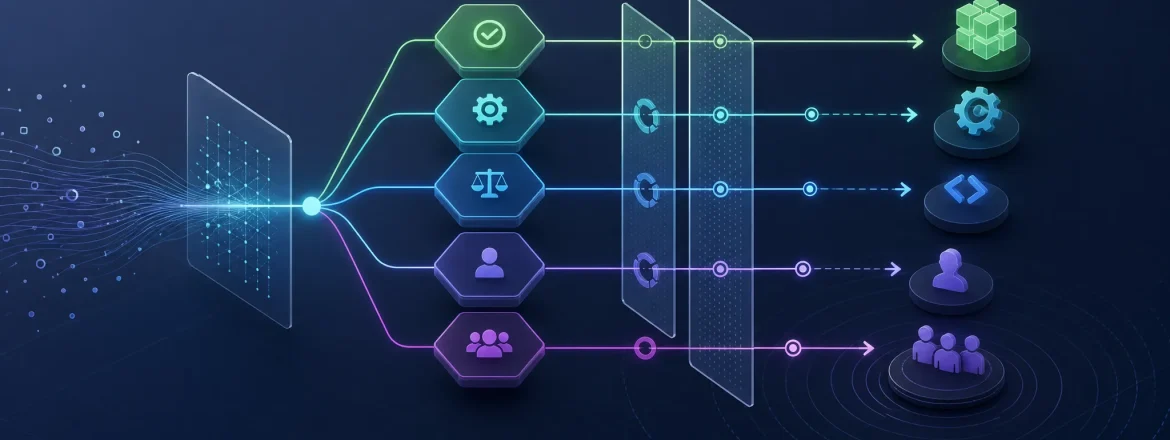
Agentic AI Operating Model: Assign Decision Rights Before You Add Autonomy
A practical framework for mapping agent autonomy to risk, reversibility, observability, and failure cost.
The hard part of production agents is usually not getting an LLM to call a tool. It is deciding which actions the model is allowed to take when nobody is watching.
Most agent demos answer: “Can the model do the task?”
Production systems need a different question: who owns the decision when the task goes wrong?
An agentic AI operating model is the set of rules, controls, and feedback paths that determine what an agent may decide and do. The useful unit is not “autonomous” versus “not autonomous.” It is AI decision rights: which decisions belong to the model, deterministic software, policy rules, tools, or humans for a specific task.
This post proposes a practitioner framework for assigning those decision rights before increasing autonomy. It is intended for AI engineering leads, platform engineers, and product teams shipping LLM-based systems into production.
Evidence boundary
This is a practical operating framework, not a production case study or a report on validated internal results. It does not claim measured ROI, productivity gains, adoption, safety improvements, AGI, ASI, or human replacement. Treat the framework as a starting point for system design and review, not as legal, compliance, privacy, or security advice.
For related context on why production agents need more than a prompt, tools, and a loop, see The Agent Loop Ceiling: When LLM Agents Need More Than a Prompt, Tools, and a While Loop.
Terms used in this operating model
| Term | Meaning in this post |
|---|---|
| Agentic AI operating model | Rules, controls, and feedback paths that determine what an agent may decide and do |
| Decision rights | Assignment of which decisions belong to the model, deterministic software, policy rules, tools, or humans |
| Autonomy level | A graduated level of execution authority, from advisory to narrow unreviewed execution |
| Human review boundary | Explicit definition of when review happens, who reviews, what evidence is shown, what actions are allowed, and how escalation works |
| Policy gate | Deterministic control that blocks, allows, or routes an action for review before execution |
| Tool gateway | Runtime control layer that enforces tool permissions, schemas, budgets, rate limits, and environment boundaries |
| Trajectory | The intermediate path an agent takes: retrieved context, decisions, tool calls, policy checks, reviews, actions, and rollback |
| Operational confidence | Confidence that the system can execute safely, detect failure, contain blast radius, recover, and learn — not merely that the model output looks plausible |
| Demotion criteria | Conditions that reduce autonomy after unsafe actions, policy violations, rollback failures, poor auditability, or ownership gaps |
Agent failures are trajectory failures, not just answer failures
A chatbot can be wrong in a visible, bounded way: it returns a bad answer.
An agent can be wrong across a chain of decisions:
- It retrieves the wrong context.
- It chooses the wrong tool.
- It interprets policy incorrectly.
- It skips escalation.
- It mutates state.
- It sends a message, updates a record, opens access, changes configuration, or triggers another workflow.
That does not make agents unusable. It means the operating model has to decide where judgment belongs.
A production agentic AI operating model should answer:
- What is the task?
- What downstream action follows the model output?
- What can the model decide?
- What must deterministic software constrain?
- What requires human review?
- What must be logged, reversible, and measured before autonomy increases?
That is the mental model for the rest of the post: autonomy is a distribution of decision rights, not a product toggle.
The Decision Rights Ladder
The Decision Rights Ladder is a proposed operating framework for assigning autonomy levels. It is not a validated internal standard or universal industry taxonomy.
Higher autonomy is not inherently better. The right level depends on the task’s risk profile and the maturity of the surrounding controls.
Choose the lowest acceptable autonomy level
Use this as an operating heuristic, not empirical proof of safety.
Start with the task and downstream action.

1. Is the action high-impact, irreversible, sensitive, privileged, regulated, or poorly observable?
   → Yes: keep Level 1 Advisory or Level 2 Drafted action.
   → No: continue.

2. Can deterministic software define safe boundaries for the task?
   → No: use Level 2 Drafted action or Level 3 Supervised execution.
   → Yes: continue.

3. Are tools scoped by task, permission, input schema, rate/budget limit, and environment?
   → No: do not grant autonomous execution yet.
   → Yes: continue.

4. Is rollback or compensation available for material actions?
   → No: keep supervised execution.
   → Yes: continue.

5. Is the task low-cost to fail, reversible, observable, and narrow?
   → Yes: consider Level 4 Bounded autonomous execution.
   → Only if exceptionally low-risk and strongly observable: consider Level 5.
Level 1: Advisory
The agent provides information, summaries, rankings, classifications, or recommendations.
Decision right: human or deterministic system decides and acts.
Good fit:
- summarizing long records,
- ranking candidate next steps,
- extracting evidence for review,
- suggesting categories without mutating state.
Required controls:
- source/context visibility,
- confidence or uncertainty presentation where useful,
- reviewer or downstream system ownership,
- audit log of recommendation and final decision.
Failure mode:
- Users may treat advisory output as authoritative even when it is only a recommendation.
Level 2: Drafted action
The agent prepares an action, but does not execute it without approval.
Examples:
- draft a customer response,
- draft a ticket update,
- draft a remediation plan,
- draft a configuration change,
- prepare a data entry update for review.
Decision right: model drafts; human or deterministic policy approves.
Required controls:
- explicit approval before execution,
- diff view or evidence packet,
- reviewer identity or role,
- ability to edit or reject,
- audit log of draft, edits, approval, and final action.
Failure mode:
- Reviewers may rubber-stamp if evidence is poor or queues are overloaded.
Level 3: Supervised execution
The agent executes steps within a workflow, but humans approve sensitive transitions, exceptions, or final submission.
Examples:
- gather context, call read-only tools, and prepare an action;
- execute non-sensitive steps, then pause before external communication;
- run diagnostics, then request approval before remediation.
Decision right: model can act inside the workflow; humans or policy gates own sensitive transitions.
Required controls:
- step-level permissions,
- transition gates,
- exception routing,
- review triggers,
- audit trail for intermediate tool calls,
- rollback or compensation for executed steps.
Failure mode:
- The system may appear safe because final submission is reviewed, while earlier tool calls or state changes are under-observed.
Level 4: Bounded autonomous execution
The agent acts without pre-approval inside explicit constraints.
Constraints should include scoped tools, typed inputs, allowlists, rate limits, budgets, environment boundaries, policy checks, audit logs, and rollback paths.
Examples:
- tag low-risk records,
- update internal metadata,
- schedule a non-critical follow-up,
- resolve a reversible internal workflow step,
- execute a known remediation with bounded blast radius.
Decision right: model can plan and execute within a constrained action space; deterministic software owns boundaries.
Required controls:
- tool gateway,
- policy gate,
- rate and budget limits,
- permission checks,
- observability,
- rollback hook,
- demotion criteria,
- owner for incidents and autonomy changes.
Failure mode:
- Constraints drift from business risk as tools, policies, or product behavior change.
Level 5: Narrow unreviewed execution for reversible tasks
Use this sparingly.
This level should only apply to narrow tasks where failure cost is low, reversibility is high, observability is strong, and policy exposure is minimal.
Examples might include internal housekeeping tasks, reversible metadata updates, or low-impact workflow cleanup. Whether those examples are acceptable depends on the organization’s context and controls.
Decision right: model can decide and execute the task end-to-end within a narrow domain.
Required controls:
- narrow task definition,
- strong auditability,
- automatic rollback or easy compensation,
- monitoring by task class,
- clear demotion criteria,
- periodic review of whether the task remains low risk.
Failure mode:
- “Low risk” becomes stale as the workflow becomes more user-visible, more privileged, or more integrated with downstream systems.
The ladder in one table
| Level | Name | Model may do | Must be constrained by | Good fit |
|---|---|---|---|---|
| 1 | Advisory | Recommend, summarize, classify, rank | Human or deterministic decision owner | Evidence packets, summaries, suggested categories |
| 2 | Drafted action | Prepare an action but not execute it | Approval, diff/evidence view, audit trail | Draft responses, remediation plans, updates |
| 3 | Supervised execution | Execute bounded workflow steps | Transition gates, exception routing, review triggers | Diagnostics, context gathering, non-sensitive steps |
| 4 | Bounded autonomous execution | Plan and execute inside explicit constraints | Tool gateway, policy gate, permissions, rollback, monitoring | Reversible internal metadata or low-risk workflow actions |
| 5 | Narrow unreviewed execution | Decide and execute end-to-end in a narrow domain | Strong observability, low failure cost, rollback, periodic review | Narrow, low-risk, reversible housekeeping tasks |

“Human-in-the-loop” is too vague to be a control plane
“Human-in-the-loop” is often used as if it resolves the safety question.
It does not.
A human review step is only useful if the system defines the review boundary:
| Question | Vague HITL | Designed human review boundary |
|---|---|---|
| Trigger | “When needed” | Explicit conditions: risk class, policy conflict, irreversible action, sensitive data, abnormal tool sequence |
| Reviewer | “A human” | Named role, queue, ownership, escalation backup |
| Evidence | Model output only | Task classification, retrieved context IDs, proposed action, policy checks, tool calls, uncertainty signals, prior state |
| Reviewer action | Approve/reject | Approve, reject, edit, request more evidence, escalate, rollback |
| Latency | Undefined | Review expectation appropriate to the workflow |
| Escalation | Manual discovery | Predefined owner for ambiguity, dispute, policy conflict, or tool failure |
| Rollback | Not considered | Required for material actions before autonomy increases |
| Audit record | Partial logs | Reviewer identity or role, decision, rationale where appropriate, timestamp, final action state |
The same issue applies to tool access. Broad tool access can turn model uncertainty into system-level risk if permissions are not scoped to the task. That claim is an engineering inference; validate it against your own threat model and production traces before turning it into policy.
A more precise production question is:
Can the organization detect, contain, reverse, and learn from bad intermediate decisions before they reach users or critical systems?
If the answer is no, adding a human somewhere in the workflow is not enough.
For a narrower example of bounded workflow design, see AI support triage should be a bounded workflow, not an autonomous agent. For a more operational discussion of what production exposure reveals, see If Your Agent Has Never Embarrassed You, You’re Probably Not in Production.
Autonomy decisions must account for risk, reversibility, observability, and failure cost
Before choosing an autonomy level, classify the task by operational risk.
A practical starting matrix:
| Dimension | Lower-risk signal | Medium-risk signal | Higher-risk signal |
|---|---|---|---|
| Failure cost | Mistake is cosmetic or easy to ignore | Mistake causes user confusion, rework, or degraded workflow | Mistake causes financial, operational, legal, security, or safety impact |
| Reversibility | Action can be undone automatically | Action can be corrected with manual work | Action is irreversible or expensive to compensate |
| Observability | System can inspect inputs, tool calls, decision state, and outcome | Some intermediate state is visible | Failure may be hidden until downstream harm occurs |
| Data sensitivity | Public or low-sensitivity data | Internal business data | Personal, confidential, regulated, or privileged data |
| Security exposure | Read-only or low-privilege action | Limited write access | Privileged access, access control, secrets, infrastructure, or identity changes |
| Regulatory exposure | No meaningful compliance dependency | Policy-sensitive but bounded | Legal, compliance, contractual, or regulated decision impact |
| User trust impact | Low user visibility | Visible but recoverable | User-facing decision that can damage trust if wrong |
Security, privacy, legal, and compliance interpretations should be reviewed by qualified owners before production use.
The key distinction is model confidence versus operational confidence.
A model can be confident and still not be operationally safe to execute. If the action is irreversible, poorly observable, policy-sensitive, or security-sensitive, confidence in the generated answer is not enough. That is an inference from the risk framework rather than a measured claim.
Useful operating questions:
- Can the action be undone?
- Can the system know it made a mistake?
- Can a reviewer understand the evidence quickly enough to intervene?
- Does the action expose private data, privileged systems, or regulated workflows?
- Is there a deterministic policy that should override model judgment?
- Is the model selecting tools from a constrained set or improvising across broad permissions?
- What audit record would be needed during an incident review?
Observability should exist at the decision level, not only the request level. For agentic workflows, inspectable state may include prompts, retrieved context identifiers, tool calls, policy checks, reviewer decisions, final action state, rollback status, and safe summaries of intermediate reasoning where appropriate.
External references on agent workflow evaluation and trace inspection include OpenAI agent evaluations and OpenAI trace grading.
Assign decision rights separately for each part of the workflow
A common mistake is assigning one autonomy level to the whole system.
Instead, assign decision rights separately:
| Decision type | Model may own | Software/policy should own | Human should own |
|---|---|---|---|
| Observation | Summarize, classify, extract evidence | Validate schemas, enforce data access, filter unavailable sources | Resolve ambiguous or contested evidence |
| Interpretation | Suggest meaning, identify likely category | Apply deterministic policy, validate thresholds | Decide policy-sensitive or disputed interpretation |
| Planning | Propose steps | Enforce allowed workflow graph | Approve high-impact plan |
| Tool selection | Choose from allowed tools | Restrict tool list by task, role, environment, risk | Approve unusual or sensitive tool use |
| Execution | Execute bounded, reversible actions | Enforce permissions, budgets, rate limits, state preconditions | Approve irreversible or high-impact action |
| Exception handling | Detect uncertainty or conflict | Trigger escalation rules | Resolve ambiguity, dispute, or exception |
| Final impact | Generate response or state update | Verify constraints and final state | Own high-risk user/system impact |
The same agent may be Level 1 for policy interpretation, Level 3 for workflow execution, and Level 4 for low-risk metadata updates.
That is the core benefit of decision rights: they let teams avoid both extremes — banning useful automation and granting broad autonomy.
Alternatives teams usually try — and why each is incomplete
A decision-rights model does not mean every workflow should become an agent. Most production systems need a mix of deterministic software, human judgment, and model assistance.
| Operating pattern | Best fit | Failure mode if overused |
|---|---|---|
| Fully manual workflow | High-impact, ambiguous, or sensitive decisions where human accountability is required | Slow queues, inconsistent review quality, unclear evidence presentation |
| Deterministic workflow only | Known paths, policy enforcement, repeatable state transitions | Brittle rules, stale assumptions, poor handling of messy input |
| LLM as advisor only | Summaries, rankings, classifications, recommendations, evidence packets | Leaves low-risk reversible actions manual even when automation may be acceptable |
| Broad autonomous agent | Demos, sandbox tasks, constrained experiments | Risky in production if tool access, memory, permissions, and recovery are not constrained |
| Generic human-in-the-loop | Initial safety layer when autonomy is immature | Rubber-stamping, unclear ownership, no escalation path, weak audit trail |
These are qualitative engineering tradeoffs, not benchmarked findings.
The point is not to pick one architecture for every workflow. The point is to assign decision rights by task.
A support triage workflow, for example, might use:
- deterministic routing rules for known categories,
- an LLM to summarize user context,
- a human to review sensitive escalations,
- bounded autonomous execution for low-risk ticket tagging,
- and policy gates before refunds, account changes, or access decisions.
That decomposition matters more than whether the system is marketed as an “agent.”
For a third-party framing of workflows versus more autonomous agents, see Anthropic’s Building effective agents.
Translate autonomy levels into runtime control surfaces
An autonomy policy only matters if it changes runtime behavior.
At implementation time, bind each autonomy level to concrete control surfaces.

Tool access should be scoped by autonomy level
Tool access should not be a flat list in the prompt.
Use a tool gateway or equivalent control layer to enforce:
- tool allowlists by task type,
- read versus write separation,
- typed inputs and schema validation,
- environment boundaries,
- rate limits,
- budget limits,
- preconditions,
- idempotency requirements where applicable,
- rollback or compensation registration.
Typed tool interfaces and schema-constrained outputs are one practical building block for this pattern. See OpenAI’s reference on function calling and structured outputs.
Policy enforcement should not depend only on model self-policing
For high-impact actions, deterministic checks should sit before execution.
Examples of policy checks may include:
- “This action requires review.”
- “This tool is not available for this task class.”
- “This record contains sensitive data.”
- “This state transition is not allowed.”
- “This action is irreversible and lacks rollback.”
- “This user or system role does not have permission.”
Security-, privacy-, legal-, and compliance-sensitive checks require review by the appropriate owners before production use.
Human review boundaries should be explicit
Define review triggers such as:
- high risk class,
- low reversibility,
- insufficient observability,
- policy conflict,
- abnormal tool sequence,
- sensitive data access,
- privileged tool use,
- user dispute,
- model uncertainty,
- unexpected state transition,
- rollback failure.
For each trigger, define:
- reviewer role,
- evidence packet,
- allowed reviewer actions,
- escalation path,
- latency expectation,
- audit record,
- recovery behavior.
Escalation paths should be designed before launch
Ambiguity needs a destination.
Route specific cases to specific owners:
| Escalation condition | Possible owner |
|---|---|
| Tool failure | Owning service team or platform on-call |
| Policy conflict | Policy owner or domain SME |
| User dispute | Product/customer operations owner |
| Security-sensitive action | Security owner |
| Privacy-sensitive action | Privacy/legal owner |
| Reviewer queue saturation | Operations owner |
| Repeated unsafe action | Agent system owner and incident process |
The exact ownership model depends on the organization. The important part is that escalation is not discovered during an incident.
Audit logs should capture trajectories, not just outputs
For agentic workflows, audit records should capture enough information to reconstruct what happened without exposing unnecessary sensitive data.
A practical audit record may include:
- task classification,
- assigned autonomy level,
- risk class,
- retrieved context identifiers,
- tool calls,
- tool inputs and outputs where safe to retain,
- policy checks,
- reviewer actions,
- final state,
- rollback or compensation status,
- exception reason,
- autonomy policy version.
Privacy and retention rules must be reviewed before logging sensitive prompts, outputs, user data, tool payloads, or intermediate reasoning artifacts. In many systems, audit logging should also include minimization, redaction, access controls, retention limits, and deletion or correction workflows where required.
Memory should be treated as a privileged capability
Persistent memory is not harmless context.
If an agent can write memory, retrieve it later, and use it to make future decisions, memory becomes state. Treat it like a privileged capability:
- constrain what can be written,
- constrain what can be read,
- define retention rules,
- separate user-visible memory from internal operational memory,
- audit memory writes that affect future actions,
- provide deletion or correction paths where required.
This is a practitioner inference from the broader control-surface model; teams should adapt it to their privacy, security, and product requirements.
For broader production-runtime considerations, see LangChain’s discussion of the runtime behind production agents.
A policy-gated tool call should make the review boundary visible
The implementation goal is not to stop the model from proposing actions. It is to prevent proposed actions from becoming system changes without passing the right gates.
A simplified policy-gated invocation:
def handle_agent_action(task, proposed_action, context):
    risk = classify_risk(task, proposed_action, context)
    autonomy_level = autonomy_policy.lookup(task.type, risk)

    audit.record(
        event="action_proposed",
        task_id=task.id,
        action_type=proposed_action.type,
        risk_class=risk.label,
        autonomy_level=autonomy_level,
        context_ids=context.ids,
    )

    policy_decision = policy_gate.evaluate(
        task=task,
        action=proposed_action,
        risk=risk,
        autonomy_level=autonomy_level,
    )

    if policy_decision.blocked:
        audit.record(
            event="action_blocked",
            task_id=task.id,
            reason=policy_decision.reason,
        )
        return safe_response_or_escalation(task, policy_decision)

    if policy_decision.requires_review:
        review_id = review_queue.enqueue(
            task=task,
            proposed_action=proposed_action,
            evidence=build_evidence_packet(task, context, policy_decision),
            allowed_reviewer_actions=["approve", "edit", "reject", "escalate"],
        )
        audit.record(
            event="review_requested",
            task_id=task.id,
            review_id=review_id,
            reason=policy_decision.reason,
        )
        return {"status": "pending_review", "review_id": review_id}

    permission_decision = tool_gateway.check_permissions(
        tool=proposed_action.tool,
        inputs=proposed_action.inputs,
        autonomy_level=autonomy_level,
        risk=risk,
    )

    if not permission_decision.allowed:
        audit.record(
            event="tool_denied",
            task_id=task.id,
            reason=permission_decision.reason,
        )
        return safe_response_or_escalation(task, permission_decision)

    result = tool_gateway.execute(proposed_action)

    rollback.register_if_available(
        task_id=task.id,
        action=proposed_action,
        result=result,
    )

    audit.record(
        event="action_executed",
        task_id=task.id,
        tool=proposed_action.tool,
        result_state=result.state,
        rollback_status=rollback.status(task.id),
    )

    return result
This is illustrative pseudocode, not a production implementation. Do not copy it without adapting authentication, authorization, privacy, retention, idempotency, observability, and incident-response requirements.

Evaluate trajectories, not just final answers
Final-answer accuracy is not enough for agentic systems.
Production risk often lives in intermediate decisions:
- Was the right context retrieved?
- Was the right tool selected?
- Were tool inputs valid?
- Did the agent skip a required review?
- Did a policy check fire?
- Did the system escalate ambiguity?
- Did rollback work?
- Was the audit trail complete?
Evaluation template: measure by task class and autonomy level
These are recommended measurement targets, not current findings.
| Metric | Segment by | Why it matters |
|---|---|---|
| Task success rate | Task class, autonomy level, risk class | Prevents aggregate metrics from hiding risky categories |
| Human intervention rate | Task class, review trigger | Shows where the system still needs judgment or better automation |
| Escalation frequency | Escalation reason, owner | Reveals ambiguity, policy conflict, tool failure, or ownership gaps |
| Unsafe or false action rate | Action type, tool, autonomy level | Tracks actions that should not have happened |
| Policy violation rate | Policy type, task class | Detects boundary failures |
| Rollback/compensation rate | Action type, autonomy level | Shows how often recovery is needed |
| Rollback success rate | Action type, system owner | Tests whether reversibility is real |
| Audit-log completeness | Required event type | Determines whether incidents can be reconstructed |
| Latency | Review path, tool path, task class | Captures orchestration and review cost |
| Cost per task | Model, tool, review, infrastructure | Prevents unmeasured automation cost claims |
| User trust/satisfaction signal | User-facing task class | Captures impact where appropriate |
| Security incident rate | Security-reviewed definitions | Tracks security-relevant failures; requires security review |
Measure the review system too:
- reviewer agreement,
- override reasons,
- time-to-review,
- stale queue count,
- unresolved escalations,
- review edits by category,
- reviewer fatigue or rubber-stamping indicators.
Use trace-level inspection where appropriate to understand why the agent chose a tool, skipped a review, or escalated. External references include trace grading and agent evaluations.
Promotion and demotion criteria
Do not promote a task up the ladder because a demo looked good.
A task should not move to a higher autonomy level until the team has evidence for:
- reliability by task class,
- reversibility,
- observability,
- policy compliance,
- tool permission correctness,
- review effectiveness,
- rollback or compensation behavior,
- incident ownership,
- acceptable latency and cost.
Demote autonomy when you observe:
- repeated unsafe actions,
- skipped reviews,
- policy violations,
- poor auditability,
- rollback failures,
- unresolved escalations,
- unclear ownership,
- drift in task risk,
- new tool permissions that expand blast radius.
This is a lifecycle model, not a one-time launch checklist.
Tradeoffs: control reduces risk, but adds latency, cost, and ownership burden
A decision-rights model is not free.
| Control surface | Benefit | Cost | Failure mode |
|---|---|---|---|
| Human review | Prevents high-impact actions from executing unchecked | Adds latency, queue management, reviewer training | Rubber-stamping, stale queues, unclear accountability |
| Tighter tool permissions | Reduces blast radius | More engineering maintenance, more denied actions | Overly narrow permissions cause unnecessary escalations |
| Deterministic policy gates | Enforces known constraints | Rules can become brittle or stale | Legitimate edge cases get blocked |
| Audit logging | Improves debuggability and incident review | Privacy, retention, storage, and data-minimization concerns | Logs are incomplete or too sensitive to use |
| Rollback hooks | Makes autonomy safer for reversible actions | Requires system design work and state tracking | Rollback fails or only partially compensates |
| Risk classification | Makes autonomy decisions explicit | Can become abstract or bureaucratic | Teams treat the class as truth instead of a review aid |
| Eval pipeline | Supports promotion/demotion decisions | Requires test cases, traces, labeling, and maintenance | Aggregate metrics hide task-specific failures |
The tradeoff is not “safety versus speed.” It is more specific:
- More review can reduce unchecked execution, but increases latency.
- Less review can improve responsiveness, but may let failures reach users or critical systems.
- Tighter tool permissions reduce blast radius, but can increase failed tasks and escalations.
- More logging improves investigation, but creates privacy and retention obligations.
- Deterministic policy gates constrain known risks, but can encode stale policy.
Bounded autonomy may improve throughput for low-risk reversible tasks, but that should be measured rather than assumed.
Failure modes: where agent autonomy breaks down
The following failure modes are practitioner syntheses from the operating-model framework, not claims from a production incident dataset.
| Failure mode | What it usually means | Control to add or strengthen |
|---|---|---|
| Reviewers rubber-stamp outputs | Evidence is poor, queues are overloaded, or accountability is unclear | Better evidence packets, reviewer actions, queue metrics, escalation paths |
| Agent skips required review | Review trigger is model-discretionary or weakly enforced | Deterministic review triggers and policy gates |
| Tool call is valid but unsafe | Tool permission model is too broad for the task risk | Task-scoped allowlists, read/write separation, input schemas, preconditions |
| Final answer looks fine but path was unsafe | Evaluation focuses only on outputs | Trace-level evaluation of retrieval, tool choice, policy checks, escalation, rollback |
| Rollback fails | Reversibility was assumed rather than tested | Rollback hooks, compensation plans, rollback success tracking |
| Autonomy becomes stale | Workflow, tools, permissions, or business risk changed | Periodic autonomy review and demotion criteria |
| Audit trail cannot reconstruct incident | Logs capture outputs but not trajectory | Log task class, autonomy level, context IDs, tool calls, policy checks, reviewer decisions, final state |
| Memory carries bad state forward | Persistent memory is treated as harmless context | Treat memory reads/writes as privileged operations with retention and correction paths |
The anti-patterns below are the same failures expressed as authority-design mistakes.
Anti-pattern 1: Treating autonomy as binary
The question is not “Should this agent be autonomous?”
The better question is:
Which decisions in this workflow can the model own, which must software constrain, and which require human judgment?
Anti-pattern 2: Granting broad tool access before defining allowed actions
A tool list is not a permission model.
Before granting execution authority, define:
- allowed actions,
- preconditions,
- input schemas,
- rate limits,
- budgets,
- environment boundaries,
- rollback behavior,
- audit records.
Anti-pattern 3: Using human review as a generic safety blanket
If you cannot say who reviews, what they see, when they intervene, and how failures recover, you do not have a human review boundary.
You have a hope.
Anti-pattern 4: Evaluating only final answers
An agent can produce an acceptable final answer after taking unacceptable intermediate steps.
Evaluate trajectories:
- context retrieval,
- tool choice,
- policy checks,
- escalation behavior,
- review triggers,
- rollback success,
- final state.
Anti-pattern 5: Letting the model decide when human review is needed
The model can help identify uncertainty, but deterministic triggers should handle high-risk conditions.
Examples:
- sensitive data access,
- irreversible action,
- privileged tool use,
- policy conflict,
- user dispute,
- abnormal tool sequence.
Anti-pattern 6: Promoting autonomy based on demo success
Demo success is not production evidence.
Promotion should depend on observed signals by task class and autonomy level, including intervention rate, escalation frequency, unsafe action rate, rollback behavior, latency, cost, and audit completeness.
Anti-pattern 7: Treating memory as harmless context
Persistent memory affects future behavior.
If an agent can remember, it can carry forward stale, sensitive, incorrect, or policy-relevant state. Treat memory writes and reads as privileged operations.
Anti-pattern 8: Failing to define incident ownership
Production failures may come from:
- model output,
- tool execution,
- stale policy,
- bad retrieval,
- reviewer error,
- insufficient permissions,
- excessive permissions,
- rollback failure,
- unclear escalation.
If nobody owns the boundary between those systems, incident response will be slow and ambiguous.
A worked example: support triage without broad autonomy
This example is illustrative and fictional. It is meant to show how the framework can be applied, not to describe a deployed system.
| Field | Example assignment |
|---|---|
| Task | Triage inbound support tickets |
| Downstream action | Assign category, summarize context, route to queue, optionally tag metadata |
| Affected users/systems | Support team, ticketing system, customer communication workflow |
| Risk class | Mixed: low for internal tags; higher for refunds, account changes, access decisions, or external replies |
| Autonomy level | Level 1 for policy interpretation; Level 2 for drafted customer replies; Level 4 for reversible internal tagging |
| Model decision rights | Summarize issue, suggest category, draft response, propose next step |
| Software/policy constraints | Enforce allowed categories, detect sensitive data, block refunds/account/access changes without review |
| Allowed tools | Read ticket history; write internal low-risk tags; draft but not send replies |
| Denied actions | Refunds, account changes, permission changes, external send without approval |
| Human review trigger | Sensitive data, customer dispute, account change, refund request, policy conflict, low observability |
| Evidence packet | Ticket summary, source message IDs, proposed category, policy checks, draft response, prior state |
| Rollback path | Remove/rewrite internal tags; revert routing; do not rely on rollback for external messages |
| Metrics | Tag correction rate, escalation rate, review override rate, stale queue count, policy violations, audit completeness |
The useful design move is decomposition. The “support agent” is not globally autonomous or non-autonomous. It has different decision rights for summarization, routing, drafting, tagging, and high-impact actions.
A practical checklist for assigning AI decision rights
Use this as a starting template. Adapt it to your regulatory, security, privacy, product, and operational context.
| Step | Question to answer | Output |
|---|---|---|
| Classify the task | What decision is being made, and what downstream action follows? | Task class and affected system/user |
| Score operational risk | What are the failure cost, reversibility, observability, data sensitivity, security exposure, regulatory exposure, and user trust impact? | Risk class |
| Pick autonomy level | What is the lowest autonomy level that satisfies the product need? | Level 1–5 assignment |
| Assign decision rights | Which decisions belong to the model, software/policy, tools, or humans? | Decision-rights map |
| Scope tools | Which tools, inputs, permissions, budgets, rate limits, and preconditions are allowed? | Tool access policy |
| Define review boundary | What triggers review, who reviews, what evidence is shown, and what actions can the reviewer take? | Human review contract |
| Require recovery | Can the action be rolled back or compensated? Who owns recovery? | Rollback/compensation plan |
| Instrument trajectory | What will be logged across context retrieval, tool calls, policy checks, reviews, execution, and rollback? | Audit and observability plan |
| Set lifecycle rules | What signals promote, hold, or demote autonomy? | Promotion/demotion criteria |
Rollout template: document one task before increasing autonomy
Security, privacy, legal, and compliance fields should be reviewed by qualified owners before production use.
| Field | Fill in |
|---|---|
| Task name | |
| Task owner | |
| Downstream action | |
| Affected users/systems | |
| Current autonomy level | |
| Proposed autonomy level | |
| Risk class | Low / medium / high |
| Failure cost | |
| Reversibility | Automatic / manual / hard / impossible |
| Observability | Strong / partial / weak |
| Data sensitivity | |
| Security or regulatory exposure | |
| Model decision rights | |
| Software/policy constraints | |
| Allowed tools | |
| Denied tools/actions | |
| Human review triggers | |
| Reviewer role | |
| Evidence packet | |
| Escalation owner | |
| Rollback or compensation path | |
| Audit events required | |
| Promotion criteria | |
| Demotion criteria | |
| Open security/privacy/legal review items |
Treat decision rights as part of the system contract. Document autonomy levels alongside APIs, tool permissions, policy rules, evals, runbooks, incident response, data retention, and reviewer operations.
Three things to remember
- Autonomy is not one switch. Assign decision rights separately for observation, interpretation, planning, tool selection, execution, exception handling, and final impact.
- Model confidence is not operational confidence. Irreversible, sensitive, privileged, poorly observable, or high-impact actions need stronger gates regardless of how plausible the model output looks.
- Autonomy should have a lifecycle. Promote, hold, or demote by production signals segmented by task class, risk class, and autonomy level — not by demo success.
Conclusion: autonomy is a decision-rights system
Production agent autonomy should not be granted as a binary capability.
It should be assigned as graduated decision rights across the model, deterministic software, policy rules, tools, and humans.
The Decision Rights Ladder gives teams a practical vocabulary:
- Advisory — the agent recommends; humans or deterministic systems decide.
- Drafted action — the agent prepares; humans or policy gates approve.
- Supervised execution — the agent executes bounded steps; humans approve sensitive transitions.
- Bounded autonomous execution — the agent acts inside explicit constraints, with auditability and rollback.
- Narrow unreviewed execution — only for narrow, low-risk, reversible, strongly observable tasks.
A more defensible next step is not always adding more humans. It is not always adding more automation either.
The next step is making decision rights explicit and measurable.
Pick one production workflow. For each decision and action:
- classify the task,
- score risk,
- assign an autonomy level,
- constrain tools,
- define human review boundaries,
- instrument the trajectory,
- require rollback where material,
- and set promotion and demotion criteria.
That is the core of an agentic AI operating model: not whether the agent is autonomous, but what it is allowed to decide.