

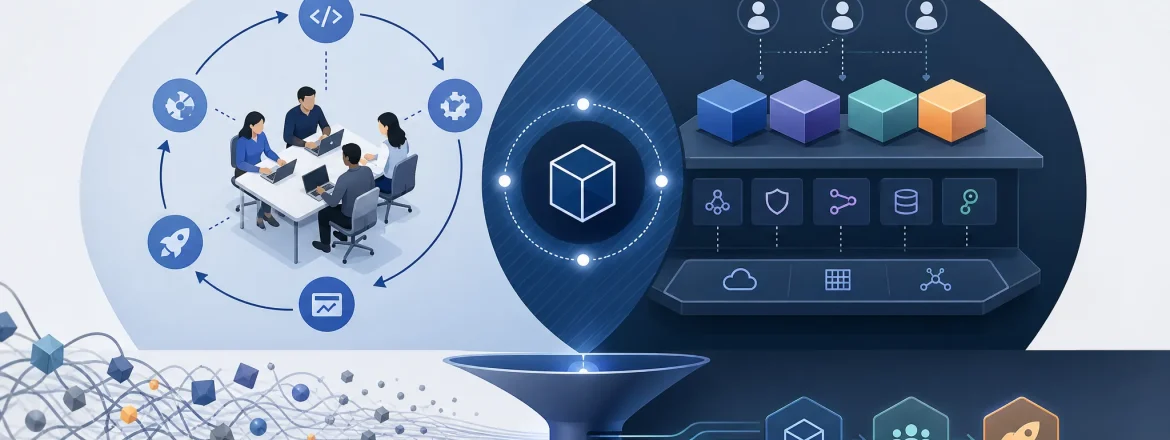
Quick answer: Platform engineering vs DevOps is not a debate about which trend is better. DevOps is the operating model for ownership and fast learning through feedback loops. Platform engineering is the operating model for reducing delivery friction with self-service and reusable “golden path” workflows. Start by identifying the bottleneck (ambiguity vs toil vs duplicated work), then apply the model that removes that bottleneck first.
If you’re leading engineering, building an internal developer platform (IDP), or trying to fix repeated delivery pain, this guide gives you a practical framework: what each operating model is trying to solve, how to tell them apart, what to measure, and how to avoid creating a platform-as-bottleneck or a DevOps-as-slogan outcome.
Platform engineering vs DevOps at a glance
Quick answer: If your problem is unclear responsibility and weak learning, lead with DevOps. If your problem is repeated toil and inconsistent delivery paths, lead with platform engineering. Many organizations need both, but not for the same reason.
| Dimension | DevOps | Platform engineering |
|---|---|---|
| Primary bottleneck it addresses | Ownership ambiguity, slow feedback loops, weak operational follow-through | Cognitive load, repeated setup/deployment toil, duplicated mechanics across teams |
| Main mechanism | Shared responsibility across build, ship, run, and learn | Self-service capabilities delivered by a platform team |
| What it changes in practice | Who owns incidents, releases, and the learning that changes the next release | How teams provision, deploy, observe, and operate using reusable paved roads |
| Typical artifacts | Service ownership practices, incident routines, release discipline, learning loops | IDP tooling/workflows, golden paths, guardrails, templates, reusable delivery pipelines |
| Success looks like | Clear accountability and faster improvement from production signals | Less repetition, easier onboarding, lower friction for common delivery tasks |
| Common failure mode | Slogan without structure; everyone is “responsible,” so nobody is | Platform-as-bottleneck; ticket queues and manual interventions replace self-service |
Rule of thumb: DevOps answers who owns the work and how quickly teams learn. Platform engineering answers how to make the work easier to do safely and consistently at scale.

Suggested filename: platform-engineering-vs-devops-bottlenecks-ownership-vs-toil.svg
Definitions: what DevOps means in this article (and what it does not)
Quick answer: In this article, DevOps is an operating model for shared responsibility and continuous learning across the software lifecycle. It is not just automation, not a tool list, and not a team name.
DevOps is often used so loosely that it becomes hard to act on. Some people use “DevOps” to mean build tooling; others mean a reorg; others mean infrastructure automation. Ambiguity is part of the delivery problem.
Operating model definition (practical): DevOps means the people responsible for changing a service stay connected to how that service runs. That connection creates a shorter learning loop: production signals drive investigation, follow-up actions, and better decisions in the next release.
This does not require every engineer to do every operational task. Instead, it requires that the team boundary includes enough responsibility that ownership is real—especially around incidents, post-incident learning, and release decisions.
A healthy DevOps operating model typically shows up as:
- Clear service ownership: someone is accountable for operational outcomes, not just code changes
- Incident follow-through: investigation and action items happen in a structured way
- Short feedback loops: production learning reaches the team that changed the system
- Fewer handoffs: fewer “dev throws it over the wall to ops” moments
- Shared meaning of “good operation”: teams agree what operational quality looks like
What is missing from that definition? A requirement for a “DevOps team.” A requirement for a specific automation tool. Automation can help—but the real point is accountability that stays connected to reality.
Signals your DevOps practice is weak
Quick answer: If production feedback exists but doesn’t change behavior, you likely have a DevOps (ownership + learning loop) gap.
- Teams do not know who owns a service after it ships
- Incident follow-up stalls because it is not anyone’s explicit job
- Release decisions are separated from operational feedback
- Production problems get discussed but the next release doesn’t improve
- Handoffs increase as systems become more complex
Definitions: what platform engineering means in this article (and what it does not)
Quick answer: In this article, platform engineering is an operating model for reducing cognitive load through self-service and reusable delivery paths. It is not just “centralization.”
Platform engineering is also commonly overused and flattened into vague ideas like “centralize everything.” That confusion creates the same downstream issue as vague DevOps: people can’t decide what to do next.
Operating model definition (practical): Platform engineering means a dedicated platform team builds self-service capabilities that reduce the effort and uncertainty required for application teams to provision, deploy, observe, and operate services.
Important boundary: the platform team does not own application behavior. It owns the reusable delivery paths (the “paved roads”) and the guardrails that make the common path safe.
Platform engineering often targets friction that sits around the code:
- Credentials and access workflows
- Environment setup and configuration consistency
- Cluster access patterns
- Observability wiring (metrics/logs/traces defaults)
- Deploy approvals and release mechanics
- Routine operational tasks that every team repeats
When platform engineering is working, teams experience it as:
- Self-service for common tasks: fewer ticket-driven requests
- Less duplicated setup: fewer teams rebuilding the same mechanics
- Lower cognitive load: less mental overhead during delivery
- More consistent production paths: fewer “it works here but not there” differences
- Faster onboarding: clearer and repeatable service entry points
The key term here is self-service. A platform that becomes a shared-services queue has stopped serving its purpose.
Another common term is internal developer platform (IDP). An IDP is the combination of tools, workflows, guardrails, and interfaces that makes the common path easier to follow.
Signals platform engineering is the missing piece
Quick answer: If teams are responsible for outcomes but still spend excessive time on repeated setup/deployment mechanics, you likely have a platform (self-service + standardization) gap.
- Many teams repeat the same delivery mechanics
- Onboarding a service takes too many manual steps
- Provisioning/deployment/access still requires hand-crafted work
- Each team builds its own path because there is no paved road
- Operational complexity is being recreated across product teams

Suggested filename: platform-engineering-vs-devops-decision-tree-ownership-friction.svg
Key terms you will hear in platform engineering vs DevOps conversations
Quick answer: These terms matter only if they help you make the decision and design the boundary.
- Cognitive load: the mental effort required to deliver safely and consistently (often increased by too many choices, unclear workflows, and inconsistent tooling)
- Self-service: a path that teams can use without opening a ticket for every routine delivery task
- Golden path: the recommended way to build, deploy, and operate a service (the standard path that works most of the time)
- Paved road: the standardized path that is easier to follow than inventing a custom process
- Internal developer platform (IDP): tooling/workflows/guardrails that support common delivery work
- Service ownership: clear accountability for a service after release (including operational outcomes and follow-up actions)
- Team topology: how teams are structured so work flows with fewer handoffs (useful for designing boundaries)
- Toil: repetitive manual work that adds little durable value
- Operational feedback: signals from production that improve the next change (incident learnings, reliability signals, etc.)
When you use these words correctly, they help you locate the bottleneck. When you use them loosely, they become slogans.
Why people confuse platform engineering vs DevOps
Quick answer: The confusion usually happens because people treat a symptom like the root cause.
Platform engineering and DevOps share surface traits: both care about delivery outcomes, both benefit from engineering discipline, and both often involve automation.
But shared ingredients do not mean identical operating models.
The deeper difference is this:
- DevOps changes who is responsible and how quickly teams learn from production
- Platform engineering changes how much friction teams experience while carrying that responsibility
That is why the same organization can genuinely need both models:
- A team can own services well and still waste enormous time on manual deployment work
- A team can have great tooling but fail because accountability after release is unclear
DevOps is about making responsibility explicit. Platform engineering is about making that responsibility easier to carry.
Start with the bottleneck, not the label
Quick answer: The fastest way to choose the wrong approach is to start with the team name.
The better question is:
What is stopping delivery right now?
Is it ambiguous ownership? Slow learning from production? Repeated toil? Duplicated setup mechanics? Unsupported self-service? The answer tells you which operating model to strengthen first.
Here is a diagnostic table you can use in planning discussions, architecture reviews, or leadership alignment sessions:
| If your main problem is… | Likely bottleneck | Best first move | Why this fits |
|---|---|---|---|
| Unclear ownership for changes, incidents, and follow-up | DevOps maturity gap | Clarify ownership across build, ship, run, and post-incident actions | Responsibility and learning loops must start working before a platform can reliably support them |
| Multiple teams rebuilding the same delivery mechanics | Platform (self-service + standardization) gap | Create a bounded platform with a self-service contract for common tasks | Repeated toil is a system friction problem, not a single-team effort problem |
| Teams own services, but setup/access/deploy cost is too high | Self-service path gap | Build platform capabilities around the highest-friction paths | The work is already owned; it is just too expensive to do |
| Incidents are noisy and production feedback does not change behavior | Operating discipline (learning loop) gap | Tighten incident flow, release discipline, and team responsibilities | Better tooling will not fix weak learning loops by itself |
| Platform requests pile up because exceptions keep getting escalated | Platform support model gap | Re-scope the platform contract; improve self-service; document supported exceptions | A platform-as-bottleneck is often a contract/interface failure, not a “platform team exists” problem |
Featured-snippet style takeaway: Use platform engineering vs DevOps as a bottleneck diagnostic. DevOps targets ownership + learning loops. Platform engineering targets friction + cognitive load through self-service golden paths.
A practical decision checklist (use it in under 10 minutes)
Quick answer: Ask these questions in order. Stop when you find the first decisive bottleneck.
- Do teams know exactly who owns the service after release? If not, address DevOps discipline first.
- Are incidents and follow-up actions clearly assigned? If not, fix ownership and feedback loop mechanics.
- Do multiple teams repeat the same provisioning/deployment/setup work? If yes, you have a platform opportunity.
- Is the support path self-service or ticket-driven? If it depends on tickets, the platform is not yet reducing cognitive load.
- Are teams blocked by the system or blocked by ambiguity? System friction suggests platform engineering; ambiguity suggests DevOps structure.
- Is the organization growing faster than informal practices can scale? If yes, plan for both models, sequenced correctly.
The point is not to make teams identical. The point is to make the bottleneck visible so the fix matches the problem.
How the choice looks in real organizations
Quick answer: Different orgs feel “pain” differently. Platform engineering vs DevOps is best selected by pattern, not by org size alone.
Scenario 1: A startup with vague ownership
Quick answer: If the same people are building, deploying, and troubleshooting without clear incident/release ownership structure, start with DevOps (responsibility + learning loop), not platform engineering.
In a small company, the usual pain is often not duplicated mechanics. It is accountability ambiguity: “who owns the service after it ships?” and “who drives improvement after incidents?”
Best first move: clarify ownership, define incident and release routines, and keep the people who change the service close to production feedback.
Scenario 2: A scale-up with multiple product teams rebuilding deployment paths
Quick answer: If teams already know what they own but keep repeating the same scripts and setup mechanics, start with platform engineering.
The pain here is often a repeated tax:
- access requests
- environment setup steps
- deployment mechanics that differ slightly between teams
- observability wiring done inconsistently
Best first move: build an internal developer platform around the highest-friction common tasks and make the self-service path better than the old workflow.
Scenario 3: A regulated enterprise with strong operations but too much manual delivery work
Quick answer: If operational accountability exists but delivery remains full of manual approvals and handoffs, platform engineering can reduce toil while preserving controls.
In these environments, DevOps alone may not remove repetition. The teams need standardized workflows, guardrails, and reusable delivery paths that reduce cognitive load while keeping governance intact.
Best first move: keep ownership explicit, then provide platform support for the common path with controlled variability.
Scenario 4: A platform team that is now handling every exception
Quick answer: If your “platform” feels like an escalation sink, you likely broke the platform contract and interface.
Symptoms include:
- ticket queues replace self-service
- special cases expand because application teams cannot safely self-serve
- application teams stop learning the platform path because “the platform will handle it”
Best first move: narrow platform scope, improve the self-service contract, and push supported exceptions into clear patterns that teams can execute (instead of “platform does everything”).

Suggested filename: devops-platform-engineering-together-responsibility-local-self-service.svg
When DevOps is the right first move
Quick answer: Choose DevOps first when teams are not yet carrying responsibility cleanly, especially around incident ownership and learning from production.
DevOps-first tends to work best when:
- teams do not know who is responsible for operational outcomes
- production feedback reaches the org but does not change engineering behavior
- incident response is improvised instead of practiced
- release ownership is split across too many groups without clear decision rights
- the primary bottleneck is ambiguity rather than repetitive toil
In these situations, building a platform may add coordination overhead without addressing the core issue.
DevOps-first practical goal: make responsibility legible—define who owns the service, who participates in incidents, who drives follow-up, and how learning changes the next release.
Once ownership is real, platform engineering becomes easier to introduce because you can clearly decide what should remain local vs what should become a shared paved road.
When platform engineering is the right first move
Quick answer: Choose platform engineering first when many teams are already responsible for their services, but the cost of common delivery work is too high.
Platform-first signals include:
- every product team solves the same setup/deployment problems differently
- service onboarding is slow because the path is full of manual steps
- access, provisioning, or runtime setup consumes too much engineering time
- teams know what they own, but mechanics of delivery are still expensive
- the organization needs a consistent low-friction path to production
Platform-first practical goal: make the common path safe, simple, and scalable—so teams stop inventing their own versions of the same plumbing.
That is where golden path and paved road are useful. They describe the same idea from different angles: a standard path that is easy to follow and reduces repeated decision-making.
Boundary reminder: platform engineering is not a replacement for ownership. It supports ownership at scale. If the platform absorbs every special case, it becomes a shared services team with a nicer name.
Why many organizations need both (and the right sequence)
Quick answer: The false choice is “platform vs DevOps forever.” Many organizations need both—but not for the same bottleneck and not in the wrong order.
As services multiply, informal practices break down. You can’t rely on ad hoc fixes or undocumented knowledge.
The typical sequence that preserves effectiveness looks like:
- Make ownership explicit (DevOps discipline)
- Identify repeated delivery friction (platform opportunity mapping)
- Build platform capabilities around common, high-cost paths
- Keep the boundary clear so the platform doesn’t become a catch-all escalation sink
Shortcut rule:
- DevOps preserves the accountability loop.
- Platform engineering reduces the effort required to stay inside that loop.
They reinforce each other when the boundary between local responsibility and shared self-service is clear.
How to define boundaries before you build a platform team
Quick answer: One of the most important parts of platform engineering is deciding what the platform will not own. Without boundaries, the platform becomes a coordination sink.
Before you create or expand a platform team, define three things:
- Ownership: who owns service behavior and operational outcomes
- Contract: what teams can self-serve reliably
- Support path: what happens when self-service fails
1) Define ownership boundaries
Quick answer: Separate “service responsibility” from “shared delivery enablement.”
Example boundary you can adapt:
- Application teams own service behavior and user outcomes
- Application teams own their services’ incidents and post-incident action items
- The platform team owns shared tooling, workflows, and paved paths
- The platform supports common delivery tasks through self-service
- Escalation rules are explicit before problems appear
If the boundary is vague, the platform team slowly absorbs everyone else’s ambiguity. It can feel helpful at first (less friction today), but it makes accountability less clear over time.
2) Define the platform contract
Quick answer: The platform contract is the set of capabilities teams can use without opening tickets for every routine action.
A strong contract focuses on high-value recurring tasks. Common contract elements include:
- Provisioning environments
- Managing access and identity workflows
- Deploying services via standardized pipelines
- Standard runtime configuration patterns
- Observability defaults (logs/metrics/traces wiring)
- Build and release workflows
A good contract is opinionated enough to reduce toil, but flexible enough to support real service differences. Too much flexibility stops simplification. Too much rigidity creates workarounds.
3) Define the support path (so self-service is real)
Quick answer: Self-service does not mean “no support.” It means support is bounded and predictable.
Decide what happens when a team hits a platform problem:
- Is there a documented path for platform issues?
- What is the escalation route for bugs in shared tooling?
- Is there an interface for requesting supported exceptions?
- Is there a way to classify issues as “team error” vs “platform defect”?
Without a defined support path, teams default to ad hoc communication. That usually becomes ticketing or “message the platform person,” which reintroduces human bottlenecks.
A helpful framing is to treat the platform team like a product team with internal users. That mindset keeps the work focused on usability, reliability, and adoption—rather than endless one-off interventions.
Role clarity table: who does what in platform engineering vs DevOps?
Quick answer: Use this table to start a boundary conversation. It is not a perfect RACI, but it helps teams align on responsibilities.
| Area | Application teams | Platform team |
|---|---|---|
| Service behavior | Own the code, reliability, and user outcomes | Provide shared tooling and paths that enable delivery |
| Incidents | Respond to incidents for their services and handle follow-up | Respond to incidents for platform services and fix platform defects |
| Deployment path | Use the standard path and improve it with feedback | Build and maintain the reusable delivery workflow |
| Exceptions | Own service-specific exceptions and make service-level decisions | Define which exceptions are supported and how they are requested |
| Observability | Use defaults and add service-specific signals where needed | Provide the common observability baseline |
| Onboarding | Adopt service templates and runtime conventions | Make templates easy to use and document them clearly |
If that table is unclear in your organization, you likely need boundary work before you need more platform features.
What an internal developer platform should do (practical checklist)
Quick answer: A good IDP lowers the effort required for common delivery work while preserving service-team ownership.
In practice, an internal developer platform often includes some combination of:
- Self-service provisioning paths
- Standardized deployment workflows
- Opinionated templates or scaffolding for new services
- Observability defaults and operational guardrails
- Standardized workflows that still allow controlled exceptions
- Improved onboarding for new teams and new services
Non-goal: it should not endlessly centralize decisions or force teams through an approval maze for every routine change.
Usability test: If the platform team were unavailable for a short time, would application teams still understand how to self-serve the standard paths? If the answer is no, the platform may be hiding complexity rather than removing it.
Good IDP design principles (so your platform engineering investments stick)
- Make the common path obvious: teams should find the standard path quickly
- Optimize for adoption, not novelty: a platform only matters if teams use it
- Reduce choices where choices do not matter: keep flexibility for real service differences
- Provide clear documentation and examples: discoverability is part of self-service
- Keep the user experience consistent: repeated patterns lower cognitive load
A platform that feels boring, repeatable, and dependable usually wins over one that is technically clever but operationally confusing.
What an internal developer platform should not do (common failure modes)
Quick answer: Avoid designing the platform so that it becomes a ticket queue or manual dependency.
Common warning signs:
- Every request becomes a ticket
- The platform team manually reviews every exception
- Application teams cannot make routine changes without platform intervention
- The platform is technically useful but hard to adopt operationally
- The platform team spends more time coordinating than simplifying
When this happens, the platform is adding cognitive load instead of removing it. The fix is usually not “more effort.” It’s better boundary definition, better interfaces, and a contract that supports self-service for the highest-value paths first.
Design the platform like a product with a user experience. If it feels harder than rolling your own, teams will route around it.
How to measure whether platform engineering vs DevOps is working
Quick answer: Use outcomes that reflect the bottleneck you targeted. If you measure the wrong thing, you can get “activity” without friction reduction.
You do not need a perfect measurement system on day one. But you do need visibility into whether the operating model change moved the bottleneck.
Useful metrics and indicators include:
- Deployment frequency — how often teams ship changes
- Lead time — how long it takes from change to production
- Change failure rate — how often releases cause incidents or rollbacks
- MTTR — how quickly teams restore service after an issue
- Service onboarding time — how long it takes to bring a new service onto the platform
- Platform adoption — whether teams use the shared paths
- Developer satisfaction — whether the platform reduces frustration
Measure with intent: treat metrics as signals, not guarantees. A platform can be launched and still fail to reduce toil. DevOps practice can improve without eliminating a messy delivery path. The goal is to measure the bottleneck you attempted to remove.
Later, ask questions like:
- Did ownership become clearer after the change?
- Did the common delivery path become easier to use?
- Did teams stop rebuilding the same mechanics?
- Did onboarding become faster and more consistent?
- Did people feel less burdened by routine delivery work?
What to measure for DevOps vs platform engineering (quick comparison)
Quick answer: Compare proof-by-signal for each operating model. Then interpret both together for overall flow and reliability.
| Operating model | Watch first | Positive signal looks like… |
|---|---|---|
| DevOps | Ownership clarity, incident follow-through, feedback loop speed | Teams know who owns the service and act on production learning quickly |
| Platform engineering | Adoption, self-service success rate, onboarding time, toil reduction | More teams use the same path with fewer manual interventions |
| Both together | Flow, reliability, and the size of repeated-friction tax | Teams ship faster without losing accountability |
Common trap: Overstating progress because only one model is visible. A platform can look successful while ownership remains blurry. A DevOps initiative can look successful while delivery still requires manual workarounds.
Common failure modes to avoid (platform engineering vs DevOps)
Quick answer: Both operating models fail for the same underlying reason: boundaries and interfaces aren’t clear enough.
Platform team failure modes
- Becoming a centralized bottleneck by handling too many exceptions
- Turning into a shared-services queue with a new name
- Standardizing so aggressively that service-specific needs disappear
- Building tools that are technically impressive but hard to adopt
- Measuring activity instead of adoption and friction reduction
DevOps failure modes
- Becoming a slogan instead of a real operating model
- Collapsing into “everyone is responsible,” which often means nobody is
- Leaving teams with operational expectations but no structural support
- Assuming automation alone will fix ownership problems
- Failing to connect production feedback to team behavior
Self-service failure modes
- Moving work around instead of removing it
- Hiding complexity behind abstractions that remain difficult to use
- Looking successful on paper while manual intervention remains common
- Creating a platform that only advanced users can navigate
- Optimizing the platform for internal enthusiasm instead of internal adoption
Practical lesson: the model matters, but the interface matters just as much. A platform no one can use will generate friction. A DevOps model no one can sustain becomes another kind of friction.
A simple implementation path if you are deciding now
Quick answer: Don’t solve everything at once. Use platform engineering vs DevOps as a bottleneck-driven sequence.
Step 1: Name the bottleneck in plain language
Write down the complaint in a way any engineer can recognize. Examples:
- “Teams do not know who owns incidents after release.”
- “Every team spends too much time setting up the same deployment path.”
The clearer the problem statement, the better your operating-model selection.
Step 2: Decide whether the problem is ownership, friction, or both
If ambiguity dominates, focus on responsibility and feedback loops. If repeated toil dominates, focus on self-service and standardization. If both are present, choose which blocker is hurting flow most right now.
Step 3: Put explicit boundaries on teams involved
Before adding a platform team, define what it owns and what it does not. Before asking application teams to own more, define what support they need to do that responsibly.
Step 4: Build the smallest useful path
Choose one high-value workflow and make it significantly easier than the previous approach. Prove value there before expanding scope.
Step 5: Define supported exceptions (so exceptions don’t become queues)
Self-service must include a strategy for “when the standard path doesn’t fit.” Define how exceptions are requested, evaluated, and incorporated. Otherwise, the platform becomes the place where every exception is escalated.
Step 6: Instrument feedback loops
DevOps and platform engineering both depend on feedback. Ensure production signals (incidents, reliability events, operational learnings) and delivery friction signals (failed self-service attempts, onboarding issues) reach the right teams.
Step 7: Measure the bottleneck movement
Watch metrics that correspond to the original pain:
- If ownership was unclear: did service-team accountability improve after the change?
- If toil was high: did onboarding time and manual intervention reduce?
Step 8: Iterate the contract, not just the tooling
Many platforms fail because the interface (contract + support path) is unclear. Fix the contract first: documentation, workflows, escalation rules, and what “supported” means.
Step 9: Review boundaries as the org scales
As teams grow, the right boundary can shift. Revisit platform engineering vs DevOps boundary decisions periodically so the platform remains an accelerator—not a bottleneck.
Where platform engineering support during a hiring gap fits
Quick answer: If you are making operating-model decisions under staffing pressure, separate the immediate support need from the long-term operating-model design.
Sometimes the platform decision is forced by resourcing constraints: missing key people, waiting to hire platform engineers, or temporary operational strain. In those cases, you may need temporary delivery support while your team structure catches up.
For a related perspective, see:
- Platform engineering support during a hiring gap: put cloud economics in the delivery loop
- Cloud economics during a platform hiring gap: keep cost decisions in the engineering loop
Why this matters for platform engineering vs DevOps: operating models only work in real conditions—real boundaries, real staffing, real tradeoffs. If your platform depends on heroic effort to survive a hiring gap, the design may be too fragile.
What to read next (related operating model topics)
Quick answer: If you are expanding platform engineering vs DevOps work into adjacent operating-model decisions, boundary design and decision rights usually come next.
- Cloud-Native Development Is an Operating Model, Not a Tool List — helpful for avoiding tool-chasing when you’re trying to fix delivery flow.
- Terraform Modules for Kubernetes: A Practical Boundary Guide — a companion read if your platform work includes infrastructure boundaries and reusable modules.
- Agentic AI Operating Model: Assign Decision Rights Before You Add Autonomy — useful if your platform workflows include automation and you need clear decision rights and escalation patterns.
These topics reinforce the same principle: platform engineering and DevOps only succeed when boundaries and feedback paths are explicit.
Why boundary-first infrastructure thinking matters
Quick answer: Platform engineering in infrastructure-heavy orgs must be boundary-first, or teams will either fork everything or escalate everything to the platform team.
Infrastructure work—Terraform modules, Kubernetes abstractions, deployment templates, and access workflows—sits right on the line between reusable support and service-specific needs.
When boundaries are clear, teams know what to self-serve and what to keep local. When boundaries are unclear, you get:
- platform absorption of decisions that should stay with application teams
- workarounds and forks that return friction
- inconsistent outcomes across teams
If this matches your current pain, read:
It follows the same operating-model logic as this article: make the common path reusable, but do not confuse reuse with universal ownership.
External references for further reading
Quick answer: If you want industry background on the concepts behind platform engineering vs DevOps, the references below are good starting points.
- AWS: What is DevOps? — a general overview of how DevOps is described in industry
- Team Topologies: Platform team — platform team concept framing that aligns with bounded interfaces
Use these references as background when aligning leadership vocabulary across engineering leadership, platform teams, and product teams.
Frequently asked questions (FAQ) — platform engineering vs DevOps
Quick answer: Below are concise answers to the questions readers most often ask after learning the difference between platform engineering vs DevOps.
What is the difference between platform engineering vs DevOps?
Quick answer: DevOps is an operating model focused on shared responsibility, clear ownership, and feedback loops. Platform engineering is an operating model focused on reducing cognitive load through self-service and reusable delivery paths.
One-liner: DevOps answers who owns the work; platform engineering answers how the work becomes easier to do.
Do I need DevOps before platform engineering?
Quick answer: Usually you need at least some level of DevOps discipline—especially clear ownership—before a platform can be fully effective.
If nobody owns services clearly after release, a platform may unintentionally make ambiguity easier to hide.
Can platform engineering replace DevOps?
Quick answer: No. Platform engineering can support DevOps by reducing toil, but it does not replace ownership, incident responsibility, release discipline, and learning loops.
A platform can reduce friction without making accountability unnecessary.
When should a company build a platform team?
Quick answer: Build a platform team when multiple teams repeat the same delivery work and the common path can be improved for everyone.
If the main bottleneck is unclear responsibility, start with DevOps discipline first. If the main bottleneck is repeated toil and inconsistent paths, platform engineering is a strong candidate.
What is an internal developer platform (IDP)?
Quick answer: An internal developer platform (IDP) is the collection of tools, workflows, guardrails, and interfaces that help teams self-serve common delivery tasks.
Its job is to reduce friction and simplify the common path while preserving service-team ownership.
What does “golden path” mean?
Quick answer: A golden path is the recommended standard workflow for building, deploying, and operating a service.
It should work reliably for the majority of cases and include clear guardrails and documentation for safe usage.
How do I prevent a platform team from becoming a bottleneck?
Quick answer: Keep the platform contract and support path bounded, and design for self-service adoption.
If every exception routes to the platform team, you’re replacing self-service with ticket queues. Define supported exceptions, improve documentation, and keep responsibility boundaries explicit.
What metrics should I use to know whether platform engineering vs DevOps is working?
Quick answer: Start with the metrics that reflect the bottleneck you targeted:
- DevOps: ownership clarity, incident follow-through, and feedback loop speed
- Platform engineering: adoption, self-service success rate, onboarding time, and toil reduction
Then interpret both together for end-to-end flow and reliability.
What are common failure modes of DevOps as a concept?
Quick answer: The biggest failure mode is making DevOps too vague—turning it into a slogan rather than an operating model.
When responsibility becomes unclear, the feedback loop breaks down.
What should I do first if my organization is unsure?
Quick answer: Name the bottleneck in plain language.
- If ambiguity dominates: improve ownership and release/incident discipline.
- If repeated toil dominates: build self-service paths for the most common workflows.
- If both are present: fix the blocker that hurts flow most right now.
Conclusion: use platform engineering vs DevOps to solve the right bottleneck first
Quick answer: Platform engineering vs DevOps is not a choice between two competing fashions. It is a choice about which bottleneck you should remove first.
DevOps connects ownership, operations, and learning into a working accountability loop. Platform engineering makes repeated delivery work easier through self-service and reduced cognitive load.
If ownership is unclear, strengthen DevOps practice first. If common delivery work is duplicated and expensive, invest in platform engineering. And if your organization is growing, you may need both: DevOps to preserve accountability and platform engineering to keep the path usable at scale.
Bottom line: Choose the operating model that removes the real friction in front of your teams—not the label that sounds more current.