

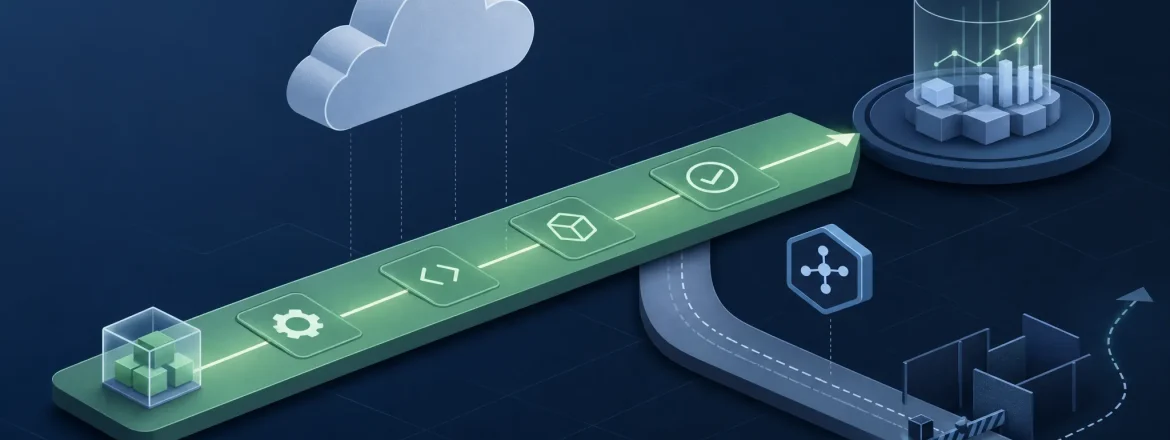
Direct answer: A cloud-native development operating model is the way your platform standardizes the common delivery path (the paved road), automates repeatable work, exposes runtime signals for feedback, and routes non-standard requests through an explicit, governed exception lane.
Cloud-native gets reduced to “the stack”—containers, Kubernetes, infrastructure as code (IaC), registries, and tooling. Those pieces matter. But they don’t explain the real day-to-day difference between teams that ship reliably through a paved road and teams that still rely on tickets, tribal knowledge, and hand-assembled environments.
The difference is an operating model: a designed system for how work moves from intent to running services, with standards baked in and deviations made visible.
What is a cloud-native development operating model?
A cloud-native development operating model is the set of behaviors, workflows, templates, policies, and feedback loops that govern how developers request, build, deploy, observe, and improve services in production.
It answers four practical questions:
- Common case path: How do teams do the standard thing without tickets and without guessing?
- Repeatability: What work is automated so teams aren’t redoing the same wiring by hand?
- Runtime visibility: How do runtime signals (what happened) feed back into the platform (what should be improved)?
- Exceptions: When the standard path doesn’t fit, how is the deviation handled—with ownership, review, and an expiry window?
Tool stack vs operating model: what you can’t see from a list
Tooling is visible. Operating models are experienced—by how quickly a request becomes a running service, and how predictable production behavior is when something changes.
Here’s a simple contrast you can use in platform discussions:
| Aspect | Tool-list model (what teams often say they have) | Cloud-native development operating model (what teams need) |
|---|---|---|
| Standard path | “We have a CI/CD pipeline and Kubernetes.” | “We have an approved path that developers can trigger with templates + defaults.” |
| Developer experience | “Use the portal / run this script / ask the platform team.” | “Self-service request surfaces route you onto the paved road in the common case.” |
| Guardrails | “Security reviews happen manually.” | Policy checks run close to workflow so failures are early, explainable, and teachable. |
| Runtime signals | “Observability is configured sometimes, if you remember.” | Observability is part of the default template so signals are consistent across services. |
| Deviation handling | “It’s an exception… when someone approves it.” | Exceptions are explicitly modeled with ownership, time-bound approval, and a decision about whether to standardize later. |
| Platform improvement | “We’ll update docs later.” | Feedback loops connect production outcomes to platform updates, templates, and policies. |
Cloud-native changes the delivery path, not just the runtime
Containers, Kubernetes, and IaC make workloads deployable across environments and make infrastructure easier to manage. But they don’t automatically create a usable delivery path for the common case.
The shift in a cloud-native development operating model is this:
- Cloud-native stops being a pile of infrastructure choices you assemble per service.
- Cloud-native becomes the system that closes the loop from request → build → deploy → observe → feedback → platform improvement.

The core principles (the “paved road + explicit exceptions” model)
If you remember only one thing, remember these four principles. They define the operating model:
1) Standardize the common path
The platform should encode a standard route that makes routine work boring:
- Create service from approved templates
- Apply safe defaults
- Deploy through the standard workflow
- Get consistent observability out of the box
When this common path is awkward, teams route around it. When teams route around it, you lose uniformity and you lose feedback.
2) Automate repeatable work
Automation is not only about build speed. It’s about removing “environment assembly” from the developer’s critical path.
In a healthy operating model:
- Repo layout, CI wiring, and deployment configuration are produced from templates
- Common security checks run early and automatically
- Operational essentials (like runbook links and telemetry wiring) are default
3) Make runtime signals visible
Observability isn’t an add-on; it’s a feedback mechanism.
A cloud-native development operating model treats runtime visibility as part of delivery quality:
- Logs, metrics, and traces are expected outcomes of service creation
- Dashboards and alerting behaviors are consistent across services where appropriate
- Runbook links and operational context are attached so incidents become learnable events
4) Keep exceptions explicit (and time-bound)
Exceptions will always exist—non-standard dependencies, unusual networking requirements, regulated constraints, or legacy compatibility.
But in an operating model, exceptions are handled in a way that preserves learning and control:
- Exceptions are documented, not hidden in side channels
- Exceptions have ownership (someone is responsible)
- Exceptions are reviewed with clear decision criteria
- Exceptions are time-bound, so temporary deviations eventually become either standardized or retired
The default path should be easy—and deviations should be visible
Direct answer: In a cloud-native development operating model, developers should be able to take the default path without tickets for the standard case, while exceptions should be routed through a governed, observable process.
Two practical tests help you evaluate this:
- Ticket test: If “new service” requires a ticket and a human assembling the environment, automation is incomplete and developer self-service is not real.
- Visibility test: If deviations are approved through private email threads or tribal knowledge, the platform cannot reliably learn or improve.
Distributed systems change the problem (delivery quality includes resilience)
Distributed systems can be “up” and still be wrong for users. A service may respond slowly, fail partially, or break correctness through dependency interactions.
That means resilience isn’t separate from delivery—it’s part of the operating model’s definition of “done.”
In practice, this affects the operating model in two ways:
- Standard workflow includes resilience essentials: timeouts, retries, circuit-breaking patterns, and failure-aware defaults where they apply
- Observability supports failure learning: signals required to understand partial failures must be available without scrambling
Multi-workflow reality: different workloads may need different guardrails
A platform shouldn’t enforce one workflow on every context as if all services are identical. Customer-facing services, internal tools, and regulated workloads may need different constraints.
But the operating-model goal remains the same:
- Consistency in the common case (so most work is predictable)
- Explicit review in the unusual case (so exceptions are governed and time-bound)

A concrete example: one service request end to end
Imagine a team wants to ship a small internal API. In a cloud-native development operating model, the request flows through a paved road with feedback built in.
- Developer selects an approved template via a portal or CLI.
- The template generates a repo and wiring for build, test, deployment, and default observability.
- Policy checks run early (for example: image source rules, required labels, secret-handling expectations, and environment constraints).
- The service deploys through the standard workflow without needing a human to assemble the environment.
- Telemetry is attached by default: logs, metrics, traces, plus an operational context artifact (like a runbook link) to support incident response.
- Runtime feedback returns to the platform: if the template was missing a default, or if policy was too strict, the platform can improve the paved road.
Now consider the same team later needs a non-standard outbound network rule. In a healthy operating model, this request should not disappear into a hidden queue.
- It should go through a documented exception lane with clear ownership and approval criteria.
- The approval should have a time boundary.
- When the exception expires, platform leadership can decide whether to standardize the pattern or keep it exceptional.
What a practical cloud-native platform provides
In a cloud-native development operating model, the “platform” is less about a single tool and more about a set of behaviors and interfaces.
Usually, it provides one or more request surfaces—portal forms, CLIs, templates, or workflow entry points.
From those surfaces, the platform consistently delivers these outcomes:
- Service templates encode defaults for repo structure, deployment config, security checks, and observability hooks.
- Policy runs close to the workflow, so developers learn early (not after they deploy).
- Observability is part of the template so services behave consistently during incidents and investigations.
- Exceptions are documented, time-bound, and owned so deviations don’t accumulate silently.
- Runtime signals feed back so the paved road improves with real operational learning.
If you’re also thinking about how boundaries shape delivery systems, you can connect this operating-model framing with boundary-first module design. See Boundaries are your friends for a design perspective on limiting blast radius and making “safe defaults” practical.
Decision tree: how to route work between the paved road and exceptions
Direct answer: A cloud-native development operating model routes requests by deciding whether they fit the standard path, whether the standard can be extended safely, or whether the work qualifies for a time-bound documented exception.

When a request comes in, route it with three questions:
- Does it fit the standard path?
- If not, can the standard be extended safely? (Add a new approved template option or broaden a default pattern.)
- If not, does it qualify as a documented exception? (Ownership, criteria, and an expiry decision are required.)
This decision tree helps prevent two common problems at once:
- Problem 1: Every edge case becomes a permanent exception (platform stagnates and becomes ungovernable).
- Problem 2: Legitimate edge cases get forced into workflows they were never designed for (developers bypass the platform).
Where cloud-native efforts usually fail (and how the operating model fixes it)
It’s easier to improve a system when you can name its failure modes. Below are common ones—and the operating-model response.
| Failure mode | What it looks like | Operating-model fix |
|---|---|---|
| Tool-list model | Teams say they use containers, Kubernetes, and IaC—but delivery still requires manual assembly | Define the operating model: request surfaces, templates, paved workflows, and exception lanes |
| Portal façade | A portal exists, but the work still lands in a human queue | Expose an approved path with automation + policy + feedback, so the portal actually initiates paved-road delivery |
| Approval maze | Routine changes require manual sign-off, even for low-risk cases | Encode standards in automation; reserve approvals for true exceptions and keep them time-bound |
| Over-standardization | The paved road becomes a gate for edge cases (everything must be shoehorned) | Create an explicit exception lane with decision criteria so deviations don’t break developer flow |
| Too many exceptions | Deviations become the real standard; learning doesn’t reduce exceptions | Tighten governance: revisit the default path, standardize what repeats, expire what doesn’t |
| Self-service without guardrails | Teams move fast but drift into inconsistent configurations and fragile runtime behavior | Add policy checks and runtime visibility so self-service remains safe and teachable |
What to measure (without pretending you already have the answers)
Not every platform organization starts with clean instrumentation. So treat measurements as a plan, not a claim of proven results. Your goal is to validate whether the operating model is actually improving delivery.
A practical starting set for a cloud-native development operating model:
- Paved-road adoption: the share of routine requests completed through the approved path vs. total routine requests
- Exception turnaround: elapsed time from exception request to approval, rejection, conversion into a standard, or expiry
- Request-to-deploy lead time: time from service request being opened to first successful deployment through the paved road
- Recovery behavior: whether rollbacks/restores are possible without relying on “memory” and manual reconstruction
- Observability coverage: whether services created through default templates reliably include logs, metrics, traces, and a runbook link
How to use these metrics: Don’t optimize dashboards. Use the measurements to answer two questions:
- Is the common case actually easier now?
- Is the exception lane actually controlled, explainable, and improving over time?
Cloud-native works when the pieces reinforce each other
A cloud-native development operating model treats major components as a single delivery system—not separate checkboxes.
- Containers make packaging predictable.
- Automation makes repeatable work cheap.
- Observability makes runtime behavior visible.
- Resilience makes failures survivable.
- Developer self-service makes the path usable without a human bottleneck.
Designed independently, these pieces can fight each other. Designed together, the platform becomes easier to use and easier to operate.
Roles and decision rights (so exceptions don’t become politics)
A common reason exceptions fail is not technical—it’s unclear decision rights.
In a mature cloud-native development operating model, decision rights are assigned before autonomy expands. That principle is familiar in agentic workflows as well: you decide, you escalate when needed, and you stop when you can’t safely proceed.
For an operating-model angle that parallels exception governance, see Agentic AI Operating Model: Assign Decision Rights Before You Add Autonomy.
In cloud-native delivery, the equivalent is simple:
- Platform team owns templates, paved workflows, and exception process design.
- App teams own what they build, including correctness and appropriate use of standard patterns.
- Security/compliance defines guardrail criteria (implemented via policy checks), not ad-hoc approvals for routine changes.
- SRE/operations defines operational expectations (telemetry, runbooks, recovery behaviors) that templates enforce.
Implementation roadmap: build the cloud-native development operating model in phases
Direct answer: Start by defining the standard path and request surface, then build templates + policy checks, then wire observability and feedback loops, and finally formalize exception handling with ownership and time boundaries.
Below is a phased approach you can adapt. It’s intentionally practical and oriented around deliverable outcomes.
Phase 0: Baseline the current delivery path
- List the most common service request types (internal APIs, web apps, workers, scheduled jobs).
- Map the current steps from request to deploy (including approvals and human handoffs).
- Identify the “queue points” where delivery depends on humans.
- Identify where runtime learning is lost (insufficient telemetry, missing runbook context, incomplete incident workflows).
Phase 1: Define the paved road (common case first)
- Choose a first “golden path” template (start narrow, like one service category).
- Decide what “done” means for that category (deploy success + required telemetry + operational artifacts).
- Define policy expectations that should fail early (e.g., required labels, approved image sources, secret-handling rules).
- Specify the exception criteria for anything that cannot fit the paved road.
Phase 2: Build request surfaces and templates
- Create a request entry point (portal, CLI, or workflow form) that collects the minimal required inputs.
- Generate repo structure and workflow wiring from templates.
- Ensure the template outputs consistent operational context (telemetry endpoints, log conventions, runbook links).
- Make “standard configuration” explicit so deviations don’t hide in defaults.
If you’re implementing Kubernetes infrastructure with module boundaries, you can translate “safe defaults” into reusable primitives. See Terraform Modules for Kubernetes: A Practical Boundary Guide for an approach to designing infrastructure components that help keep delivery predictable.
Phase 3: Add policy-as-code and early feedback
- Implement policy checks that run close to workflow triggers (so developers see failures early).
- Return errors that are actionable: what failed, why it failed, and how to fix it.
- Track recurring policy failures as inputs to improving templates and defaults.
Phase 4: Wire observability and feedback loops
- Ensure logs, metrics, and traces are enabled through the default template, not configured ad-hoc.
- Attach runbook links or operational instructions as part of deployment outputs.
- Establish a feedback mechanism that connects real incidents and runtime behavior back to platform improvements.
Phase 5: Operationalize the exception lane
- Create an exception request workflow separate from the paved road.
- Define what must be included: problem statement, ownership, risk justification, and implementation plan.
- Add time boundaries (expiration and review cycles).
- At expiry, decide: fold into standard, extend the exception, or retire the pattern.
Phase 6: Measure, learn, and iterate
- Track paved-road adoption and exception turnaround.
- Use exception outcomes to expand templates and reduce recurring deviations.
- Improve the standard path until it covers the majority of real work.
Step-by-step: conduct a cloud-native development operating model review
If you want to make the operating model real, run a structured review. This is a repeatable exercise you can do quarterly.
- Pick a service category (e.g., internal API) and define it precisely.
- Trace the current request-to-deploy journey and mark each handoff to a human.
- Identify whether the journey is paved-road or queue-driven (what triggers automation vs what triggers manual work?).
- Check for early policy visibility: do developers learn about violations before deployment?
- Check observability defaults: do services come with telemetry and operational artifacts by default?
- Examine exceptions: where do deviations go, who owns them, and do they expire?
- Map feedback loops: how do runtime signals change templates, policies, and standards?
- Decide 2–3 improvements that reduce queue points and convert repeated exceptions into standard templates.
Checklists you can use immediately
Paved road checklist (standard path)
- There is a clearly defined request surface for the category.
- Templates produce consistent repo structure and workflow wiring.
- Policy checks fail early and provide actionable error messages.
- Observability is enabled by default (logs/metrics/traces) and operational context is included.
- Deployment success is followed by practical operational validation signals.
Exception lane checklist (non-standard path)
- Exceptions are documented and reviewable, not implicit.
- Exceptions have an owner and defined decision criteria.
- Exceptions are time-bound (with expiry and review outcomes).
- The exception workflow links to telemetry and operational expectations.
- Exception decisions feed back into template improvements to reduce future exceptions.
How this operating model supports developer self-service
Developer self-service is not “give developers the keys.” In a cloud-native development operating model, self-service means:
- Developers can trigger the standard workflow without needing humans to assemble environments.
- Guardrails are encoded so developers can move quickly without drifting into insecure or inconsistent configurations.
- Failures are instructive because policy checks and runtime signals create feedback.
So self-service remains fast and controlled. That’s the paved road effect.
Common misconception: “Self-service” is only about tooling
Direct answer: Self-service is an operating-model behavior. It depends on templates, automation, policy checks, and feedback—tools alone don’t guarantee it.
If developers can only self-serve by asking questions in a chat or filing tickets for each change, the system still behaves like a queue. The platform may look “modern,” but delivery still relies on human throughput.
Connecting exception handling to human review patterns
Exceptions often require human judgment (risk tradeoffs, environment constraints, or compatibility decisions). The operating-model challenge is to keep judgment structured and bounded.
For a similar pattern in AI workflows—where you must decide whether to proceed, escalate, or stop—you may find this useful: Human Review in AI Workflows: When to Decide, Escalate, or Stop.
In cloud-native delivery, the same principle applies:
- Decide if the paved road fits.
- Escalate to exception handling when it does not.
- Stop if the request can’t meet guardrail criteria or operational expectations.
- Review outcomes so exceptions become learning, not permanent drift.
How to evolve templates over time without breaking the standard path
Platforms fail when templates become rigid gates rather than living standards.
In a cloud-native development operating model, template evolution should follow predictable rules:
- Version templates so changes don’t unexpectedly break existing services.
- Backfill defaults intentionally (for example, when new observability requirements appear, define how services migrate).
- Use exception lane outcomes to decide what becomes standard.
- Measure adoption to ensure improvements actually reduce queue work.
Operational maturity: how to know you’re improving the operating model
One reason operating-model work is hard to communicate is that improvements can look like “boring automation.” That boredom is the point.
Here are signs your cloud-native development operating model is maturing:
- Most new services start on the paved road without tickets.
- Policy failures are rare for correct inputs and explainable for incorrect ones.
- Exceptions have ownership and expiration, and their volume trends down as patterns standardize.
- Runtime incidents lead to platform changes (templates, policies, defaults), not only documentation updates.
- Recovery steps don’t require “memory”—they’re embedded in artifacts and workflows.
Putting it all together: a concise operating-model definition you can share
If you need a short definition for leadership buy-in or platform strategy documents, use this:
Cloud-native development operating model: the system that standardizes the common delivery path, automates repeatable work, exposes runtime signals for feedback, and routes non-standard requests through explicit, governed exception handling—so delivery becomes faster, safer, and continuously improvable.
FAQ: Cloud-Native Development Operating Model
Is a cloud-native development operating model the same as DevOps?
No. DevOps is a collaboration and culture set of practices, while a cloud-native development operating model is the platform-driven system that defines the paved delivery path, the governed exception lane, automation behavior, policy visibility, and feedback loops for improving standards.
What does “paved road” mean in practice?
In practice, the paved road is an approved request surface plus templates + workflows that let developers create and deploy services for the common case without manual assembly. It includes defaults and early policy checks, and it wires observability so runtime signals are consistently available.
What should go into a “service template”?
A service template should generate or configure the standard repo/workflow structure, deployment wiring, required security labels and checks, and default observability (logs/metrics/traces) plus operational context such as runbook links. The goal is to encode safe defaults so delivery becomes predictable.
How do exceptions work without slowing delivery?
Exceptions can be fast when they are structured. The exception lane should have clear criteria, ownership, time-bound approval, and a decision about whether to standardize the pattern later. That prevents exceptions from becoming ad-hoc queues.
How do we prevent “exception sprawl”?
Prevent exception sprawl by time-bounding approvals, tracking outcomes, and requiring decisions at expiry: standardize, extend with justification, or retire. Use exception patterns to update templates so the paved road absorbs repeat deviations over time.
Do we need observability for every service from day one?
In a cloud-native development operating model, observability is typically part of the default template for the common case. The intent is consistent runtime visibility and learnable incidents. If a workload truly can’t include certain telemetry, that should route through the exception lane with explicit governance.
What should we measure to validate the operating model?
Start with measurement plans such as paved-road adoption, exception turnaround, request-to-deploy lead time, recovery behavior availability, and observability coverage. Use results to answer whether the common case is truly easier and whether exceptions are controlled and improving.
Conclusion: treat cloud-native as an operating model, not a tool list
Cloud-native development is not a tool list. It is an operating model that standardizes the common path, automates repeatable work, instruments the delivery system for feedback, and keeps exceptions explicit and governed.
When the paved road is easy and the exception lane is visible, developers move faster without losing control. And when runtime signals feed back into templates and policies, the platform improves over time instead of slowly accumulating queue points and tribal workarounds.
Your next platform review question: Is there a true self-service path for the common case—or just a form that triggers manual work behind the scenes?