

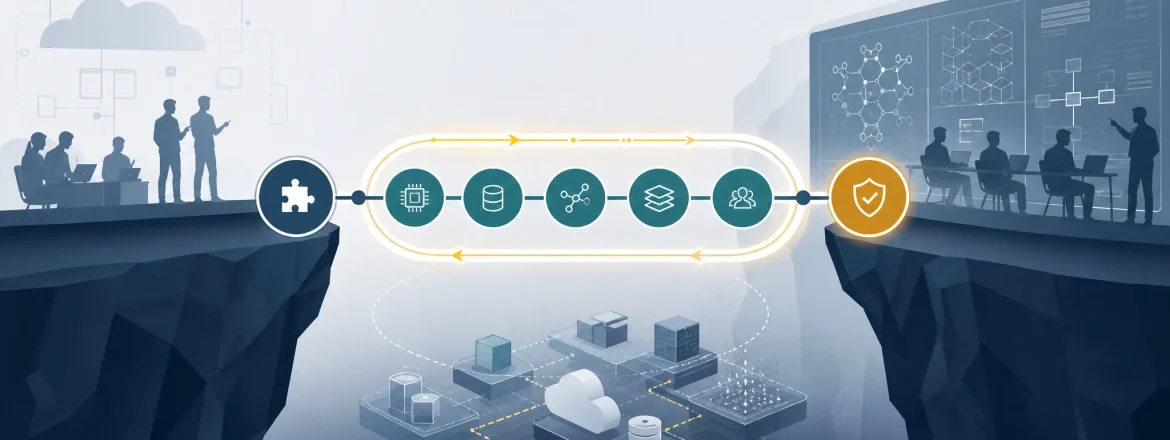
Cloud Economics During a Platform Hiring Gap: Keep Cost Decisions in the Engineering Loop
A practical workflow for reviewing cost-sensitive architecture decisions without turning delivery into an approval queue.
Platform work does not pause because a platform role is open.
Teams still choose compute patterns. They still create environments. They still decide how much telemetry to ingest, how long to retain data, which managed services to adopt, what deployment path becomes the default, and who owns cleanup.
The risk during a platform hiring gap is not only that the monthly cloud bill goes up. The quieter risk is that cost-sensitive decisions become architecture before anyone has enough platform capacity to review them.
This post is for engineering leaders, platform engineering managers, staff engineers, and technical founders operating with incomplete platform capacity. It does not argue that temporary platform engineering support should replace an internal platform team. The useful version is narrower: add review and implementation capacity around cloud economics decisions while internal hiring and ownership continue.
The central idea:
During a platform hiring gap, useful cloud economics work often happens before spend appears in a report: when teams choose defaults for compute, storage, observability, environments, deployment paths, and ownership. Temporary platform engineering support is defensible when it increases throughput through those decision loops—not when it becomes a parallel finance-led approval layer.
For related background, see Cloud Economics Belongs in Architecture Review, Not Just Finance Reports and Cost-Aware Architecture Review: Where Cloud Economics Belongs in System Design.
Context: platform hiring gaps do not pause platform decisions
A platform hiring gap is a capacity problem, not a freeze on platform decisions.
Even when the platform team is understaffed, product teams continue to ship. They choose where workloads run, how deployment pipelines work, how environments are provisioned, what telemetry is collected, and how data is retained. Many of those choices are durable: they become service templates, Terraform modules, Kubernetes defaults, environment conventions, runbooks, and informal “this is how we do it” patterns.
Cloud economics belongs in that engineering context because cloud cost is often a consequence of system behavior and platform defaults. That is a practitioner inference, not a quantified claim from supplied data.
The practical concern is not “engineers spend too much.” It is that teams optimize locally under delivery pressure. Without a functioning platform review loop, each team may make reasonable decisions in isolation that later become recurring spend, operational drag, or ambiguous ownership.
Examples of decisions that can harden during a capacity gap:
- A service template defaults to always-on capacity for workloads that are idle most of the day.
- A non-production environment has no lifecycle policy or teardown owner.
- Log ingestion is enabled broadly before teams define which signals they need for debugging, SLOs, security, auditability, or compliance.
- Data retention is copied from another service without verifying access patterns or legal constraints.
- A managed service default is accepted because no one has time to compare the operational tradeoffs.
- Cleanup ownership is unclear after a migration, experiment, or incident workaround.
These are categories to investigate, not universal causes. Their importance depends on workload shape, architecture, pricing model, compliance obligations, traffic, and team ownership.
Problem: spend reports arrive after many cost drivers have already become architecture
Finance and business reporting are useful. They show where money went, which accounts or services changed, and where budget conversations may be needed.
But spend reports usually arrive after the engineering decision has already been made. They can show that observability spend increased, for example, but they do not decide which logs are required for debugging, what sampling strategy is acceptable, how long audit data must be retained, or which team owns changes to the instrumentation path. Those questions live closer to architecture review, platform intake, infrastructure pull requests, and service ownership.
A useful cloud economics review asks: what architectural behavior created this spend pattern?
| Spend symptom from reporting | Possible architectural driver to investigate | Owner to involve | Review question |
|---|---|---|---|
| Compute spend increases after a new service launch | Baseline capacity, worker concurrency, autoscaling policy, runtime choice | Service owner + platform owner | Is demand steady, bursty, latency-sensitive, or batchable? |
| Non-production spend remains high outside working hours | Always-on environments, no TTL, unclear teardown owner | Platform owner + product team lead | Which environments must be long-lived, and who owns lifecycle policy? |
| Storage grows steadily | Data volume growth, retention duration, replication factor, access tier | Data owner + security/compliance reviewer + platform owner | What must be retained, for how long, and under what constraints? |
| Observability cost jumps after onboarding | Broad log ingestion, high-cardinality metrics, retention defaults | Service owner + observability owner | Which signals are needed for SLOs, debugging, audit, security, or compliance? |
| Network or transfer cost appears unexpectedly | Cross-region traffic, replication, data movement between services | Service owner + architecture reviewer | Is the data movement required by the reliability or tenancy model? |
| Unallocated spend persists | Missing ownership metadata, incomplete tagging, orphaned resources | Platform owner + engineering manager | Who owns the resource, and what cleanup workflow applies? |
The point is not to move architecture decisions into finance. It is to keep cloud economics close to the engineers who can explain and change system behavior.
Constraints: why cloud economics work gets harder when platform capacity is thin
Cloud economics work is easy to oversimplify and hard to do well.
During a platform capacity shortage, the remaining platform engineers may already be covering reliability work, deployment support, environment issues, incident follow-up, infrastructure changes, and internal enablement. Adding detailed cost review to that queue can exceed available attention. This is a practitioner inference based on the scenario, not an independently measured claim.
There are five constraints that matter.
| Constraint | Why it matters | Failure mode if ignored |
|---|---|---|
| Delivery pressure | Product teams need timely answers to keep work moving. | Cost review becomes a blocker, so teams bypass it or avoid asking. |
| Platform capacity | The team that understands shared defaults may be overloaded. | Cost-sensitive decisions go unreviewed or receive shallow review. |
| Workload context | Useful recommendations depend on traffic, latency, reliability, tenancy, data lifecycle, and operations. | Advice becomes generic and may optimize the wrong thing. |
| Ownership boundaries | Temporary help can add capacity, but internal teams need durable ownership. | External support becomes a shadow platform team. |
| Review latency | Teams need predictable routing and fast enough feedback. | The process becomes an approval queue instead of decision support. |
Cloud cost advice is workload-specific. A batch workload, latency-sensitive API, multi-tenant data service, regional failover system, and compliance-heavy audit path may all have different acceptable cost profiles. Cost review has to make those tradeoffs explicit rather than optimize only for spend.
Any recommendation touching retention, auditability, security, privacy, or compliance should be reviewed by the appropriate internal authority before implementation.
Alternatives: what teams usually try, and where each option breaks down
Temporary platform engineering support is only one option. It is not always the right first move.
| Option | When it helps | Where it breaks down | Require before choosing it |
|---|---|---|---|
| Defer cloud economics work until hiring completes | Preserves short-term focus for the remaining platform team. | Cost-sensitive defaults may continue accumulating while the role is open. | A list of decisions that are safe to defer and owners for later review. |
| Move cost control primarily to finance or procurement | Improves budget visibility and business accountability. | Architecture decisions may be reviewed too late or without enough system context. | A path back to engineering owners for workload-specific decisions. |
| Ask product teams to self-manage cost | Preserves autonomy and local context. | Methods may become inconsistent, and teams may duplicate learning. | Shared review prompts, ownership metadata, and escalation paths. |
| Add temporary platform engineering support | Adds review and implementation capacity while hiring continues. | Creates dependency if scope, decision rights, and exit criteria are vague. | Explicit boundaries, internal owners, handoff artifacts, and a wind-down plan. |
| Buy or expand tooling | Improves visibility if allocation and tagging are already usable. | Visibility does not automatically change architecture, defaults, or ownership. | Engineering workflow integration and owners who can act on findings. |
Tools can help. Finance visibility can help. Product team ownership can help. The failure mode is treating any of them as a substitute for engineering decision capacity. If the missing loop is “who reviews and changes the platform default before it spreads,” a dashboard alone will not close it.
For a deeper discussion of tooling limits, see Why FinOps Tools Don’t Actually Reduce Cloud Spend (And What Does).
Framework: the Cost-Aware Platform Support Loop
The operating model is simple:
- Detect cost-sensitive decisions.
- Classify the architectural cost driver.
- Choose a lightweight review path.
- Implement guardrails or fixes.
- Hand ownership back to the internal team.
- Measure drift over time.
- Feed what you learn into the platform backlog and defaults.
This is a conceptual framework, not evidence of guaranteed savings.

The loop should run inside normal engineering workflows:
- design review
- platform intake
- infrastructure-as-code pull requests
- service templates
- environment requests
- observability onboarding
- incident and post-incident follow-up
- service catalog updates
The goal is to keep review near the decision. If the review becomes a separate approval board, it will either slow delivery or get bypassed.
A useful classification taxonomy:
| Cost driver class | What to look for | Typical review question |
|---|---|---|
| Compute | Baseline capacity, burst capacity, autoscaling, worker concurrency, runtime choice | Does the workload need always-on capacity, or can it scale with demand? |
| Storage and retention | Data volume, retention duration, access frequency, replication | What data must be kept, where, and for how long? |
| Network and data movement | Cross-zone, cross-region, replication, egress, service-to-service movement | Is this data movement required by reliability, tenancy, or architecture constraints? |
| Observability | Logs, metrics, traces, cardinality, sampling, retention | Which signals are necessary for debugging, SLOs, security, auditability, or compliance? |
| Environments | Long-lived environments, preview environments, test clusters, teardown policy | Which environments need to persist, and who owns lifecycle? |
| Managed service defaults | Instance classes, storage defaults, backup defaults, replication settings | Are the defaults appropriate for workload behavior and recovery needs? |
| Ownership gaps | Missing tags, unclear service owner, orphaned resources | Who can approve, change, or delete this resource? |
Step 1 — Detect cost-sensitive decisions before they become defaults
Do not review every ticket. Review decisions likely to create durable spend, operational burden, or shared defaults.
Useful triggers include:
- new production service
- new non-production environment
- new managed service selection
- compute runtime or deployment model change
- always-on worker or batch fleet
- multi-region or cross-region design
- data retention change
- observability pipeline or instrumentation change
- service template or infrastructure module change
- unclear cleanup owner
- incident action item that adds capacity, logging, replication, or environments
Detection should be visible and predictable. Teams should know when to ask for help and what information to bring.
Possible intake surfaces:
| Existing workflow | Detection mechanism |
|---|---|
| Architecture review doc | Add a cost-driver section for compute, data, observability, environments, and ownership. |
| Infrastructure pull request | Add a label such as cost-sensitive or a checklist item for durable spend. |
| Service catalog | Require owner, environment class, retention class, and observability profile metadata. |
| Platform request queue | Add routing questions for new environments, managed services, and shared defaults. |
| Observability onboarding | Ask for signal purpose, expected volume, retention class, and owner. |
| Incident follow-up | Flag action items that increase capacity, replication, logging, or environment lifetime. |
Illustrative service metadata fields:
# Illustrative only. Adapt to your existing service catalog or platform workflow.
service:
  name: example-service
  owner: team-name
  criticality: internal | customer-facing | regulated
  workload_shape: steady | bursty | batch | event-driven
  environment_lifecycle:
    production: long-lived
    staging: scheduled
    preview: ttl-based
  data:
    retention_class: short | standard | extended | regulated-review
    access_pattern: frequent | infrequent | archive
  observability:
    profile: minimal | standard | high-debug | audit-review
    log_retention_class: short | standard | extended | regulated-review
  cleanup_owner: team-name
Do not copy this verbatim into a production catalog. The fields should match your architecture, compliance model, and ownership structure. Avoid exposing internal account names, hostnames, project IDs, customer names, or private infrastructure patterns in public examples.
Copy this, don’t copy this
| Copy this pattern | Don’t copy this literally |
|---|---|
| Require an accountable owner for services, resources, environments, and cleanup. | Do not publish real team names, account IDs, project IDs, customer names, or internal hostnames. |
| Classify workload shape, environment lifecycle, retention class, and observability profile. | Do not assume the sample classes match your compliance model or platform architecture. |
| Add review prompts to existing workflows such as ADRs, IaC PRs, service catalogs, and platform intake. | Do not create a separate approval process unless the risk justifies it. |
| Use retention and observability profiles to force explicit tradeoffs. | Do not reduce logs, metrics, traces, or retention without security, audit, legal, privacy, and compliance review where applicable. |
| Encode repeated decisions into modules, templates, checklists, or guardrails. | Do not hard-code rigid defaults without exception paths for unusual workloads. |
| Define handoff artifacts and exit criteria for temporary support. | Do not let temporary support become the permanent decision authority. |
Step 2 — Classify the architectural cost driver, not just the cloud service line item
A cloud bill line item is a starting point, not a diagnosis.
The review should identify the behavior that drives the line item:
- baseline capacity
- burst capacity
- idle time
- request rate
- queue depth
- data volume
- data retention duration
- access frequency
- replication factor
- network transfer
- telemetry volume
- metric cardinality
- environment lifetime
- ownership ambiguity
This distinction matters because the same service line item can have different engineering causes. Compute spend might be caused by latency requirements, worker overprovisioning, autoscaling limits, inefficient job scheduling, or a legitimate traffic increase. Without workload context, the recommendation is guesswork.
| Line item | Possible cost driver | Engineering question |
|---|---|---|
| Compute | Baseline capacity | What must be available during idle periods? |
| Compute | Burst capacity | Is scaling tied to demand, queue depth, or a fixed schedule? |
| Storage | Retention duration | What retention is required by product, debugging, audit, or legal needs? |
| Storage | Access frequency | Can lifecycle policy match how data is actually read? |
| Observability | Log volume | Which logs are needed for debugging, audit, security, or compliance? |
| Observability | Cardinality | Are labels or dimensions creating unbounded series growth? |
| Network | Data movement | Is cross-region or cross-zone traffic required by the architecture? |
| Environments | Lifetime | Which environments can be ephemeral, scheduled, or TTL-based? |
| Managed service | Default configuration | Which defaults are operationally necessary, and which were accepted accidentally? |
| Ownership | Unowned resources | Who can modify, archive, or delete the resource? |
Review prompts by category:
Compute questions
- Is the workload latency-sensitive, throughput-oriented, event-driven, or batchable?
- Is demand steady, bursty, seasonal, or tied to external events?
- What happens during idle periods?
- Are workers sized relative to queue depth, throughput, or a static guess?
- Does autoscaling optimize for user impact, job completion time, or cost containment?
- What failure mode appears if capacity is reduced too aggressively?
Storage and data questions
- What data is required for product behavior, debugging, audit, compliance, or recovery?
- How long must each data class be retained?
- How frequently is retained data accessed?
- Is replication required for reliability, locality, compliance, or recovery?
- Who can approve lifecycle policy changes?
Any recommendation to reduce retention or change access policy requires internal review when legal, compliance, security, contractual, or audit obligations may apply.
Observability questions
- Which signals support SLOs?
- Which signals support incident debugging?
- Which signals support security monitoring or auditability?
- Which logs are high-volume but low-use?
- Are metrics or traces using high-cardinality dimensions?
- What retention period fits each signal type?
- Who owns instrumentation changes?
Environment questions
- Which environments must be long-lived?
- Which can be scheduled, ephemeral, or created on demand?
- Who owns teardown?
- What dependencies make teardown hard?
- Are preview environments isolated enough to be short-lived safely?
Step 3 — Choose a review path that matches risk and reversibility
Not every cost-sensitive decision needs the same process.
A low-risk, reversible setting change does not need the same review as a data retention policy, production compute pattern, multi-region design, or service template default used by many teams. Route decisions by:
- cost exposure
- reversibility
- reliability impact
- security/privacy sensitivity
- data lifecycle implications
- number of teams that will inherit the default
- implementation burden
The goal is not maximum review. The goal is enough review before a decision becomes expensive or hard to unwind.

A decision tree for avoiding blanket approval gates. Route cost-sensitive decisions by reversibility, shared impact, reliability/data sensitivity, and implementation burden.
Use the decision tree as a routing aid, not as a global policy. The important distinction is not “cost review or no cost review.” It is whether the decision is reversible, whether many teams will inherit it, whether it affects production reliability or data lifecycle, and whether implementation capacity is required.
| Review path | Use when | Expected artifact | Internal owner | Temporary support role |
|---|---|---|---|---|
| Path A: async comment or checklist | Low-risk, reversible choice with limited blast radius | PR comment, checklist result, short note | Service owner or platform owner | Ask review questions and document decision |
| Path B: short architecture review | Production reliability, recurring spend, data lifecycle, or shared default is affected | ADR or review note | Platform owner + service owner | Facilitate tradeoff review and options analysis |
| Path C: paired implementation | The right answer requires IaC, module, observability, migration, or cleanup work | Merged change, runbook, rollback note | Internal platform owner | Pair on implementation and transfer context |
| Path D: platform backlog item | Repeated issue exposes a missing platform default | Backlog item with owner, rationale, validation signal | Platform manager or platform tech lead | Shape backlog item and propose guardrail |
Do not invent global approval thresholds. If thresholds are useful, define them internally based on your workloads, budget model, risk tolerance, and review capacity.
Step 4 — Implement guardrails where repetition is likely
If the same cost-sensitive decision appears across teams, repeated manual review is a smell.
A platform team should not have to explain the same environment lifecycle policy, retention class, ownership metadata, or observability profile in every request. When repetition appears, encode the better default into the platform path.
Possible guardrails:
- infrastructure modules with explicit sizing inputs
- service templates with required owner metadata
- environment TTLs or schedules for eligible non-production environments
- default log retention classes
- observability profiles by service criticality
- cleanup workflows for orphaned resources
- budget anomaly routing to engineering owners
- exception registers for justified deviations
- runbooks for lifecycle changes
Guardrails should preserve escape hatches. The goal is safer defaults, not rigid standardization that misfits unusual workloads.
| Recurring issue | Platform guardrail | Owner | Validation signal |
|---|---|---|---|
| Preview environments remain active indefinitely | TTL-based environment class with explicit extension path | Platform team | Environments have owner and expiry metadata |
| Services launch without clear ownership | Required owner metadata in service template or catalog | Platform team + engineering managers | New resources map to an accountable team |
| Teams choose inconsistent log retention | Retention classes tied to observability profiles | Observability/platform owner | New telemetry pipelines declare profile and retention |
| Managed services use accidental defaults | Module inputs require sizing, backup, and retention choices | Platform team | Module usage includes explicit configuration |
| Orphaned resources persist after migrations | Cleanup checklist and resource ownership review | Service owner + platform owner | Unowned resource count trends are reviewed |
| Repeated one-off review questions | Checklist embedded in architecture review or IaC PR template | Platform team | Review questions are answered before implementation |
Illustrative module interface:
# Illustrative only. Provider-neutral shape; adapt to your platform.
module "service_runtime" {
  source = "./modules/service-runtime"

  service_name = "example-service"
  owner        = "team-name"

  environment_class = "production" # production | staging | preview | batch
  lifecycle_policy  = "long-lived"  # long-lived | scheduled | ttl-based

  workload_shape = "bursty"         # steady | bursty | batch | event-driven
  criticality    = "customer-facing"

  observability_profile = "standard" # minimal | standard | high-debug | audit-review
  retention_class       = "standard" # short | standard | extended | regulated-review

  exception_reference = null
}
Do not publish provider-specific configuration that reveals sensitive infrastructure patterns, account names, project identifiers, internal hostnames, customer names, or security-relevant topology.
For more on module boundaries, see Terraform Modules for Kubernetes: A Practical Boundary Guide and Boundaries are your friends.
Step 5 — Hand ownership back deliberately
The fastest way for temporary platform engineering support to fail is to become a shadow platform team.
The scope should be explicit:
- what temporary support reviews
- what it implements
- what it documents
- what it does not own
- who makes final decisions internally
- when support winds down
Internal platform owners should retain final decision rights, platform roadmap ownership, prioritization authority, and long-term ownership of defaults. Temporary support can add capacity, but it should not become the permanent authority for platform decisions.
Handoff artifacts should be part of the work, not an afterthought:
| Artifact | Why it matters |
|---|---|
| Architecture decision records | Preserve tradeoffs, rejected options, and rationale. |
| Module or template changes | Turn repeated review into reusable platform defaults. |
| Runbooks | Make operations and exception handling maintainable. |
| Review checklists | Let internal teams continue the loop without external reviewers. |
| Known exceptions | Prevent justified deviations from becoming undocumented drift. |
| Ownership map | Clarifies who owns services, resources, environments, and cleanup. |
| Unresolved risk register | Keeps deferred risks visible. |
| Measurement plan | Defines how drift will be reviewed after handoff. |
A RACI-style model can keep boundaries clear:
| Activity | Internal platform team | Product/service teams | Temporary platform engineering support | Finance/business stakeholders |
|---|---|---|---|---|
| Platform roadmap | Accountable | Consulted | Informed | Consulted |
| Architecture tradeoffs | Accountable | Responsible for service context | Consulted/supporting | Informed or consulted |
| Cost-driver analysis | Responsible/accountable | Responsible for workload context | Supporting | Consulted |
| IaC/module implementation | Accountable | Consulted or responsible depending on ownership | Supporting/paired | Informed |
| Retention/security/compliance decisions | Accountable with approved internal authorities | Consulted | Consulted only | Consulted where appropriate |
| Budget visibility | Consulted | Informed | Informed | Responsible/accountable |
| Handoff and exit criteria | Accountable | Consulted | Responsible for artifacts | Informed |
For a related discussion of decision rights, see Agentic AI Operating Model: Assign Decision Rights Before You Add Autonomy.
Validation: measure drift, not just one-time savings
Because no before/after data was provided, this post cannot claim that the workflow reduces spend, accelerates delivery, or improves hiring outcomes. The right validation section is therefore a measurement plan: what teams should track if they adopt the loop.
Measure drift over time, not only next month’s bill.
| Metric | Why it matters | Possible data source | Caveat | Owner |
|---|---|---|---|---|
| Cost allocation coverage | Shows whether spend can be mapped to teams/services/environments | Billing export, tags, service catalog | Tagging quality may vary | Platform + finance |
| Spend by team/service/environment | Helps connect cost to ownership and workload context | Billing export, allocation model | Avoid exposing sensitive account or workload identifiers | Platform + finance |
| Non-production uptime patterns | Identifies always-on environments that may not need to be | Cloud inventory, scheduler logs | Some environments must remain long-lived | Platform owner |
| Idle or underutilized resources | Highlights possible cleanup or sizing review | Utilization telemetry, cloud inventory | Low utilization may be intentional for reliability | Service owner |
| Observability ingest/storage by signal type | Separates logs, metrics, traces, and retention drivers | Observability platform | Security/audit signals may have retention requirements | Observability owner |
| Data volume and retention growth | Tracks whether lifecycle assumptions are still valid | Storage metrics, data catalog | Retention changes may require legal review | Data owner |
| Cost-sensitive decisions reviewed | Leading indicator for review loop adoption | Intake queue, ADRs, PR labels | Volume alone does not prove quality | Platform manager |
| Review latency | Shows whether review is helping or blocking delivery | Ticket timestamps, PR timestamps | Do not optimize latency by skipping hard decisions | Platform manager |
| Backlog age for cost-sensitive items | Shows whether identified issues are being resolved or accumulating | Platform backlog | Age must be interpreted with priority and risk | Platform manager |
| Ownership coverage | Tracks unowned or ambiguously owned resources | Service catalog, tags, CMDB | Ownership metadata can drift | Platform owner |
Do not claim causality from these signals without accounting for traffic, seasonality, launches, migrations, pricing changes, workload mix, and organizational changes.
Separate leading indicators from outcome indicators.
Leading indicators:
- decisions reviewed
- guardrails shipped
- owner metadata coverage
- review latency
- backlog items classified
- handoff artifacts completed
Outcome indicators:
- spend trend changes
- fewer unowned resources
- reduced idle resource inventory
- fewer long-lived non-production environments without owners
- lower unresolved backlog for cost-sensitive platform defaults
If cloud billing exports are used in a public case study or blog post, review account IDs, project names, customer names, workload identifiers, and any sensitive infrastructure metadata before publication.
Results: what the reader should expect—and what not to expect
Do not measure this only by next month’s cloud bill.
A useful near-term result may be avoiding new ambiguous defaults rather than immediately lowering spend. That is cost drift prevention, and it is harder to quantify without a baseline and counterfactual.
Expected outputs from the workflow:
- reviewed cost-sensitive decisions
- documented architecture tradeoffs
- clearer ownership for services, environments, telemetry, and cleanup
- safer platform defaults
- reusable review checklists
- infrastructure module or service template improvements
- known exceptions with owners and expiration/review paths
- a ranked backlog of fixes based on engineering impact, reversibility, and risk
Do not expect, without additional evidence:
- guaranteed savings
- specific percentage reductions
- automatic delivery acceleration
- replacement for internal platform hiring
- a tool-only fix
- cost optimization that ignores reliability, security, compliance, operability, or developer productivity
| Expected artifact | Anti-pattern |
|---|---|
| ADR explaining compute tradeoffs | “Use cheaper compute” without workload analysis |
| Environment lifecycle policy | Blanket shutdown rule that breaks needed test workflows |
| Observability profile | Unreviewed log reduction that removes debugging or audit signals |
| Ownership map | Shared resources with no accountable team |
| Guardrail with escape hatch | Rigid standard that unusual workloads must work around silently |
| Handoff checklist | External reviewers remain permanent approvers |
Temporary platform engineering support is successful when it reduces unreviewed decision load and leaves internal teams with maintainable artifacts. That is a framework claim, not a proven outcome from supplied data.
Tradeoffs: keeping review lightweight can miss issues; making it strict can stall delivery
The hard part is choosing the right amount of process.
| Lever | Upside | Failure mode | Mitigation |
|---|---|---|---|
| Lightweight async review | Low friction; easier adoption | May miss subtle cost risks in complex systems | Escalate when decisions affect data, reliability, recurring spend, or shared defaults |
| Strict review path | Catches more issues before implementation | Slows delivery and encourages bypassing | Reserve for high-impact, hard-to-reverse decisions |
| Standardized defaults | Reduces repeated decisions | Misfits unusual workloads | Provide documented escape hatches and exception review |
| Tooling | Improves visibility | Does not automatically change architecture or ownership | Route findings to engineering owners with implementation paths |
| Temporary support | Adds capacity during a gap | Coordination cost and dependency risk | Define scope, decision rights, handoff artifacts, and exit criteria |
| Spend-focused optimization | Can expose waste | May damage reliability, latency, operability, security, or compliance | Review tradeoffs explicitly and involve the right owners |
Cost is one architecture concern. It should not dominate reliability, latency, operability, security, compliance, or developer productivity. Good review makes those tradeoffs explicit.
Security, privacy, legal, and compliance constraints should override generic cost reduction advice where applicable.
Implementation details: a lightweight operating model for temporary platform engineering support
Start narrow.
During a platform hiring gap, do not create a giant cloud economics program. Pick a small set of decision categories for temporary review, then route them through workflows teams already use. Do not make teams learn a separate process if a PR label, architecture review prompt, ticket field, Slack channel, or service catalog update will work.

Lightweight rollout template
Scope for the first 2–4 weeks
- New services
- New environments
- Observability onboarding
- Data retention changes
- Managed service selection
- Shared infrastructure module changes
- Ambiguous ownership or cleanup issues
Intake surface
- Architecture review prompt
- IaC PR label or checklist item
- Platform request queue field
- Service catalog metadata update
- Incident follow-up tag for capacity, replication, logging, or environment lifetime changes
Weekly triage
- Classify the cost driver.
- Route to async review, short architecture review, paired implementation, or platform backlog.
- Assign an internal owner.
- Decide whether temporary support is reviewing, implementing, documenting, or only advising.
Handoff artifact required
- ADR or review note
- Merged module/template/IaC change, if applicable
- Runbook or checklist
- Exception record, if applicable
- Owner and review date
- Measurement signal for drift
Exit criteria
- Internal owner assigned for each recurring decision category
- Review path documented
- High-repeat guardrails merged or on the platform backlog
- Known exceptions recorded
- Measurement ownership transferred
This cadence is a starting point, not a universal operating model. Adapt it to your team topology, deployment process, risk model, and platform maturity.
Cost-aware architecture review prompt
Use this prompt in an architecture review doc, IaC PR template, service catalog intake, or platform request form.
# Cost-Aware Architecture Review Prompt

## Workload shape
- What is the workload type: request/response, worker, batch, event-driven, streaming?
- Is demand steady, bursty, seasonal, or unknown?
- What latency, throughput, or reliability constraints matter?

## Compute
- What baseline capacity is required?
- What scales with demand?
- What happens during idle periods?
- What failure mode appears if capacity is reduced too aggressively?

## Data lifecycle
- What data is created, copied, replicated, or retained?
- What retention class applies?
- Who approved the retention requirement?
- What access pattern is expected?
- Are legal, audit, security, privacy, or compliance constraints involved?

## Observability
- Which logs, metrics, and traces are required?
- Which signals support SLOs, debugging, security monitoring, auditability, or compliance?
- What retention profile applies?
- Are there high-cardinality dimensions or high-volume logs?

## Environments
- Which environments are required?
- Which are long-lived, scheduled, ephemeral, or TTL-based?
- Who owns teardown?

## Ownership
- Who owns the service?
- Who owns the infrastructure?
- Who owns cleanup?
- Who approves exceptions?

## Tradeoffs and decision
- What options were considered?
- What was chosen?
- What was rejected?
- What follow-up belongs in the platform backlog?
Reader takeaways: what to review, defer, delegate, and keep internal
| Review now | Defer carefully | Delegate temporarily | Keep internal |
|---|---|---|---|
| Decisions that create recurring spend | Low-risk tuning where ownership is clear | Review preparation | Platform roadmap ownership |
| Shared platform defaults | Reversible configuration cleanup | Cost-driver analysis | Final architecture tradeoffs |
| Data retention changes | Experiments with clear TTLs | IaC/module implementation | Reliability decisions |
| Always-on capacity | Minor right-sizing with low blast radius | Observability policy cleanup | Security decisions |
| New long-lived environments | Workloads with stable, documented defaults | Environment lifecycle automation | Compliance decisions |
| Observability ingestion and retention | Cleanup already owned by a team | Documentation and runbooks | Prioritization authority |
| Managed service selection | Non-shared local service choices | Exception register maintenance | Long-term ownership of defaults |
| Ambiguous cleanup ownership | Backlog items with low risk and clear owner | Measurement dashboard specification | Hiring and team design |
Use temporary platform engineering support as a bridge for capacity, not as a substitute for internal platform judgment.
The useful delegation boundary is implementation and decision support. The internal boundary is decision rights, roadmap ownership, reliability/security/compliance authority, and long-term ownership.
Closing checklist: run this audit this week
Review the last month of platform-affecting decisions. For each decision, ask:
- Did it create recurring spend?
- Did it change compute defaults?
- Did it add or extend an environment?
- Did it change data retention, replication, or access patterns?
- Did it add telemetry ingestion or retention?
- Did it select or reconfigure a managed service?
- Did many teams inherit the default?
- Is there a clear owner for cleanup?
- Was the tradeoff documented?
- Should this become a platform guardrail, checklist, or backlog item?
Then classify each decision:
- Detect the cost-sensitive decision.
- Classify the architectural cost driver.
- Route it to async review, architecture review, paired implementation, or backlog.
- Implement the fix, guardrail, exception, or documentation.
- Hand ownership back to the internal team.
- Measure drift over time.
The hiring gap is not the root problem by itself. The risk is leaving durable cloud decisions outside a functioning platform review loop. Cloud economics should stay near the engineers making those choices, especially when the platform team has less capacity than the organization needs.
Temporary platform engineering support is credible when it adds review and implementation capacity, produces durable artifacts, and hands ownership back. It is not credible when it becomes a permanent approval layer or a replacement for internal platform ownership.