

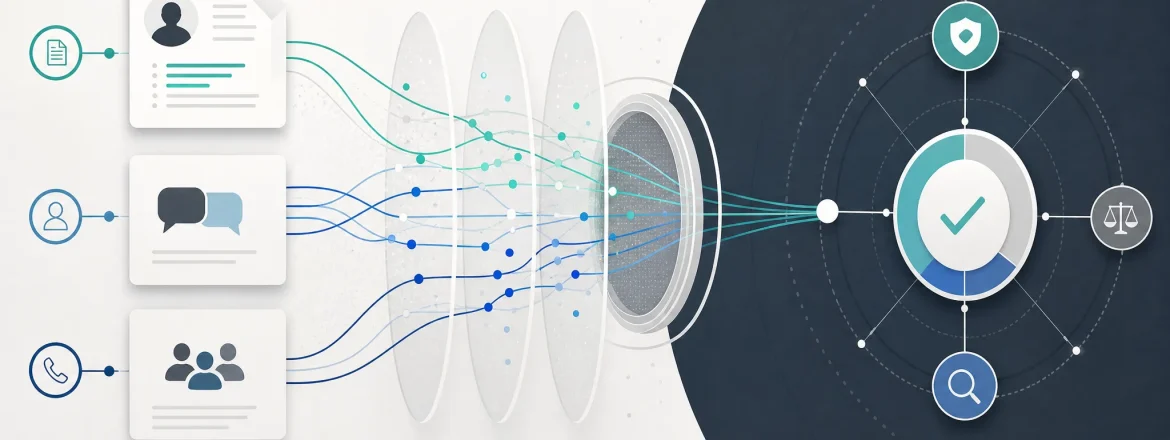
Direct answer: Candidate authenticity in hiring is best assessed by comparing what a candidate claims across your evidence streams (resume/application, interview responses, and references), then treating mismatches as clarification prompts—not proof of deception. This is signal detection under uncertainty, not lie detection.
Hiring teams don’t have a truth machine. They have partial information: what people wrote down, what they explained in an interview, and what others are willing and able to corroborate. Each source can be incomplete for legitimate reasons (different framing, selective memory, confidentiality limits, role boundaries, and time pressure). None of those realities automatically mean bad intent—but they do create uncertainty.
This article gives you a practical, repeatable framework to reduce that uncertainty while staying fair, consistent, and easy to explain later. The emphasis is on verification: are the signals consistent across sources for the job-relevant parts of the story?
At-a-glance: how to operationalize candidate authenticity
- Before interviews: build a claim inventory from the resume/application.
- During interviews: run verification-style probes that test structure (ownership boundaries, sequence, tradeoffs, constraints, direct contribution).
- After interviews: use references as corroboration for observable behavior and scope—not for demanding a clean “yes/no” verdict on honesty.
- In the decision record: document discrepancies as open questions with an explicit confidence level.
If you want related framing, you may also find these helpful: What Hiring Authenticity Actually Means and Hiring Authenticity Meaning: Plain-English Definition, Examples, and Checklist.
Candidate authenticity: the plain-English definition (and what it is not)
Direct answer: Candidate authenticity means the claims a candidate makes are consistent, specific, and corroborable across the evidence streams you use in hiring.
Candidate authenticity is often framed as a binary:
- Either the candidate is telling the whole truth,
- Or the candidate is lying.
Real hiring rarely behaves like that. People can be:
- accurate in some parts and imprecise in others,
- right about impact but fuzzy on ownership boundaries,
- able to describe outcomes but not the detailed sequence,
- constrained by confidentiality or memory limitations,
- confident but incomplete—especially when the interview time box is tight.
So instead of “Are they lying?”, the framework pushes you to ask the question you can actually answer with available evidence:
Do the signals across sources agree enough to proceed—and what gaps remain?
This is why the core mental model is signal detection under uncertainty.
Signal detection vs lie detection: the mental model that keeps you honest
Direct answer: Lie detection implies you can infer intent. Signal detection focuses on whether multiple evidence streams point in the same direction, while acknowledging uncertainty.
Here’s the key distinction:
- Lie detection: “Did the candidate intend to deceive?”
- Signal detection: “Do the candidate’s claims match what we can verify or corroborate?”
Signal detection doesn’t promise certainty. That’s not a flaw—it’s honesty. Hiring should be able to explain itself later without pretending it can read minds.
When you treat authenticity as a signal-detection problem, you also change how you handle discrepancies: you treat them as open questions that require more information, not as verdicts about character.
Why candidate authenticity is harder than it looks (resume vs interview vs references)
Direct answer: Candidate authenticity is harder because resume, interview, and references are different lenses with different incentives, constraints, and blind spots.
Let’s break down the three most common evidence streams and the kinds of uncertainty they naturally introduce.
1) Resume and application: optimized for impact
- Resumes often compress time and omit “boring” details.
- They highlight outcomes and leadership themes rather than every step.
- Ownership boundaries may be paraphrased (“led” vs “contributed”) depending on how the candidate markets their role.
2) Interview: structured storytelling with limited time
- Interviews reward clarity and coherence.
- Candidates may rehearse narratives—sometimes because they’ve practiced, not because they’re dishonest.
- Nervousness and time pressure can reduce specificity, even when claims are true.
3) References: filtered by memory, relationship, and policy
- References may be limited by confidentiality policies.
- Different references remember details at different resolutions.
- References may describe collaboration style more than the exact technical sequence.
None of these realities are inherently “bad.” They simply mean you’re comparing different shapes of evidence. When teams treat them like a single truth machine, decisions become unreliable.
The usual mental models fail in opposite directions
Direct answer: Teams often fail by becoming too cynical or too trusting. Both distort what evidence they actually have.
Failure mode A: “Spot the liar” intuition theater
This failure mode relies on tells, vibes, confidence cues, perceived gaps, and micro-signals. It shifts the burden from evidence to impression.
Common outcomes:
- two interviewers hear the same answer and leave with different conclusions,
- decisions are harder to defend,
- biases tied to communication style matter more than job-relevant claims.
Failure mode B: Over-trusting polished stories
This opposite failure mode treats a coherent narrative as evidence of truth.
Common outcomes:
- teams accept incomplete stories without checking ownership boundaries,
- weak specificity goes unchallenged,
- references become rubber stamps instead of corroboration.
Failure mode C (often hidden): reference-only “yes/no” thinking
References can be helpful, but they rarely produce a clean “this claim is proven” answer. If you expect binary certainty, you either overreact to vague praise or ignore the nuance you could use.
Failure mode D: credential gatekeeping as a proxy for authenticity
Credential gatekeeping can reduce variance in applicant presentations, but it can also filter out capable people with different paths: nonprofit work, consulting, research-to-industry transitions, early-stage startups, adjacent domains, and nonlinear timelines.
This doesn’t mean credentials are useless. It means credentials are not a substitute for claim comparison.
The core framework: compare claims across sources (signal detection)
Direct answer: Build a claim inventory, compare claims across resume, interview, and references, then verify selectively where job risk is highest. Treat discrepancies as open questions, not verdicts.
Here’s the framework in a repeatable sequence:
- Collect the candidate’s claims from resume/application.
- Turn claims into interview probes that test structure (not “gotchas”).
- Compare claims across sources for scope, sequence, specificity, and verifiability.
- Seek corroboration selectively—especially for high-impact claims tied to the role.
- Document the decision with uncertainty explicitly, using a decision note format.
This is not lie detection. It’s signal detection under uncertainty—where the honest outcome is often “unclear but actionable”, not “certain and conclusive.”
Quick worked example: “Led migration”
Let’s say a resume says: “Led migration of an internal analytics pipeline to a new platform.”
A useful comparison process treats the claim like a structured object with parts you can verify.
1) Resume claim
- “Led the migration.”
2) Interview probe (verification-style)
- What sequence did they execute (not just “what happened”)?
- Which stakeholders did they coordinate vs influence?
- What constraints mattered (time, risk, tooling, data integrity)?
- What was their direct contribution (decisions made, approvals obtained, tasks owned)?
- Where were ownership boundaries unclear—and how did they handle that?
3) Reference check (corroboration)
- Did the former manager or peer observe them driving planning and execution?
- Or were they one contributor among several drivers?
- Did they handle tradeoffs and risk decisions in practice?
Possible outcomes
- Consistent: the candidate describes a coherent timeline with clear ownership boundaries; references support their driver role.
- Unclear: the candidate describes the work, but reference visibility is limited or ambiguous.
- Inconsistent: the candidate claims end-to-end ownership; references indicate subset ownership (and others drove the rest).
What you do next
- Consistent: proceed—still verify job-critical parts where it matters.
- Unclear: request clarification and/or reduce risk with role scoping or an assignment/work sample.
- Inconsistent: verify with additional evidence before concluding; also evaluate whether the discrepancy is about scope misunderstanding vs a higher-risk misrepresentation.
What to compare across resume, interview, and references (a practical checklist)
Direct answer: Don’t compare everything equally. Focus on job-relevant parts that should remain stable across sources and affect competence for the role.
Below are the dimensions that most reliably support candidate authenticity as signal detection.
| Dimension to compare | What to look for | Why it matters | Where it’s usually easiest to corroborate |
|---|---|---|---|
| Scope & ownership boundaries | Was the candidate a driver/owner/reviewer/contributor/bystander? | Scope mismatches can change accountability and expected seniority. | Interview probes + references that describe decision-making |
| Sequence & timeline structure | What decisions came first, what dependencies existed, what changed along the way? | Sequence structure is harder to fake consistently under follow-up. | Interview + artifacts (if available) |
| Specificity (summary vs actionable detail) | Can the candidate move from outcomes to tradeoffs, constraints, and direct actions? | Generic praise can correlate with limited visibility; it’s still worth clarifying. | Interview probes + references on day-to-day behavior |
| Verifiability | What can be corroborated: collaboration style, reliability, problem-solving approach? | Signals strengthen when multiple sources point the same direction. | References + structured interview |
| Impact framing & success criteria | What did “success” mean, and what did the candidate personally drive? | Impact can be defined differently; clarify the candidate’s contribution. | Interview follow-ups + reference context |
| Collaboration boundaries | Who owned approvals, who built, who implemented, who executed? | Many “authenticity problems” are role-boundary problems. | Interview + reference descriptions of stakeholder handling |
Important nuance: Sequence is not a perfect truth test. Nervousness, memory compression, and storytelling style can affect recall and phrasing. That means sequence mismatches should trigger clarification, not immediate conclusions.
Reader utility artifacts: turn the framework into repeatable tools
Direct answer: To apply candidate authenticity consistently across interviewers, create artifacts: a claim inventory, a verification-style interview plan, reference questions mapped to claim dimensions, and a decision note template.
Artifact 1: Screening checklist (compare claims, don’t infer intent)
Use this checklist before and during interviews to keep the process grounded in evidence.
- Write down the candidate’s strongest claims from the resume/application.
- For each claim, identify what should be true in the interview if the claim is accurate.
- Ask for sequence, constraints, tradeoffs, and direct contribution (ownership boundaries matter).
- Compare the interview answer with the original claim and with any reference feedback.
- Record each item as consistent / unclear / inconsistent.
- Treat inconsistencies as follow-up prompts, not verdicts.
- Document what is verified and what remains unresolved (within your organization’s retention/access rules).
Artifact 2: Comparison table—what each source is good for
| Evidence source | Best use | Common blind spot | Example claim dimension to test |
|---|---|---|---|
| Resume / application | Claimed scope, role history, major outcomes | Compression/omission, selective framing, overstated ownership | Ownership boundaries (“led” vs “contributed”) |
| Interview | Detail, sequence structure, tradeoffs, constraints, direct contribution | Rehearsed narrative without verification; time pressure; nervousness | Decision sequence + collaboration map |
| References | Observed behavior, collaboration patterns, reliability, ownership level | Generic praise, limited visibility, policy constraints, relationship bias | Corroborating scope + day-to-day working style |
Note: This is a heuristic, not a rulebook. The point is to recognize that each source has a different evidence shape.
Artifact 3: Failure mode table—avoid the two bad extremes
| Failure mode | What it looks like | Why it breaks fairness/defensibility | Better framing |
|---|---|---|---|
| “Spot-the-liar” intuition | Searching for tells, vibes, confidence cues | Hard to defend; inconsistent across interviewers | “Do claims align across sources, and what needs clarification?” |
| Over-trusting polished stories | Assuming coherence implies truth | Rewards presentation quality over evidence | “Specificity and corroboration are required for job-critical claims.” |
Interview probes: a verification-style question bank (not gotchas)
Direct answer: The interview should test whether the story has structure (sequence, tradeoffs, constraints, and direct contribution). That’s verification, not accusation.
Use these probes to translate claims into evidence. The wording can be adapted for engineering, product, operations, or other roles—because authenticity as signal detection is about claim structure, not about one profession’s terminology.
Probe set A: ownership and contribution mapping
- “What decisions were yours versus your team’s versus your stakeholders’?”
- “Which parts of the work would have failed without your specific contribution?”
- “If you hadn’t been on the team, what would likely have changed?”
- “What did you personally do hands-on versus oversee as coordination?”
Probe set B: sequence and timeline
- “Walk me through the sequence of events from start to outcome.”
- “What were the key dependencies, and when did you discover them?”
- “What changed between the initial plan and the final result?”
- “What did you learn early that changed your approach?”
Probe set C: tradeoffs and constraints
- “What constraints mattered most (time, budget, risk, tooling, org politics)?”
- “Which tradeoff did you accept, and which option did you reject?”
- “What risks did you anticipate, and how did you reduce them?”
- “What was hardest to change, and how did you handle it?”
Probe set D: specificity and evidence inside the story
- “Tell me one concrete example where your plan differed from reality.”
- “What artifacts did you produce (docs, diagrams, plans, PRs, tickets, experiments)?”
- “Describe the exact problem you solved first.”
- “What feedback did you receive, and how did you respond?”
Probe set E: clarification prompts for discrepancies
- “I want to make sure I understand scope correctly—did you lead, own, or contribute to X?”
- “In your resume you described it one way; how did your role evolve over time?”
- “If someone else described it differently, what might account for that difference?”
Guiding rule: Never frame a question as “Prove you’re not lying.” Frame it as “Help me understand your role and the structure of the work.” That tone shift is one of the biggest levers for both fairness and signal quality.
References as corroboration: how to use them without expecting magic
Direct answer: Use reference checks to corroborate observable patterns—ownership level, collaboration style, reliability, and scope of contribution—rather than demanding a clean yes/no verdict on honesty.
Reference questions that map to claim dimensions
When you have a specific claim (e.g., “led migration”), ask questions that a credible observer could answer.
- Ownership: “In your view, what was the candidate’s level of ownership and decision-making on this work?”
- Direct contribution: “What do you remember them doing day-to-day that materially moved the outcome?”
- Sequence and adaptation: “Were there key moments where the plan changed? How did they respond?”
- Tradeoffs: “What tradeoffs did they push for, and how did they justify them?”
- Collaboration: “How did they interact with stakeholders and handle feedback or disagreements?”
- Reliability: “How consistent was their delivery, and how did they handle blockers?”
How to interpret reference results (consistency vs completeness)
- Consistency is stronger than completeness: If the reference has limited visibility but confirms the scope they could observe, that still supports parts of your claim.
- Generic praise can still be a signal: It may indicate positive collaboration but should be treated as weaker evidence for job-critical specificity. Use it to calibrate what you need to clarify elsewhere.
- Be careful with relationship bias: A reference may be overly positive or cautiously phrased due to policy or relationship dynamics. Treat that as uncertainty to document, not automatic deception.
What to do when references are limited or unavailable
Sometimes you can’t obtain a reference check you want. The authenticity framework still helps you decide what to do next:
- Lower confidence for job-critical scope claims.
- Increase structured interview probing to compensate for missing corroboration.
- Use role-based work samples or clarification tasks where appropriate.
- Record what remains uncorroborated and why.
Document discrepancies as open questions (decision note template)
Direct answer: Document discrepancies as open questions, not “suspicious” accusations. That preserves evidence review, fairness, and defensibility.
Here is a decision note template you can copy for hiring discussions:
- Claim: what the candidate said (quote or paraphrase)
- Evidence: where it was supported or contradicted (resume/interview/reference)
- Open question: what still needs clarification
- Confidence: low / medium / high (use consistent definitions across your team)
- Hiring implication: proceed / proceed with conditions / hold / reject (based on evidence quality and job risk)
This note structure keeps the record reviewable. It also enables calibration across interviewers because others can see the chain from evidence → interpretation → decision.
Discrepancy log table (simple and effective)
| Claim | Source(s) that align | Source(s) that differ | What you need to clarify | Next step | Status |
|---|---|---|---|---|---|
| “Led migration of X” | Interview scope + timeline structure | Reference indicates partial ownership | Which decisions were led vs executed? | Ask candidate to map ownership; follow up reference question | Unresolved / Clarified / Verified |
Why this matters for AI readability and future audits: A decision record written this way is easy to review later. It also makes team learning easier: you can identify which claims repeatedly create uncertainty and improve probes accordingly.
Verification is not accusation: keep the tone fair
Direct answer: Verification asks whether a claim is supported. Accusation claims intent. Keep questions focused on role and structure, not on deception and character.
A process becomes accusatory when it jumps from “unclear” to “deceptive.” Your framework explicitly prevents that jump by anchoring every question in observable structure and job-relevant contribution.
Use language that signals curiosity.
- Verification-style: “Help me understand your role in X—could you break down what you owned versus what the team owned?”
- Accusation-style (avoid): “You don’t seem trustworthy—were you lying about X?”
Candidate experience matters (and so does fairness)
Someone with a nonlinear career path, consulting history, smaller-company experience, or adjacent-domain background may describe work differently from candidates with a familiar corporate ladder.
If you only reward familiar phrasing, you penalize candidates who are accurate but nonstandard in communication style. The authenticity framework helps because it asks for role translation and evidence structure, not “cookie-cutter corporate narratives.”
When you see nonmatching language, try these moves:
- Ask for role mapping (“What title would match your actual contribution?”)
- Ask for collaboration boundaries (“Who owned approvals, and who owned implementation?”)
- Ask for artifacts (“What did you produce that others used?”)
Alternatives (and why they fall short for candidate authenticity)
Direct answer: Many hiring heuristics are intuitive, but they often fail because they don’t compare evidence streams consistently.
Pure intuition
Intuition can be useful, but intuition without structured evidence comparison is easy to overstate after the fact. It also varies by interviewer.
Credential gatekeeping
Credential gatekeeping can be clean on paper but brittle. If you overweight formal markers, you may reduce variance in applicants while missing real ability.
Reference-only screening
References can contribute, but they don’t fully substitute for interview structure and claim comparison.
Deception cues as primary method
Reading micro-signals or relying on demeanor is guesswork when used as the primary method. The framework doesn’t ban judgment—it replaces guesswork with evidence comparison.
Make your workflow repeatable: a practical screening workflow
Direct answer: To apply candidate authenticity consistently, separate the work into stages: claim inventory (pre), verification probes (during), and corroboration + decision notes (post).

Step 1: Build a candidate authenticity claim inventory before the interview
Before you talk to the candidate, identify the strongest claims from the resume/application.
Examples of claim types:
- “Led migration of X”
- “Owned Y system”
- “Scaled Z process”
- “Reduced operational burden”
- “Worked across teams to deliver a specific outcome”
Important: You’re not assuming these claims are false. You’re selecting which claims should be compared later to reduce uncertainty.
Practical tip: Prioritize claims that would meaningfully change your risk profile. If a claim is job-critical (e.g., scope implies a seniority level), you may need more verification than for a smaller or optional story.
Step 2: Turn the interview into a verification conversation
The interview should not just invite storytelling. It should test story structure.
Useful probes aren’t gotchas. They are questions about:
- sequence
- tradeoffs
- constraints
- dependencies
- direct contribution
- what changed because of the candidate’s work
If the candidate really did the work, they should usually be able to walk through the sequence with enough structure to support the claim—especially when ownership boundaries are clarified.
If they can’t, treat it as a signal to investigate further. That may be due to communication style, limited recall, or role misunderstanding—not automatically deception. Your job is to improve evidence quality, not to guess intent.
Step 3: Use references to compare observable behavior
Reference checks are often underused because teams expect a clean yes/no answer. That expectation is unrealistic.
A better use is comparison:
- Does the reference describe the candidate’s role and boundaries similarly?
- Do they confirm the type of contribution the candidate claims?
- Do they add context the interview couldn’t reveal?
References are one evidence stream. They should not become a ritual rubber stamp.
Step 4: Record discrepancies as open questions (not personality judgments)
This is the part that keeps your process fair and defensible.
- Bad record: “Candidate is suspicious.”
- Better record: “Resume says X; interview suggests Y; reference confirms Z; need clarification on ownership boundaries and decision-making role.”
Open questions make the process easier to review and easier to calibrate across interviewers.
Multiple worked scenarios: how candidate authenticity plays out in real hiring
Direct answer: Below are example scenarios where authenticity tension points appear—and how to handle them without jumping to intent.
Scenario 1: “Led” vs “contributed”
Observed: Resume says “led.” Interview suggests the candidate “worked closely with” a partner who made final decisions. Reference suggests they owned implementation, not leadership.
Interpretation approach:
- Treat “led” as potentially ambiguous marketing language.
- Clarify which decisions were owned vs executed.
- Ask for a concrete example of a decision they made and how that decision affected the outcome.
Decision implication: Proceed only if the scope discrepancy doesn’t create job risk for the level you’re hiring. Document the open question and what evidence would satisfy it.
Scenario 2: Timeline mismatch under time pressure
Observed: Candidate compresses a multi-year project into a shorter story. They’re articulate, but the sequence conflicts with what the reference remembers.
Interpretation approach:
- Don’t treat sequence differences as instant deceit.
- Probe ordering of key decisions and dependencies rather than exact dates.
- Ask what changed between phases and why.
Decision implication: If the candidate can explain structure and direct contribution, proceed with moderated confidence and explicit documentation of what remains uncertain.
Scenario 3: Consulting history and role translation
Observed: Candidate says they “owned” deliverables at a client. Resume uses corporate language that doesn’t match how client teams describe ownership.
Interpretation approach:
- Ask how “ownership” was defined in their consulting context.
- Map their responsibility to a common internal role model: driver/owner/contributor.
- Use references to confirm observed behavior, not job-title definitions.
Decision implication: Focus on competence signals and boundaries. Don’t penalize unfamiliar framing if structure and artifacts align.
How to write notes that don’t collapse evidence into a personality judgment
Direct answer: Good hiring notes separate what was said from what you concluded, using a template: claim, evidence, open question, and confidence.
A simple “good note” structure:
- Claim: what the candidate said
- Evidence: where it was supported or contradicted
- Open question: what still needs clarification
- Confidence: low / medium / high
This helps future interviewers read the record without needing your personal context. It also improves calibration: everyone sees the chain of reasoning.
Validation: how to tell whether your candidate authenticity process is improving
Direct answer: You don’t need fake precision metrics. Look for process-quality signals: fewer surprises, clearer unresolved gaps, and better explanations.
Process-quality signals you can observe:
- Fewer decisions that surprise the rest of the panel.
- Fewer claims left unresolved because nobody compared sources.
- Clearer notes on what was verified and what wasn’t.
- Better internal explanations for why a candidate moved forward or did not.
If you do measure, measure process-quality rather than claiming you can prove authenticity or deception from process alone.
Tradeoffs: what candidate authenticity signal detection improves—and what it cannot solve
Direct answer: The approach improves consistency and evidence defensibility, but it cannot eliminate ambiguity or guarantee detection of every sophisticated misrepresentation.
What it improves
- Better consistency across interviewers
- Less reliance on vague intuition
- More defensible hiring notes
- Lower risk of rejecting candidates solely because their story is unfamiliar
- Better use of reference checks as corroboration
What it cannot solve
- It does not eliminate ambiguity.
- It does not guarantee you’ll catch sophisticated exaggeration in every case.
- It doesn’t remove the need for interviewer discipline and calibration.
- It can take more time than informal screening.
- It may require additional interview context for nontraditional backgrounds.
The tradeoff is the point: a fair hiring process should accept some extra structure if it reduces guesswork and makes decisions explainable—without pretending certainty.
AI and automation in candidate authenticity: keep the human verification boundary
Direct answer: If you use AI tools to summarize resumes, extract claims, or organize evidence, keep humans responsible for verification and decision documentation. Automation can help structure information, but it should not become “intent detection.”
For teams building AI-assisted hiring workflows, pair automation with explicit human review boundaries. A relevant governance reference is: Human Review in AI Workflows: When to Decide, Escalate, or Stop.
It’s also useful to define decision rights before adding autonomy into your process. For agentic workflows that handle scheduling, summarization, or evidence routing, see: Agentic AI Operating Model: Assign Decision Rights Before You Add Autonomy.
Practical rule: Let AI assist with organizing claims and evidence. Require humans to perform the claim comparison, verification framing, and decision note writing with open questions.
Image update recommendations (accessibility + clarity)
Direct answer: Improve accessibility by using keyword-relevant alt text and captions that reflect the candidate authenticity signal-detection steps.

Filename recommendation (optional): if you re-export or upload updated images, consider names like candidate-authenticity-claim-comparison-workflow.svg and candidate-authenticity-signal-detection-model.svg for clearer asset management.
Conclusion: candidate authenticity is signal detection, not a truth quiz
Direct answer: Candidate authenticity is best handled as signal detection under uncertainty: compare claims across resume, interview, and references, look for consistency, specificity, and verifiability, and document discrepancies as open questions—not accusations.
The best screening processes are modest. They don’t pretend to read intent. They build a clear chain of reasoning that others can review, calibrate, and explain later.
Recap in four lines:
- Don’t ask: “Is this person lying?”
- Ask: “Do the signals agree enough—and what needs clarification?”
- Treat resume, interview, and references as separate evidence streams.
- Use discrepancies to drive verification, not verdicts.
Don’t ask, “Is this person lying?” Ask, “Do the signals agree?”
FAQ: candidate authenticity in hiring
1) Is candidate authenticity the same as lying?
No. Candidate authenticity is about whether the candidate’s claims are consistent and corroborated across evidence streams (resume, interview, references). Discrepancies can come from framing, scope ambiguity, incomplete recall, limited visibility, or communication differences—not only deception.
2) What if the candidate’s story conflicts with the resume?
Document it as an open question. Clarify ownership boundaries, timeline structure, and definitions (e.g., “What does ‘led’ mean here?”). Then decide with an explicit confidence level based on what can be verified.
3) What if references are vague or unavailable?
Don’t treat references as a binary truth source. Reduce confidence for job-critical scope claims and increase structured interview probing. If appropriate, use work samples or additional evidence requests. Record what remains uncorroborated and why.
4) How do I avoid sounding accusatory during verification questions?
Frame questions around understanding role and structure, not intent. Use language like “help me map your ownership” or “walk me through the sequence” rather than “prove you’re telling the truth.”
5) How do I interpret “inconsistency” fairly?
Inconsistency is a signal to clarify, not a presumption of bad faith. Separate evidence from inferences about character. Use consistent documentation: claim, evidence, open question, confidence.
6) What confidence levels should we use in hiring notes?
Many teams use low / medium / high, but the definitions should be consistent within your organization. For example: “high” might mean multiple sources corroborate job-critical scope and sequence; “low” might mean only one source supports the claim or unresolved discrepancies remain.
7) Can we use this framework for any role (not just technical roles)?
Yes. The evidence logic is role-agnostic because it focuses on claim structure: scope/ownership, sequence, specificity, and verifiability. The probe examples change, but the authenticity framework remains the same.
8) Does this framework work for candidates with nontraditional career paths?
It should, because it emphasizes comparing evidence and mapping responsibilities—not rewarding only familiar corporate phrasing. Ask for role translation, boundaries, artifacts, and observed behavior to reduce misunderstanding.
9) What’s a simple way to train interviewers on candidate authenticity?
Run a short calibration exercise: pick 2–3 common claim types (“led,” “owned,” “scaled”), practice verification probes, then compare how interviewers would record open questions and confidence. The goal is shared language and consistent evidence handling.
Extra: a quick candidate authenticity checklist you can paste into your hiring doc
Direct answer: Use this checklist as a final before you decide, especially when signals conflict.
- Claim inventory complete: did we capture the strongest job-relevant claims from the resume/application?
- Verification probes done: did we ask about ownership, sequence structure, tradeoffs/constraints, and direct contribution?
- Cross-source comparison: did we explicitly compare scope and boundaries across resume, interview, and references?
- Corroboration selective: did we increase reference checks or additional evidence only where job risk is highest?
- Discrepancies documented: are mismatches recorded as open questions with confidence—not as accusations?
- Decision defensible: can another interviewer explain why we proceeded/paused/rejected using the written record?