

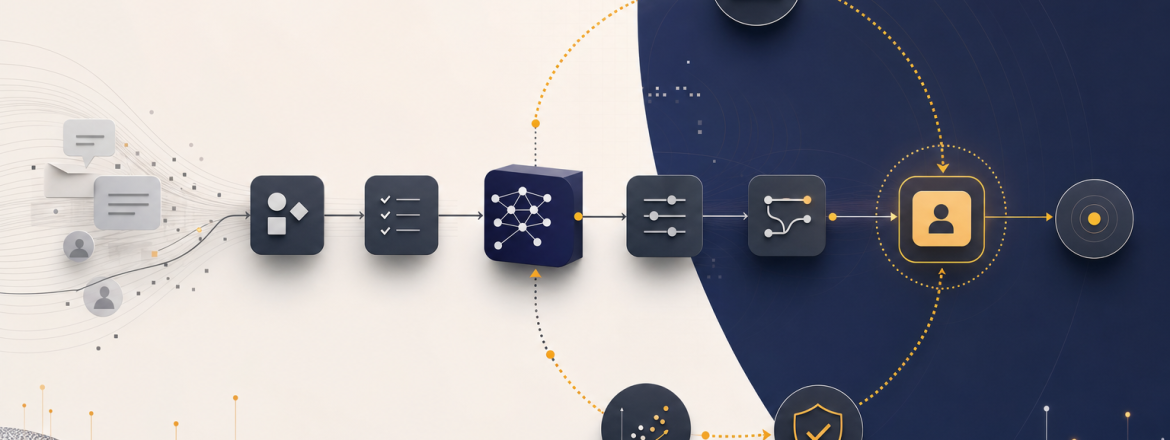
AI Support Triage Bounded Workflow: A Safer Alternative to Autonomous Agents
Direct answer: An AI support triage bounded workflow keeps the model in “proposal mode” (structured classification + uncertainty), while deterministic software enforces schema, allowlists, and policy, and a human-in-the-loop escalation gate handles unsafe, uncertain, or policy-sensitive tickets. This prevents silent misrouting and creates an audit trail you can operate.
Support triage is one of the most operationally risky places to add AI. Not because AI can’t understand tickets—but because triage affects where work goes. A wrong destination can delay escalation, overload the wrong team, hide duplicates, and create “mysterious” customer outcomes with poor traceability.
This guide shows how to design an AI support triage bounded workflow that is inspectable, testable, and governable in production. It also explains how this differs from building a general autonomous support agent that combines classification, retrieval, tool use, response drafting, and side effects in a single loop.
What this article covers (and what it doesn’t)
Direct answer: You’ll get a reusable design framework for a bounded triage workflow: the triage ladder, validation and routing controls, escalation policy, observability, evaluation, rollouts, and failure-safe fallbacks.
Not included: This article does not claim a specific measured improvement (accuracy, cost, latency, deflection, or escalation quality) for any particular model, dataset, or deployment. Instead, it focuses on design patterns and implementation-ready checklists so you can adapt and validate them for your system.
Why “autonomous agent” triage is hard to operate
Direct answer: When a model is allowed to “decide the next action” with broad autonomy, you get distributed behavior across prompts, retrieval, tool state, routing rules, and external service reliability. That makes evaluation and incident analysis difficult.
Open-ended agent loops can do many things at once:
- classify the ticket
- retrieve context
- decide whether to use tools
- route the item
- draft a response
- decide whether to escalate
- take operational actions
Even if the model is competent, the system as a whole may still behave unpredictably. For triage, unpredictability is risky because routing side effects are the core outcome.
Bounded design makes the “where work goes” decision inspectable. The system can say:
- What label was proposed?
- Did software validate it?
- Which deterministic routing rule version selected the queue?
- Why was escalation required?
- What fallback was used when uncertainty was high or validation failed?
Define the goal: triage vs response generation
Direct answer: AI support triage bounded workflow is about decision routing. Response generation is a different task with a different risk profile and different controls.
A narrow triage task can be described as:
Given an inbound support item and approved context, propose structured fields such as issue category, severity, product area, duplicate/known-issue status, customer impact, and an escalation recommendation (plus uncertainty or abstention signals).
In contrast:
- Triage decides where work should go.
- Response generation drafts customer-facing language.
A key safety principle: you can automate triage decisions carefully without automatically generating a customer-visible answer. For many organizations, the safest early step is to separate triage from response generation until you have stronger controls and evaluation.
The triage ladder: classify, validate, route, observe, escalate
Direct answer: The simplest mental model for an AI support triage bounded workflow is a “ladder” where each rung has: (1) an eval target, (2) a fallback path, and (3) an explicit owner.
Use this ladder as a design checklist. Don’t treat it as a strict implementation order; treat it as a division of responsibility.
Rung 1: Classify (model proposes)
- The model proposes structured labels from ticket content and allowed context.
- The model should output uncertainty signals (e.g., overall uncertainty level, missing-context reasons) and an explicit abstain or requires-human-review flag when applicable.
- Keep the output constrained to a defined schema. The schema is your contract.
Rung 2: Validate (software enforces)
- Deterministic validation checks schema conformance.
- Deterministic checks verify allowlists for labels, product areas, severity values, and known-issue statuses.
- Validation checks internal consistency (for example, if an output claims “known issue,” it must include a matching evidence field if your policy requires it).
- Validation enforces policy constraints and decides whether the model’s output can influence routing.
Rung 3: Route (deterministic mapping)
- Deterministic policy maps validated classifications to queues, teams, or review states.
- Routing rules should be versioned so you can reproduce decisions.
- Routing should support conservative fallback decisions (e.g., “conservative queue,” “human triage queue”) when validation is rejected or uncertainty is high.
Rung 4: Observe (structured traces + audit)
- Record structured decision events so you can debug, audit, and roll back.
- Include trace IDs, schema versions, model/prompt/config versions, validation results, routing outcomes, escalation status, and fallback reason codes.
- Apply privacy/security controls: redaction, minimization, retention limits, and role-based access.
Rung 5: Escalate (human decision on sensitive cases)
- Escalation is not a “bug.” It is a safety mechanism.
- Mandatory escalation triggers should cover: high uncertainty, unsafe or policy-sensitive categories, missing required context, high-impact incidents, or any case where validation cannot safely accept the model output.
- Human reviewers must own the final decision for these cases (and their overrides should be captured).
Put the ladder into a control table
Direct answer: Use a table to ensure every rung has: model responsibility, deterministic responsibility, eval type, and fallback.
| Rung | Model responsibility | Deterministic responsibility | Human responsibility | Eval type | Fallback |
|---|---|---|---|---|---|
| Classify | Propose labels and uncertainty signals | Enforce schema and allowed values | Define label guidelines and review examples | Label-quality eval | Abstain or human review |
| Validate | None (except uncertainty fields, if permitted) | Reject malformed, inconsistent, or disallowed outputs | Define policy boundaries | Validation test suite | Manual or rules-only triage |
| Route | None (or constrained recommendation only) | Map validated labels to queues using versioned rules | Own queue taxonomy | Route replay / routing eval | Conservative queue |
| Observe | None as an authority boundary | Persist trace/version/fallback fields with redaction controls | Review samples and overrides | Monitoring and audits | Alert, disable automation, or roll back |
| Escalate | Flag uncertainty or risk when useful | Enforce mandatory escalation rules | Final decision on sensitive cases | Escalation eval | Human review |
A direct decision tree for an AI support triage bounded workflow
Direct answer: Here is a simple decision path that prevents invalid or uncertain model outputs from producing risky side effects.
Inbound support item
  |
  v
Is the input usable and in scope?
  |-- no --> Human review or approved fallback
  |
  yes
  v
Can the model return schema-valid structured labels?
  |-- no --> Manual or rules-only triage
  |
  yes
  v
Are all labels allowed and internally consistent?
  |-- no --> Reject output; use conservative fallback
  |
  yes
  v
Does policy require human review?
  |-- yes --> Human review
  |
  no
  v
Is the uncertainty signal acceptable under approved rules?
  |-- no --> Human review or conservative queue
  |
  yes
  v
Apply deterministic routing policy (versioned)
  |
  v
Record decision, versions, fallback state, and later override (if permitted)
“Confidence” vs “uncertainty”: avoid pretending you have calibration
Direct answer: Treat model output uncertainty as a signal that must be validated empirically—not as calibrated truth unless you have tested calibration for your task and data.
For bounded workflows, the safest approach is to standardize on terms like:
- uncertainty level (low/medium/high)
- missing-context reasons (e.g., “required evidence absent”)
- abstain (explicit “do not route automatically”)
Then define policy rules such as:
- High uncertainty → mandatory escalation gate.
- Schema violations → reject output → conservative fallback.
- Policy-sensitive categories → human review even if uncertainty is low.
Implementation pattern: narrow model calls with explicit software boundaries
Direct answer: A bounded workflow often looks like: ingestion → context → model structured output → deterministic validation → escalation gate → deterministic routing → decision record.
Inbound support item
        |
        v
Ingestion layer
- normalize input
- attach permitted metadata
- assign trace ID
- apply minimization and redaction where appropriate
        |
        v
Context layer
- retrieve approved context only
- version retrieved context
- enforce access and data policies
        |
        v
Model call (triage-only)
- structured output
- allowed labels
- abstention behavior
- short, non-sensitive evidence fields (if approved)
        |
        v
Validation layer
- parse schema
- reject unknown labels
- check required fields
- apply policy constraints
        |
        v
Escalation gate
- mandatory review cases
- uncertainty fallback
- sensitive category handling
        |
        v
Routing layer
- deterministic route mapping
- versioned routing config
        |
        v
Decision record
- trace ID
- model/prompt/schema/config versions
- validation outcome
- route/fallback/escalation status
- human override outcome (where permitted)
Example schema: keep triage output structured and bounded
Direct answer: Use a predefined schema with allowlisted values, explicit abstention, and uncertainty reasons. Reject unknown outputs.
{
  "ticket_id": "opaque-trace-id-or-reference",
  "classification": {
    "issue_category": "placeholder_category",
    "product_area": "placeholder_product_area",
    "severity": "placeholder_severity",
    "known_issue_status": "unknown | possible_duplicate | known_issue | not_known_issue",
    "customer_impact": "unknown | low | medium | high",
    "requires_human_review": true
  },
  "uncertainty": {
    "overall": "low | medium | high",
    "reasons": ["ambiguous_input", "missing_required_context"]
  },
  "evidence": {
    "ticket_signals": ["short non-sensitive rationale"],
    "retrieved_context_ids": ["approved-context-id"]
  },
  "abstain": false,
  "abstain_reason": null
}
Deterministic validation (example logic)
def validate_triage_output(output, allowed_labels, policy):
    # 1) Schema conformance
    if not conforms_to_schema(output):
        return reject('schema_error', fallback='manual_triage')

    c = output['classification']

    # 2) Allowlist checks
    if c['issue_category'] not in allowed_labels.issue_categories:
        return reject('unknown_issue_category', fallback='manual_triage')

    if c['product_area'] not in allowed_labels.product_areas:
        return reject('unknown_product_area', fallback='manual_triage')

    if c['severity'] not in allowed_labels.severities:
        return reject('unknown_severity', fallback='manual_triage')

    # 3) Abstention policy
    if output.get('abstain') is True:
        return reject('model_abstained', fallback='human_review')

    # 4) Uncertainty thresholds
    if output['uncertainty']['overall'] == 'high':
        return reject('high_uncertainty', fallback='human_review')

    # 5) Mandatory review policy
    if policy.requires_human_review(c):
        return reject('mandatory_human_review', fallback='human_review')

    return accept('validated')
Keep “side effects” out of the model loop
Direct answer: The model should propose structured fields; deterministic software should decide side effects like queue routing, escalation activation, or disabling automation.
Here’s a useful accountability matrix:
| Component | Model-controlled? | Deterministic? | Notes |
|---|---|---|---|
| Parsing inbound ticket | No | Yes | Normalize input types consistently |
| Label proposal | Yes | No | Keep output structured and constrained |
| Label allowlist | No | Yes | Unknown labels should fail validation |
| Mandatory escalation | No | Yes | Humans define policy; software enforces |
| Routing side effect | No | Yes | Route via versioned policy |
| Customer-visible response | Separate workflow | Separate controls | Do not bundle with triage unless explicitly approved |
| Logging and audit trail | No | Yes | Apply redaction, retention, and access controls |
Operational constraints you must design for (before trusting triage)
Direct answer: An AI support triage bounded workflow must be built around production realities: messy inputs, latency budgets, safety policy, evaluation, observability, and privacy/security.
1) Input quality is never clean
- Tickets may be incomplete, duplicated, multilingual, emotional, or heavy with logs.
- Some tickets include context that is irrelevant to classification.
- Some tickets omit the key fields your taxonomy assumes.
Design implication: build validation, abstention, and human escalation so missing inputs don’t become risky routing decisions.
2) Safety: avoid irreversible customer-visible actions
- Route decisions can be irreversible operationally (even if the customer doesn’t “see” the decision).
- Some categories may be policy-sensitive.
Design implication: enforce policy gates and require human review where appropriate. Don’t treat the model’s label as authority.
3) Determinism: routing and policy enforcement should be software-controlled
- Use unit tests, config tests, and “route replay” to validate deterministic behavior.
4) Evaluation: every important path needs checks
- Classify correctly is only one part.
- Validation failures should be expected and tested.
- Escalation triggers should be tested as first-class outcomes.
5) Observability: decisions need structured traces
- Debugging requires reason codes, versions, and fallback states.
6) Privacy and security: minimize what you store
- Customer data, prompts, logs, and retrieved context all require review.
- Don’t log raw ticket text, prompts, retrieved context, or identifiers by default “because it’s useful.”
7) Ownership: every rung needs a human who can respond
- Define owners for regressions, taxonomy gaps, schema updates, and escalation policy changes.
Two key ideas that prevent silent harm
Direct answer: (1) Validate outputs before they can influence routing. (2) Treat escalation as a safety mechanism, not as failure.
These ideas sound obvious, but they’re commonly broken in the rush to “get it working.”
- Validate the workflow, not only the label. A correct label is meaningless if it routes to the wrong queue due to routing logic errors.
- Separate risk profiles. Triage routing is not response drafting. Keep controls separate.
Escalation gates: design them explicitly (and capture overrides)
Direct answer: Escalation must be a deliberate policy gate. Define what triggers it and ensure overrides feed back into taxonomy and evaluation sets.
Here are common escalation triggers you can implement as deterministic rules:
- High uncertainty or missing required context reasons.
- Policy-sensitive categories (security, privacy, compliance, sensitive account states).
- Unknown label or schema violations.
- Known duplicates that still require human confirmation for specific products or severities (policy-dependent).
- Potentially high-impact situations based on severity and customer impact.
When humans override, capture:
- override outcome (what the human chose)
- reason (if your process captures it)
- where the model’s uncertainty was wrong or insufficient
- whether the taxonomy needs update
If you want related reading, consider: Human Review in AI Workflows: When to Decide, Escalate, or Stop.
Routing: deterministic, versioned, and replayable
Direct answer: Routing should be deterministic and versioned. A replayable mapping ensures you can reproduce and debug routing outcomes.
A routing policy usually maps validated labels to:
- team or queue destination
- review state (auto-handled vs human triage queue)
- fallback destination when confidence/uncertainty is high
- special handling for “known issue” vs “possible duplicate”
Version everything:
- routing config version
- taxonomy definitions version
- schema version
- model/prompt config version
To deepen the architecture framing, see: Control Plane vs Agent Loop: Safe Architecture for Production Agentic Systems.
Observability and audit: make every decision inspectable
Direct answer: Your AI support triage bounded workflow should answer: what the model proposed, what validation accepted/rejected, why routing happened, why escalation happened, and which versions were active.
Minimum useful decision-event fields
- trace ID
- input metadata category (e.g., language, product module presence if you compute it)
- model version
- prompt/config version
- schema version
- retrieved context identifiers (not necessarily raw context text)
- model output labels (structured fields only)
- validation outcome (accept/reject) and failure reason code
- routing selected + routing rule version
- escalation status
- fallback reason code
- human override outcome (where permitted)
- latency, timeout status, and cost metadata (if you track cost)
Privacy/security: don’t log raw sensitive data by default
- Minimize stored content.
- Redact or hash identifiers where possible.
- Apply retention limits and RBAC.
- Review encryption requirements for at-rest and in-transit data.
Health signals you should monitor
- automation rate
- abstention rate
- escalation rate
- validation failure rate
- route distribution
- timeout rate
- parser failure rate
- provider error rate
- human override rate
- route skew after release
- missed mandatory escalation reports
Operational rule: If route distribution shifts suddenly after a prompt/model/retrieval/taxonomy/routing change, treat it as a regression signal until explained.
Fallbacks: design for wrongness, uncertainty, slowness, and outages
Direct answer: A bounded workflow must define safe fallbacks for every major failure mode. The fallback should prevent risky routing and preserve an audit trail.
| Failure mode | Detection signal | Safe fallback | Likely owner |
|---|---|---|---|
| Malformed model output | Parser/schema failure | Manual or rules-only triage | Platform/AI engineering |
| Unknown label | Allowlist validation failure | Reject and route to conservative/manual path | Support taxonomy owner |
| High uncertainty or ambiguity | Uncertainty field, weak evidence, reviewer disagreement | Human review | Support ops + AI engineering |
| Missed mandatory escalation | Escalation audit, human override, policy test failure | Disable affected automation path; route to human review | Support leadership |
| Stale or irrelevant retrieval | Retrieval eval failure, unsupported rationale, freshness check failure | Ignore context or escalate | Search/platform owner |
| Prompt/model regression | Offline regression failure, route skew, override spike | Roll back prompt/model/config | AI engineering |
| Model/provider timeout | Timeout metric, provider error | Rules-only/manual triage | Platform owner |
| Suspected prompt injection (input attempts to override policy) | Customer text contains instructions conflicting with system policy | Treat customer input as data; rely on validation and escalation gates | Security + AI engineering |
| Logging/privacy issue | Sensitive field appears in trace/log review | Stop logging the field; redact; trigger review | Security/privacy/legal |
Layered mitigation principle: prompt-injection handling is not a promise of reliable detection. The safest architectural boundary is: customer input is data, not authority. Software policy gates do the real work.
A synthetic end-to-end walkthrough (to make it concrete)
Direct answer: Here’s a realistic scenario showing how bounded triage prevents uncertain routing from becoming a silent operational decision.
Synthetic ticket: The customer says their workspace cannot export reports after a recent upgrade. They paste logs but omit the affected product module. They request urgent help because an internal deadline is approaching.
-
Classify (model proposes):
- The model proposes
reporting/export_failure. - It sets medium customer impact and high uncertainty because the module is missing from the ticket.
- It may set
requires_human_review = true(depending on your uncertainty policy rules).
- The model proposes
-
Validate (software enforces):
- The schema is valid and labels are allowed.
- Validation checks accept the output structurally but enforce the escalation gate because uncertainty is high or required context is missing (as reflected in uncertainty reasons).
-
Escalation gate:
- Policy: high-uncertainty tickets with potential business impact require human review.
-
Route (deterministic):
- No automated product-team route is applied.
- The ticket goes to the approved human triage queue.
-
Observe (decision record):
- Store the schema version, prompt version, model version, validation result, fallback reason, and escalation status.
- Raw customer text is not stored in the decision event unless your privacy policy explicitly allows it.
-
Feedback loop:
- If humans repeatedly identify the same missing module pattern, update taxonomy guidelines and add eval examples that represent this input messiness.
The point: The model isn’t “useless.” It provides structured proposals. The workflow prevents uncertain classifications from becoming unchecked routing decisions.
Four common approaches to AI support triage (and where bounded workflows fit)
Direct answer: Most teams converge on one of four designs. The bounded model-assisted workflow is the “safe middle” when you need inspectable routing.
| Approach | Good fit | Main cost/risk |
|---|---|---|
| Manual triage only | Low volume, high judgment, unclear taxonomy | Slower routing and inconsistent decisions under pressure |
| Rules-only triage | Stable inputs and deterministic policies | Brittle coverage and ongoing rule maintenance |
| Open-ended support agent | Exploratory workflows where autonomy is acceptable | Harder evals, unclear boundaries, more complex incident analysis |
| AI support triage bounded workflow (recommended here) | Ambiguous language with controlled side effects | More workflow design, validation, and ownership required |
If your architecture needs decision-right clarity before adding autonomy, this may also help: Agentic AI Operating Model: Assign Decision Rights Before You Add Autonomy.
Evaluation: measure the workflow, not just the label
Direct answer: Offline evals catch regressions before release. Online monitoring detects drift, blind spots, and operational impact. You must evaluate classification, validation, routing, escalation, abstention, retrieval behavior, and operations separately.
Offline evals vs online monitoring
- Offline evals: regression detection before release.
- Online monitoring: drift detection after release and operational impact measurement.
Build a golden set that represents real messiness
- Use approved historical tickets or approved synthetic/redacted examples.
- Include label definitions and reviewer instructions.
- Add ambiguous cases and high-risk escalation cases.
- Include examples that represent real input messiness (missing modules, multilingual text, log-heavy content).
Evaluate decision boundaries (not a single “accuracy” number)
| Decision boundary | What to test | Evidence needed before publishing results | Owner |
|---|---|---|---|
| Classification | Did the model assign approved labels correctly? | Labeled eval set, rubric, class balance, disagreement handling | AI engineering + support SMEs |
| Schema validation | Did malformed/unknown/inconsistent outputs fail closed? | Parser tests and invalid-output cases | Platform/AI engineering |
| Routing | Did validated labels map to the intended queue? | Route replay, versioned routing config, baseline decisions | Support ops + platform engineering |
| Escalation | Did mandatory-review cases get escalated? | Escalation-labeled examples and missed-escalation review | Support leadership + legal/security as needed |
| Abstention | Did the workflow avoid automation when evidence was weak? | Ambiguous/low-context/unsafe-category examples | AI engineering + support ops |
| Retrieval | Was retrieved context relevant, current, and permitted? | Retrieval relevance review, freshness checks, access-policy review | Search/platform + security/privacy |
| Operations | Did the workflow stay within latency, timeout, and cost budgets? | Traces, timeout events, cost instrumentation | Platform engineering |
| Online behavior | Did production behavior drift after release? | Route distribution, validation failures, override trends, release metadata | Platform/observability |
Rule: avoid a single undifferentiated “accuracy” number unless you clearly define label sets, dataset construction, reviewer rubric, class balance, uncertainty treatment, and exclusions.
Regression gates and rollback: design them like you mean it
Direct answer: A bounded workflow needs release gates for every change type: prompt changes, model changes, schema changes, retrieval changes, and routing config changes.
| Change type | Required checks before release | Rollback trigger |
|---|---|---|
| Prompt change | Offline eval, schema conformance, escalation cases | Label or escalation regression |
| Model change | Side-by-side eval, latency/cost review, route distribution review | Quality, cost, latency, or safety regression |
| Schema change | Parser tests, downstream compatibility tests | Validation failure spike |
| Retrieval change | Context relevance eval, stale-context checks | Unsupported rationale or retrieval failures |
| Routing config change | Route replay, policy review | Unexpected route skew or queue impact |
| Taxonomy change | Golden-set relabeling review | High disagreement or unresolved ownership |
Rollback should be owned and tested
- Decide who can roll back.
- Ensure rollback returns the workflow to a known safe configuration.
- Make sure trace records can explain which configuration produced which outcome.
Rollout plan: move from observation to constrained automation
Direct answer: Roll out bounded triage in stages: offline evals → shadow mode → assistive mode (human-approved) → constrained automation for low-risk paths → monitored expansion by segment.
| Stage | Side effects allowed? | Exit evidence | Stop condition |
|---|---|---|---|
| Offline eval | No | Golden-set results across classification, routing, escalation, abstention, schema validity | Regression on high-risk cases or unusable structured output |
| Shadow mode | No | Proposed routes compared with human/policy baseline | Unexpected route skew, high disagreement, missing trace fields |
| Assistive mode | Human-approved only | Override reasons captured; taxonomy gaps reviewed | Unsafe suggestions or high override rate in sensitive categories |
| Constrained automation | Approved low-risk paths only | Segment-specific evidence; fallback and escalation paths tested | Missed escalation, timeout spike, validation bypass, queue impact |
| Monitored expansion | Incremental by segment | Per-segment evals and production monitoring | Unexplained quality, latency, cost, or route-distribution regression |
Release-change review checklist
- What changed?
- Which eval suite ran?
- Were high-risk and ambiguous cases included?
- Did routing correctness change separately from label quality?
- Did escalation and abstention behavior change?
- Did latency/timeout/provider error/cost behavior change?
- Is rollback tested and owned?
- Who approved the release?
For agent design drift resilience, consider: Agent Eval Harness: How to Build One That Survives Workflow Drift.
Metrics: what to measure before trusting bounded triage
Direct answer: A publishable results section should specify baseline, evaluation window, sample size, label definitions, measurement methods, exclusions, and caveats—while distinguishing system health metrics from business outcome claims.
A common failure mode is to report a metric that doesn’t explain decision safety. For example, “label accuracy” can look good while routing safety is still poor.
System health metrics (workflow trust)
| Metric | Definition needed | Evidence required | Reviewer |
|---|---|---|---|
| Classification quality | Per-label agreement or task-specific measure | Labeled eval set and rubric | AI engineering + support |
| Routing correctness | Final destination vs approved baseline | Route replay or human decision comparison | Support ops + engineering |
| Escalation behavior | Missed vs unnecessary escalation measures | Escalation-labeled examples | Support leadership + legal/security as needed |
| Abstention quality | Appropriate refusal to automate | Ambiguous and unsafe cases | AI engineering + support |
| Human override rate | Frequency and reason for human changes | Assistive-mode or production review data | Support ops |
| Latency distribution | End-to-end and per-component timings | Traces | Platform engineering |
| Cost per triage attempt | Model, retrieval, and infrastructure cost | Cost instrumentation | Platform/finance |
| Timeout/fallback rate | Frequency of degraded paths | Observability events | Platform engineering |
| Operational workload impact | Change in triage effort or queue handling | Baseline and post-change measurement | Support leadership + analytics |
Do not publish approximate numbers. Even if the data exists internally, publishing “rough estimates” can be misleading and can create governance issues.
Tradeoffs: what you gain and what you pay for in a bounded workflow
Direct answer: Bounded workflows reduce flexibility to gain control. Coverage vs safety is the core tradeoff.
| Decision | Benefit | Cost | Failure mode | Mitigation |
|---|---|---|---|---|
| Restrict model to structured labels | Easier parsing, evals, and validation | Less flexible behavior | Model cannot express novel issue | Add abstention and taxonomy review |
| Use deterministic routing | Auditable side effects | Requires maintained routing policy | Stale rules misroute tickets | Versioned config and route replay |
| Conservative escalation | Reduces silent unsafe automation | More human workload | Over-escalation creates queue pressure | Track escalation quality and override outcomes |
| Add retrieval context | Potentially better classification | More latency and failure points | Stale or irrelevant context | Retrieval evals and freshness checks |
| Add validation checks | Better control | Higher complexity | False rejection of valid outputs | Review validation failures and tune boundaries |
| Optimize automation rate | Can reduce manual triage if safe | Can incentivize bad automation | Missed escalation or bad routes | Balance with override and escalation metrics |
| Richer logging | Better debugging | More sensitive-data exposure | Privacy/security risk | Redaction, retention limits, access controls |
The most important tradeoff: coverage vs safety. If you escalate too often, you may fail to reduce workload. If you escalate too rarely, you may create silent operational risk. Bias selection should be driven by ticket severity, customer impact, and organizational risk tolerance.
Questions to ask before trusting AI support triage bounded workflow
Direct answer: Before you allow the workflow to influence routing, confirm scope, schema constraints, deterministic validation, escalation authority, evaluation design, and rollback readiness.
Scope and authority
- What exact decision is the model allowed to propose?
- Which actions are explicitly out of scope?
- Is response generation separate from triage?
- Can the model trigger side effects, or only return structured outputs?
- Who owns the taxonomy and label definitions?
Classification and validation
- What schema constrains model output?
- What labels are allowed?
- What happens when the model emits an unknown label?
- What deterministic validation runs before routing?
- How is uncertainty represented?
- Can the model abstain?
Routing and escalation
- Are routing rules deterministic and versioned?
- What cases require mandatory human review?
- What is the conservative fallback queue or process?
- How are human overrides captured?
Evaluation and operations
- What is the offline eval set, and how was it labeled?
- Is routing correctness evaluated separately from classification quality?
- Is escalation evaluated as a first-class outcome?
- Are latency, timeout behavior, provider errors, and cost part of the release gate?
- What structured event is emitted for each decision?
- What dashboards detect drift and route skew?
- What is the rollback procedure?
Evidence governance
- Which claims are backed by measured evidence?
- Which claims are assumptions?
- Which metrics are safe to publish?
- Which details require security, privacy, legal, or customer approval?
Common mistakes (and how to fix them)
Direct answer: These are frequent failure patterns that break bounded safety. Each includes a practical fix.
Mistake 1: treating model output as the system of record
Symptom: The queue destination depends directly on model-emitted fields without deterministic validation.
Fix: Validate schema + allowlists + policy constraints. Reject malformed outputs and route conservatively.
Mistake 2: validating only label accuracy
Symptom: You measure “classification quality,” but routing or escalation behavior isn’t evaluated separately.
Fix: Add route replay evals and escalation test sets. Track validation failure and fallback rates.
Mistake 3: missing fallbacks for timeouts and outages
Symptom: If the model provider times out, routing fails or defaults to risky automation.
Fix: Define safe fallback behavior for provider timeouts: rules-only/manual triage and conservative routing.
Mistake 4: logging too much sensitive data
Symptom: Debug logs include raw ticket text, prompts, retrieved context, and customer identifiers by default.
Fix: Apply minimization, redaction, retention limits, and RBAC. Prefer identifiers and reason codes over raw content.
Mistake 5: unclear decision rights
Symptom: When humans override, the workflow doesn’t capture what changed or why; nobody owns taxonomy updates.
Fix: Assign owners per rung, capture overrides, and convert repeated patterns into eval examples and taxonomy updates.
Cost and performance belong in architecture reviews (not late surprises)
Direct answer: Because triage sits on the intake path, performance and cost failures can become operational failures. Address latency budgets, timeouts, retries, and provider reliability early.
- Decide synchronous vs asynchronous vs hybrid triage.
- Define what happens if retrieval succeeds but the model call times out.
- Define what happens if the model call succeeds but validation fails.
- Bound retries (and ensure retries don’t amplify load).
- Apply rate limits and backpressure mechanisms.
- Ensure the workflow can degrade to rules-only/manual triage without blocking ticket creation.
For deeper operating-model framing that includes cost-aware decisions, you may find: Cloud Economics Belongs in Architecture Review, Not Just Finance Reports and Cloud Economics in Architecture Review: A Practical Framework for Cost-Aware Design.
Decision ownership: bound autonomy by assigning rights
Direct answer: Bounded workflows work best when you explicitly assign decision rights: the model proposes, software validates and enforces, humans decide escalations.
If you want a related operating-model discussion: Agent Autonomy Boundaries: Decide, Escalate, Stop, and Review.
FAQs
1) What does “bounded workflow” mean for AI support triage?
An AI support triage bounded workflow means the model can only produce structured proposals. Deterministic software validates schema and allowlists, applies policy gates, and performs routing decisions. Humans handle uncertain or policy-sensitive cases through explicit escalation rules.
2) Do I need a “triage ladder” in my implementation?
You don’t need to copy the ladder wording, but the responsibilities should exist: classify (proposal), validate (enforce boundaries), route (deterministic side effects), observe (auditability), and escalate (human authority on sensitive outcomes).
3) Should I use a “confidence” number from the model?
Prefer uncertainty signals with defined policies (low/medium/high, missing-context reasons, abstain flags). Don’t treat “confidence” as calibrated truth unless you’ve tested calibration for your specific task and data.
4) How do I prevent silent misrouting?
Prevent it by using fail-closed validation (schema/allowlist/policy), versioned deterministic routing, and mandatory escalation gates for unknown labels, high uncertainty, and sensitive categories. Also record decision-event traces for audit and debugging.
5) What’s the safest rollout plan?
Start with offline evals, then run shadow mode without side effects, then assistive mode where humans approve, and finally enable constrained automation for low-risk paths. Expand by segment only after monitoring and eval evidence.
6) Is escalation “failure”?
No. Escalation is a safety mechanism. The goal is to avoid risky automation when evidence is weak or outcomes are high-impact. Escalation quality is evaluated, tuned, and improved over time.
7) How much should we log?
Log structured decision fields (versions, reason codes, validation outcomes). Avoid storing raw prompts, retrieved context, or customer identifiers by default unless your privacy/security policy explicitly requires it. Apply minimization, redaction, retention limits, and access controls.
8) Can I combine triage and response generation?
You can, but it increases risk and makes evaluation more complex. For a safer starting point, keep response generation separate from triage until you have robust governance and controls for customer-visible outputs.
Conclusion: use models for proposals, not unchecked ownership
Direct answer: The core standard for an AI support triage bounded workflow is: classify, validate, route, observe, escalate—with evals, fallbacks, and explicit owners at every rung.
Evals reduce uncertainty, but they don’t eliminate risk. Human review, monitoring, fallback behavior, and rollback procedures are part of the system you must build and operate.
Practical standard: If your workflow cannot show how it handles uncertainty, wrongness, slowness, outages, and regressions, it should not own routing decisions.
The goal is not to make support triage look autonomous. The goal is to make it inspectable enough to operate.