

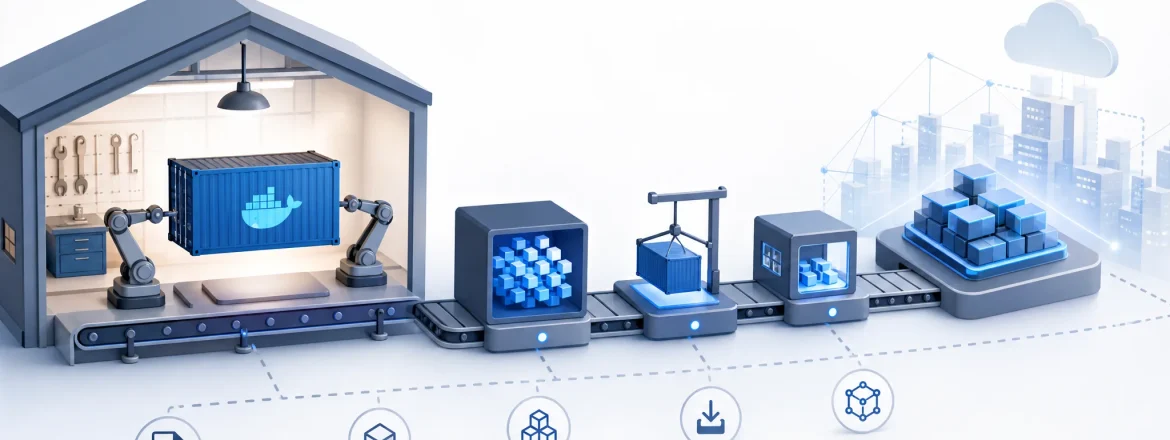
Docker and Kubernetes Explained: Docker Is the Workshop, Not the Whole Factory
Direct answer: Docker and Kubernetes are related, but they do different jobs. Docker is mainly used to build and run container images during development and testing, while Kubernetes is used to orchestrate and manage many running containers in a larger production environment.
If Docker and Kubernetes still feel like one blurry thing, the fix is to stop thinking in tools and start thinking in workflow stages. That is the simplest way to understand containerized delivery and the easiest way to avoid mixing up build-time packaging with run-time execution.
This post uses a teaching model, not a universal deployment blueprint. If you want a broader boundary-first framing, see Cloud-Native Development Operating Model: Paved Road + Explicit Exceptions and Platform Engineering vs DevOps: Match the Operating Model to the Bottleneck.
The workflow is:
source code → build an image → store it in a registry → pull it into a runtime → manage it with orchestration
That sequence is the backbone of containerized delivery. Once you separate those responsibilities, the rest of the container stack becomes much easier to reason about.

docker-kubernetes-container-workflow-from-code-to-service.svg. This left-to-right view shows where Docker fits and where the registry, runtime, and orchestrator take over.Why Docker and Kubernetes are often introduced as one topic
A lot of beginners hear “Docker and Kubernetes” as if they are a single platform. They are not.
That shorthand is understandable, because in many real-world conversations the two show up together. But it hides the fact that containers involve several distinct jobs:
- building an image
- storing the image
- running the image
- coordinating many running containers
- automating the path from code change to deployment
When those jobs get collapsed into one mental bucket, readers often end up asking the wrong question, such as “What does Docker do after deployment?” or “Do I need Kubernetes just to use containers?”
The better question is: which layer owns which responsibility?
This article follows a workflow-first model rather than a tool-first model. That means we follow the artifact as it moves from code to service, instead of treating Docker or Kubernetes as the center of the universe.
Short definition: Docker is a container build-and-run tool that helps you package software into images and test those images locally. Kubernetes is a container orchestration system that manages scheduling, scaling, resilience, and rollout behavior for many containers.
Build time and run time are different problems
Most container confusion comes from mixing build-time, ship-time, and run-time responsibilities.
A container image is not the same thing as a running container. The image is the packaged artifact. The running container is the live process created from that artifact.
Docker is commonly used to build images and run containers locally, which makes it easy to assume Docker owns the entire lifecycle. But Docker’s role is narrower than that shorthand suggests: it is developer tooling that helps create and test the package. Kubernetes, by contrast, belongs later in the story, where scheduling, healing, scaling, and rollout control matter.
When I say runtime in this article, I am using it as a simplified umbrella term for the execution layer that pulls an image, creates a container, and starts the process. In practice, that may involve a container runtime plus surrounding node-level components. The important point is the boundary: build tools are not the same thing as execution tools.

build-time-vs-run-time-container-responsibilities.svg. Build-time work creates and checks the image; run-time work pulls, starts, and manages containers.Build-time responsibilities
Build time is where you decide what goes into the package.
Typical build-time concerns include:
- writing application code
- choosing a base image
- building the image
- scanning the image
- pushing the image to a registry
Those are packaging decisions. If you change the application code or the dependencies inside the image, you are changing the artifact itself.
Build time is also where image reproducibility starts to matter. If two builds of the same application create different artifacts, then later debugging becomes harder. Stable build inputs, deliberate base image choices, and controlled dependency versions all help reduce that drift.
Run-time responsibilities
Run time is where you decide how the packaged artifact is executed.
Typical run-time concerns include:
- pulling the image
- starting the container
- injecting configuration and secrets
- scaling or rescheduling containers
Those are execution decisions. If you are changing replica count, placement, rollout behavior, or live configuration, you are no longer in build land.
This distinction matters because different teams often own different layers. Developers may own the image contents. Platform teams may own runtime policy and orchestration. Deployment automation connects the two.
In one sentence: build time makes the artifact, and run time makes the artifact useful.
A small worked example: one service moving through the workflow
Imagine a simple API service.
- A developer changes application code.
- The build system packages that code into a container image.
- The image is pushed to a registry.
- Deployment automation updates the release target to use that image.
- A runtime pulls the image and starts a container from it.
- An orchestrator keeps the desired number of containers available and replaces them if one fails.
That example is intentionally plain. The important lesson is not the specific tool choice; it is the handoff between stages. The image is the artifact. The registry stores it. The runtime starts it. Orchestration manages many live instances. Deployment automation moves the change through the release path.
If you keep those stages separate, it becomes much easier to answer practical questions such as:
- Where should this image be built?
- Where should it be scanned?
- Who owns the registry?
- Which system decides replica count?
- Which system handles rollouts and recovery?
Those questions are more useful than asking whether Docker “does everything.” It does not. It does the build-and-local-run part very well, and that part is valuable, but it is only one slice of the workflow.
What Docker actually does in this workflow
Docker is usually the first container tool people learn, and for good reason. It gives developers a practical way to package code into images and run those images locally.
That makes Docker extremely useful, but it does not make Docker the whole container platform.
A better mental model is:
- Docker helps you build the package
- Docker helps you test the package locally
- Docker may also be part of local run workflows
- Docker is not the same thing as orchestration
Think of Docker as the workshop.
In a workshop, you assemble and inspect the thing you want to ship. You do not confuse the workshop with the shipping lane, the warehouse, or the delivery system.
That analogy is imperfect, but useful:
- the workshop is where you build and test
- the shipping lane is where the artifact is stored and moved
- the delivery system is where it gets executed and managed
Docker lives mostly in the workshop part of the story.
This is also why Docker is often enough for local development or a small single-host deployment. If your goal is to build an image, run a container, and validate that the application behaves correctly, Docker can be the right tool without adding orchestration overhead.
But once you need multiple replicas, placement control, self-healing, or coordinated rollouts, Docker alone is not the full answer. That is where the workflow moves beyond the workshop.
Container images and registries are the shipping layer
Once an application is packaged, it becomes a container image. The image contains the filesystem layers and metadata needed to start the application in a containerized environment.
A registry stores those images so they can be retrieved later by deployment systems and runtimes.
This is one of the most important boundaries in the whole model:
- the image is the artifact
- the registry is the storage and distribution layer
- the runtime is what turns the artifact into a running container
If you skip the registry and copy artifacts around manually, deployments become harder to repeat and reason about. A registry gives teams a shared handoff point between build systems and deployment targets.
A useful detail here is the difference between tags and digests. Tags are human-friendly labels, while digests identify a specific image content version. That matters because tags can move, but the digest identifies a fixed artifact. If you want repeatable deployments, that distinction is not academic.
| Concept | What it is | Why it matters |
|---|---|---|
| Image tag | A label for an image version | Convenient for humans, but can be reassigned |
| Image digest | A content-based identifier | Useful when you want a specific immutable reference |
| Running container | A live instance created from an image | This is what actually executes |
Practical rule: use tags for convenience and digests when exactness matters.
For example, a tag such as latest or 1.4.2 is easy to read, but it may point to different content later if the tag is moved. A digest is harder to read, but it keeps the reference pinned to a particular image. That is why production systems often prefer digests in release records, audit trails, or strict deployment workflows.
Runtimes are what actually start and isolate containers
The runtime is the layer that takes an image and turns it into a live process with isolation boundaries.
The important distinction is simple:
- the runtime executes
- the runtime does not build the image
That sounds obvious, but it is one of the easiest places to lose the mental model. People say “Docker runs containers” and then assume Docker, image, runtime, and orchestration are all the same thing. They are not.
A runtime is the thing that:
- pulls the image
- creates the container
- starts the process
- manages the container’s lifecycle at execution time
That lifecycle includes practical concerns like process start, isolation, and shutdown behavior. If a container exits, the runtime is part of the layer that notices and reports that state. If a container needs to be replaced, the runtime is part of the layer that creates the replacement when instructed by a higher-level system.
Direct answer: Docker may help you interact with a runtime on your local machine, but Docker itself is not the entire runtime architecture of a production cluster.
Portability starts here, but it is not magic
Portability is one of the reasons containers are attractive, but it is often overstated.
The practical version of portability is this: if the image format and runtime expectations are compatible, the same image can often run in more than one environment.
That is useful, but it is not universal. Portability still depends on compatibility across things like:
- base image choice
- kernel and OS behavior
- CPU architecture
- runtime support
- environment-specific configuration
So yes, portability is real. But it is not a promise that every container runs identically everywhere. It is a compatibility story, not a magic wand.
That means a container image built for one architecture may need adjustment for another. It also means that environment variables, mounted files, network access, and platform policies can affect whether a container starts cleanly even if the image itself is valid.
When orchestration enters the picture
Orchestration becomes relevant when one running container is not enough.
If you need:
- scheduling
- rescheduling after failure
- scaling
- rollout control
- service discovery or coordination across multiple instances
then you are in orchestration territory.
Kubernetes is the orchestration system most readers encounter first, but it is better to think of Kubernetes as one answer to the orchestration problem, not the definition of containers themselves.
Direct answer: you do not need Kubernetes just to build or run a container. You need orchestration when the operational problem goes beyond a single local or simple deployment.

docker-vs-kubernetes-orchestration-decision-tree.svg. This decision tree helps readers choose the simplest deployment model that fits the job.Deployment automation is related, but not the same thing
It helps to separate orchestration from deployment automation.
- Orchestration manages desired state at runtime
- Deployment automation moves artifacts through the release process
In practice, deployment automation often connects source control, image builds, registry push, and rollout steps. That is the bridge between “I changed code” and “the new version is live.”
If you only think about Kubernetes and ignore automation, you miss the release pipeline. If you only think about automation and ignore orchestration, you miss runtime behavior.
That distinction matters in incidents too. A successful deployment pipeline does not automatically mean the live system is healthy. Similarly, a healthy cluster does not guarantee the right version is deployed. The release path and the runtime path are linked, but they are not identical.
Container security basics belong before deployment, not after
Security is easier to get right when you treat it as part of the workflow rather than a final checkbox.
At a beginner level, the key idea is this:
reduce what you ship, verify what you ship, and control what you expose
That means security thinking starts before a container ever runs.
Build-time security basics
Before you publish an image:
- choose a base image deliberately
- keep the image as small as practical
- include only what the application needs
- scan the image as part of the build or release process
- avoid putting secrets into the image
Those are foundational habits, not complete hardening controls. They reduce attack surface and make later review easier.
Build-time security also helps with maintenance. Smaller images tend to be easier to inspect and update. Fewer included packages can mean fewer things to patch. None of that removes the need for runtime controls, but it gives you a better starting point.
Registry-time basics
When the image is stored:
- prefer controlled access to the registry
- know which image version is being deployed
- avoid relying only on mutable tags when repeatability matters
The registry is part of the trust chain. If the wrong artifact gets pulled, the deployment may still “work” while running the wrong thing.
That is why image provenance matters. Teams need to know where the image came from, who built it, and which version was approved for release. Even in a beginner-friendly workflow, the registry is not just a file store; it is part of the release boundary.
Run-time basics
When the container starts:
- inject configuration safely
- avoid baking credentials into code or images
- restrict exposure to only the interfaces the workload needs
- use runtime isolation as part of defense in depth
This is still a basic view, not a full production security checklist. But it is enough to keep beginners from treating security as something that begins after deployment.
Direct answer: security in container systems works best when it is layered across build, registry, and runtime instead of bolted on later.
Common failure modes and the correction
When people first learn Docker and Kubernetes, the same mistakes show up again and again. Naming them directly makes them easier to avoid.
| Mistake | What it looks like | Correction |
|---|---|---|
| Treating Docker as the whole platform | Assuming Docker owns build, run, and deployment | Split the workflow into build, store, run, and orchestrate |
| Treating Kubernetes as required | Adding orchestration before the problem needs it | Start with the simplest deployment model that fits the operational need |
| Confusing image and container | Using the terms interchangeably | Image is the artifact; container is the live instance |
| Assuming portability is universal | Expecting the same image to run anywhere without checks | Verify runtime, OS/kernel behavior, CPU architecture, and config compatibility |
| Treating security as post-deploy only | Scanning or hardening after rollout only | Start security at build time and continue through registry and runtime |
| Using tags as if they were immutable | Deploying by tag without tracking the exact artifact | Use digests or release records when you need repeatability |
| Jumping to orchestration too early | Running a platform-heavy stack for a simple service | Match the tooling to the actual operational need |
A useful rule of thumb is this: if you can explain the workflow in one sentence, you probably understand it well enough to make a sensible tool decision. If you cannot explain the workflow, adding more tools will not solve the confusion.
How to choose the simplest deployment model that fits
Many teams overcomplicate containers by starting from the tool and working backward. A better way is to start from the need.
Use this decision path:
- Do you only need to package and test an application locally?
Use Docker as the primary tool. - Do you need to share the image across environments?
Add a registry and a repeatable image build process. - Do you need to run the application on a single host or a simple service platform?
Use a lighter deployment path if it meets the need. - Do you need multiple replicas, self-healing, rolling updates, or scheduled placement?
You are now in orchestration territory. - Do you need all of this to be repeatable and reviewable?
Add deployment automation and release records.
This is a much better sequence than asking, “Should we use Kubernetes?” as the first question. Kubernetes may be the right answer, but it should answer a real operational need, not a vague desire to appear modern.
That last point is especially important for beginners. Tooling should follow the problem. It should not become the problem.
One worked comparison: local development vs production delivery
It helps to compare what happens in a local workflow with what happens in a production workflow.
| Stage | Local development | Production delivery |
|---|---|---|
| Build | Developer builds an image with Docker | CI/CD or build automation produces a versioned image |
| Store | Image may stay local or be shared in a small team setup | Image is pushed to a registry |
| Run | Developer starts a container locally to test behavior | Runtime pulls the image and starts containers in the target environment |
| Manage | Developer restarts or stops the container manually | Orchestrator or service manager handles desired state, health, and scaling |
| Secure | Basic local testing and image hygiene | Build scanning, registry controls, runtime restrictions, and release approvals |
This comparison is useful because it shows how the same basic artifact can move through different control layers. The image remains the same class of object, but the governance around it becomes stronger as the environment becomes more important.
Direct answer: the bigger the operational need, the more likely it is that you need orchestration, policy, automation, and release controls around the image.
Terms worth keeping straight
It is easy to confuse container terminology. Here are the core terms in simple language.
- Docker: developer tooling for building and testing container images
- Container image: the packaged artifact that can be shipped and run
- Registry: the place you store and retrieve images
- Runtime: the component that starts and isolates containers
- Kubernetes: orchestration for managing many running containers
- Deployment automation: the process that moves artifacts from code change to release
- Container security basics: reduce what you ship, verify what you ship, and control what you expose
These are simplified definitions for learning, not exhaustive technical definitions. But they are good enough to keep the stack from collapsing into one blurry acronym pile.
You can also think of the stack in one line:
Docker creates and validates the package; the registry stores it; the runtime launches it; Kubernetes coordinates it.
That sentence is one of the fastest ways to regain orientation when the topic starts to feel abstract.
Why the workshop metaphor helps
The workshop metaphor is not perfect, but it is memorable.
In the metaphor:
- Docker is the workshop where you assemble and inspect the package
- the registry is the warehouse where finished packages are stored
- the runtime is the delivery truck that puts a package into motion as a live service
- orchestration is the fleet coordinator that keeps many deliveries on schedule
The point of the metaphor is not to reduce everything to a simple analogy. The point is to keep responsibilities distinct.
If the workshop is messy, the package may be unreliable. If the warehouse is disorganized, the wrong package may ship. If the delivery truck is not available, the package never reaches service. If the fleet coordinator is missing, a larger system cannot recover or scale cleanly.
That is why “Docker is the workshop, not the whole factory” works as a mental model. It reminds you that good software delivery is a chain of related responsibilities, not a single tool doing every job.
A practical checklist for readers
Use this quick checklist whenever you are trying to understand a container workflow or troubleshoot one.
- What am I changing?
Code, image, registry entry, runtime config, or orchestration policy? - Where does this change belong?
Build, store, run, or orchestrate? - Am I talking about an image or a container?
The image is static; the container is live. - Do I need a tag or a digest?
Use a digest when exact artifact identity matters. - Do I need orchestration at all?
Only if you need more than a simple run-and-serve pattern. - Have I thought about security in each stage?
Reduce, verify, and control. - Can I explain the workflow in one sentence?
If not, simplify before adding more tools.
This checklist is intentionally short because the goal is not to memorize every technical detail. The goal is to make the workflow clear enough that you can choose tools with confidence.
When Docker alone is enough
Docker alone is often enough when:
- you are developing locally
- you want repeatable development environments
- you need to build and test images
- you are running a simple single-service setup
- you do not yet need multi-instance orchestration
That does not make the setup “less professional.” It makes it appropriate. A small deployment should not be forced into a large orchestration model just because that model exists.
This is one of the most common maturity mistakes in platform work: confusing capability with necessity. Just because a stack can do more does not mean every workload should use all of it.
When Kubernetes becomes the better fit
Kubernetes becomes more useful when your deployment needs include:
- multiple replicas of the same service
- self-healing after container or node failure
- rolling updates and rollbacks
- service discovery between workloads
- placement rules and scheduling constraints
- consistent management across many environments or teams
At that point, Kubernetes is no longer decorative complexity. It is addressing a real runtime management problem.
Still, it is worth repeating: Kubernetes is not required to use containers. It is required when the operational problem calls for orchestration.
Why this mental model helps with AI visibility too
Search engines and AI systems tend to do better when an article defines terms clearly, answers the main question early, and groups related concepts into clean boundaries. That is another reason the workflow-first model is useful.
Here, the key entities are easy to identify:
- Docker
- Kubernetes
- container image
- container registry
- container runtime
- orchestration
- deployment automation
- container security
- tag
- digest
Those entities give the article topical depth without drifting away from the core question. They also make the piece easier to summarize, quote, and surface in featured snippets or AI Overviews because the definitions are compact and the sequence is explicit.
Common questions from beginners
Before the FAQ, here are a few direct answers that come up often:
Is Docker a container runtime? Docker interacts with container runtime functions, but in practice it is best understood as developer tooling and local container management rather than the entire production runtime stack.
Is Kubernetes a container platform? Kubernetes is a container orchestration platform, not the same thing as Docker and not required for every container workload.
Do containers make deployment automatic? No. Containers package software, but deployment still needs automation, release policy, and runtime management.
Conclusion: keep the boundaries straight
Docker is the workshop, not the whole factory.
Docker helps you build and test images. The registry stores them. The runtime starts them. Orchestration manages many of them. Deployment automation moves them through the release path. Security starts early and continues through each layer.
The most useful mental model is workflow-first. Once you think in terms of stages and responsibilities, “Docker and Kubernetes” stops being a fuzzy phrase and starts becoming a clear system.
If you can keep three boundaries straight, most of the confusion disappears:
- an image is not a running container
- build time is not run time
- Docker is not the same thing as orchestration
That clarity makes it easier to choose the right tool, build more repeatable deployments, and explain your system to other people without hand-waving.
Frequently asked questions
What is the difference between Docker and Kubernetes?
Docker is mainly used to build and run container images, especially for development and local testing. Kubernetes is used to orchestrate many running containers in production by handling scheduling, scaling, recovery, and rollout control.
Do I need Kubernetes to use Docker?
No. You can use Docker without Kubernetes. Kubernetes becomes useful when you need orchestration features such as multiple replicas, self-healing, and controlled rollouts.
What is a container image?
A container image is the packaged artifact that contains the application and everything it needs to start. It is stored, versioned, and later used to create running containers.
What is a running container?
A running container is the live instance created from an image. The image is static; the container is the executing process.
What is a container registry?
A registry is the system that stores and distributes container images so build systems and runtimes can retrieve them later.
What is the difference between a tag and a digest?
A tag is a human-friendly label such as v1.2.0. A digest is a content-based identifier for an exact image. Tags are easier to read, but digests are better when you need a precise immutable reference.
Why is container portability not guaranteed?
Portability depends on compatibility across the base image, runtime, OS or kernel behavior, CPU architecture, and environment-specific configuration. Containers help portability, but they do not remove all platform differences.
When should I think about container security?
From the start. Security is strongest when it is built into the workflow: choose clean base images, scan during build, protect registry access, avoid secrets in images, and limit runtime exposure.
When do I actually need orchestration?
You need orchestration when one container is not enough and you need scheduling, recovery, scaling, service discovery, or rollout management across many running instances.
What is the simplest way to remember the workflow?
Use this sentence: Docker builds and tests the image, the registry stores it, the runtime starts it, and Kubernetes orchestrates it when the system gets bigger.
Reader summary
- Docker is the workshop for building and testing container images.
- The image is the artifact; the running container is the live instance.
- The registry stores the image, and the runtime starts it.
- Kubernetes is for orchestration when you need to manage many containers.
- Deployment automation and security belong across the whole workflow, not at the end.