

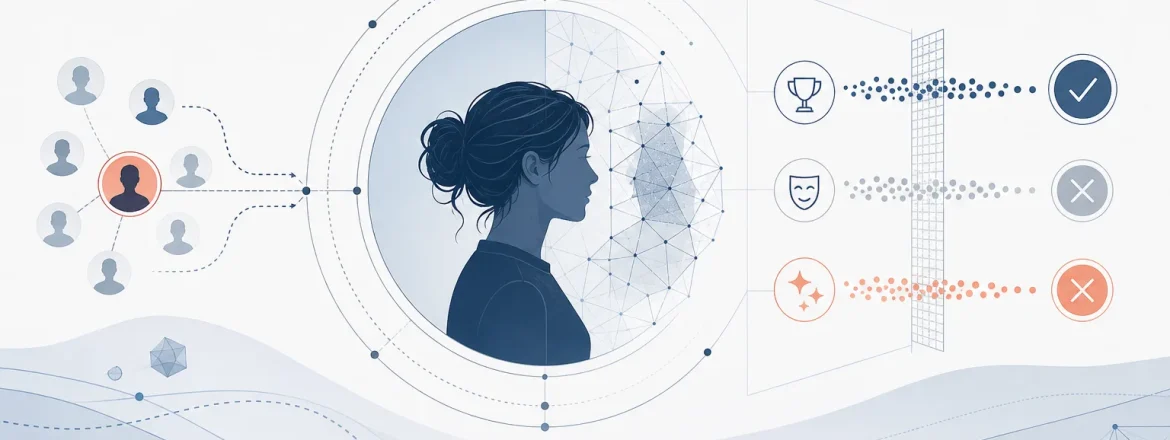
Hiring Authenticity Meaning: A Practical Definition for Interviews
Quick answer: Hiring authenticity meaning is truthful, consistent self-presentation under pressure—a coherence signal you can test using evidence from a candidate’s story, signals, and behavior in the interview loop.
Most hiring teams say they want “authentic” candidates. The problem is that the term is usually undefined. One interviewer hears “consistent narrative.” Another hears “credible vibe.” A candidate hears “be yourself,” then tries to be unfiltered. When everyone means something different, debriefs drift into preferences, arguments, and unclear decisions.
This guide turns hiring authenticity meaning into a shared, auditable decision lens. You’ll get a plain-English definition, what it is (and is not), how to evaluate it with a coherence framework, and templates you can use in structured interviews and interviewer debriefs.

Suggested filename: same-word-different-meanings-hiring-authenticity.svg
Hiring authenticity meaning in plain English (the definition you can use)
Answer: For hiring purposes, hiring authenticity meaning is truthful, consistent self-presentation under pressure.
That sentence is intentionally compact. Here’s what each part contributes to a repeatable hiring standard:
- Truthful: the candidate’s account points to evidence you can validate directly (through specifics, artifacts, and examples) or indirectly (through triangulated signals).
- Consistent: details line up across time and contexts—what they said earlier matches what they say when probed later.
- Self-presentation: this is about how they describe their work, decisions, ownership, and reasoning—not about whether they are “a good person.”
- Under pressure: the interview applies clarification, specificity, and probing until vague claims must become concrete.
Coherence is the core mechanism. You’re not trying to catch someone lying. You’re trying to determine whether their story and evidence behave like a coherent account for this hiring context.
Hiring authenticity meaning: what “under pressure” does (and doesn’t) mean
Answer: “Under pressure” means probing for specifics, not hostility.
- Does mean: follow-ups that request details, tradeoffs, before/after, ownership boundaries, and uncertainty.
- Doesn’t mean: interrogation, humiliation, or “gotcha” tactics.
- Design implication: your interview questions should be structured enough that probing is fair and consistent across candidates.
Why teams struggle with authenticity in hiring (and why it becomes a slogan)
Answer: “Authenticity” is popular because it sounds humane and positive—yet it’s often used without a rubric or evidence standard.
When leaders say they value authenticity, they may mean:
- Recruiters want a fast way to describe the candidate they’re excited about.
- Hiring managers want someone credible who “makes sense” during conversation.
- Candidates want clarity about expectations and fear being misjudged.
- Teams want a culture-aligned description they can repeat consistently.
The issue is that those meanings are not interchangeable. If hiring authenticity meaning isn’t translated into evidence-based evaluation, it becomes a slogan—“We value authenticity”—instead of a decision criterion.
Common drift: from “authenticity” to moral judgment
Answer: Undefined authenticity tends to drift into slogan or moral test patterns.
Both are dangerous, even when everyone thinks they’re doing the right thing.
| Failure mode | What it looks like in real hiring | Why it harms decisions |
|---|---|---|
| Slogan | “We value authenticity,” but no shared definition, probing style, or evidence standard. | The word replaces the rubric. You don’t improve evaluation quality—you just rename it. |
| Moral test | Calling candidates “authentic / not authentic” based on interviewer comfort or personal beliefs. | You convert preference into a criterion, which makes hiring harder to audit and easier to bias. |
| Oversharing trap | Equating candor or emotional disclosure with the “real” authenticity signal. | You reward disclosure over coherence, increasing noise and inconsistency across interviewers. |
| Similarity bias | Rewarding one narrow communication style, then labeling it “authentic.” | It confuses familiarity with credibility and can exclude valid ways of being truthful and coherent. |
| Polish ≠ coherence | Equating smooth delivery with truthfulness or competence. | Articulate answers can still be vague. Coherence under probing is the more reliable signal. |
A working definition of hiring authenticity meaning (and its boundaries)
Answer: Hiring authenticity meaning is truthful, consistent self-presentation under pressure—coherence you can evaluate using evidence.

Suggested filename: hiring-authenticity-meaning-what-it-is-not.svg
Notice what this definition intentionally does and does not do.
- Truthful points to evidence you can verify (directly or indirectly) through the process.
- Consistent points to alignment across time, stories, and specifics.
- Under pressure points to probing moments where vague answers are clarified and tested.
The goal is decision clarity. Coherence is the signal. The outcome is a better hiring judgment you can explain in debriefs.
Hiring authenticity meaning is a practical hiring definition (not a universal psychology label)
Answer: This definition is designed for hiring workflows and interview evaluation—so teams can make repeatable judgments about signals and evidence.
It’s not meant to score personality traits. It’s meant to clarify what teams should observe, how they should probe, and how they should talk about what they found.
What hiring authenticity meaning is not
Answer: Authenticity is not the same thing as perfection, polish, performance, or unfiltered disclosure.
“Not this” table: hiring authenticity meaning boundaries
| Not this | Why it’s the wrong frame |
|---|---|
| Perfection | A candidate can be credible without flawless answers. Incoherence is the issue, not imperfection. |
| Polish | Smooth delivery can hide weak evidence. Articulate does not automatically mean coherent across contexts. |
| Performance | Saying the “right” things isn’t the same as being consistent about evidence, scope, and ownership. |
| Unfiltered disclosure | Authenticity doesn’t require oversharing, emotional dumping, or saying every thought without boundaries. |
Why those boundaries matter:
- Candidates shouldn’t assume authenticity requires recklessness or oversharing.
- Employers shouldn’t assume a reserved or coached presentation automatically equals “inauthentic.”
Adjacent terms (and why they’re weaker unless you translate them)
Answer: Words like culture fit, confidence, or “feels right” can help, but they often hide ambiguity unless you translate them into observable evidence.
A practical way to prevent authenticity from being swallowed by buzzwords is to compare adjacent concepts to the coherence-based standard.
Comparison table: coherence-based authenticity vs. common hiring proxies
| Concept | What it often turns into in hiring | Why it’s weaker than hiring authenticity meaning (coherence) |
|---|---|---|
| Authenticity | Truthful, consistent self-presentation under pressure (strong only when defined) | Strong when tied to evidence categories (story, signals, behavior) and shared debrief language. |
| Culture fit | Comfort, similarity, shared style, or preference overlap | Can measure preference more than credible signals; can drift into sameness bias. |
| Confidence | Delivery style or assertiveness | A confident answer can still be hollow. Confidence doesn’t guarantee coherent evidence. |
| Likability | Interpersonal ease | Not the same as trustworthiness, evidence alignment, or role-relevant credibility. |
| “Feels right” | Unspecified intuition | Hard to defend, compare, and audit in debriefs without translation to evidence. |
How to use adjacent terms safely: if your team uses culture fit or confidence, ask: What evidence would make this claim true? Then evaluate that evidence using a shared framework.
The best lens: evaluate hiring authenticity meaning through coherence across three areas
Answer: The most useful lens is coherence across story, signals, and behavior.
When teams use this lens, conversations become:
- less about vibes
- more about alignment
- more about what holds up when you probe

Suggested filename: evaluate-authenticity-coherence-story-signals-behavior.svg
Below are concrete, interview-ready ways to apply this framework.
1) Story: does the narrative stay coherent over time?
Answer: A coherent story is internally consistent—timeline, motivations, role changes, and examples fit together without obvious strain.
You don’t need drama. You need consistency. The interview’s job is to ask questions that reveal whether the candidate can maintain their account when you request specifics.
Good signals in a story often include:
- clear timeline or understandable sequence of events
- consistent reasons for transitions (why they moved roles, what changed)
- examples that match the stated role, scope, and level
- tradeoffs that sound like real decisions (not generic statements)
Story red flags to probe (not to label immediately) include:
- dates, scope, or responsibilities that shift when asked for detail
- role claims that conflict with later descriptions of what they did
- motivations that change without explanation
Prompt idea: ask the candidate to connect the dots between “what,” “why,” and “what changed.”
- “Walk me through how this started, what changed, and what you personally owned.”
- “What was the turning point, and what evidence made it the turning point?”
- “How did the plan evolve once you learned the first version didn’t work?”
Practical note: inconsistent story details don’t automatically equal dishonesty. They can indicate missing context, recall limitations, or confusion. The right response is to ask better follow-ups and collect enough evidence to reduce uncertainty.
2) Signals: do the resume, interview answers, references, and work samples reinforce each other?
Answer: Single signals can mislead. Aligned signals create a more trustworthy picture of coherence.
Signals are the inputs you triangulate. Depending on your hiring process, signals can include:
- resume or LinkedIn claims
- interview examples and scope descriptions
- work samples or artifacts
- references (where appropriate)
- collateral evidence (project documentation, presentations, pull requests, demo recordings)
When hiring authenticity meaning is applied properly, your team doesn’t say “they didn’t feel authentic.” Instead you translate the concern into observable discrepancies.
- “The resume claims X, but the interview examples emphasize Y.”
- “The candidate describes ownership broadly, but the artifact suggests narrower responsibility.”
- “We have conflicting signals about timeline or scope; we need follow-ups or more evidence.”
Important distinction: conflicting signals are an information problem, not a moral verdict. The correct question is: What evidence would resolve the mismatch?
That mindset keeps authenticity grounded in uncertainty handling rather than moral judgment.
3) Behavior: do answers stay direct and consistent when probed?
Answer: Under pressure, credible candidates can acknowledge limits, explain tradeoffs, and maintain coherence when questions get specific.
Behavior shows up in how someone responds to:
- follow-up questions that request specifics
- requests for concrete examples (before/after, what changed)
- clarifying prompts that reduce ambiguity
- questions about what they didn’t do
- questions about uncertainty (“what would you validate?”)
What “under pressure” doesn’t mean: it doesn’t mean hostile interrogation. It means testing whether vague claims become concrete accounts.
Example pressure question types you can use without creating a hostile vibe:
- Specificity: “What exactly did you change?” “What was the before/after?”
- Ownership: “Which decisions were yours, which were shared, and which happened without you?”
- Uncertainty: “Where are you less certain?” “What data would you check next?”
- Tradeoffs: “What did you give up to get this result?”
The real hiring question becomes:
Is the signal coherent enough for this hiring context?
Employer-side standard: consistency, specificity, and trustworthiness
Answer: Hiring authenticity meaning shouldn’t be a purity test. It’s a trustworthiness question: does this person’s account seem reliable enough to represent themselves and their work accurately?
To make the standard observable, translate hiring authenticity meaning into three evaluation criteria:
- Consistency: do details line up across story, signals, and behavior?
- Specificity: are examples concrete, or mostly general claims?
- Trustworthiness: does the candidate answer in a way that makes it reasonable to rely on their account?
Also separate experience from interpretation in your internal notes:
- “I felt comfortable with them” (a perception)
- versus “The evidence was coherent across multiple signals” (an evaluable standard)
Make the team’s language auditable (replace “inauthentic” with evidence)
Answer: If the team can’t point to evidence, it shouldn’t call the issue authenticity.
A simple team practice:
- When someone says “inauthentic,” require them to specify which part of the story/signals/behavior broke coherence and what question exposed it.
- When someone says “authentic,” require them to name the specific coherence they observed (story consistency, signal alignment, or behavior under probing).
This changes debriefs from:
- “What did you feel?”
to:
- “What evidence did you observe, and what did it imply about coherence for this role?”
Extra note: If your process rewards only one communication style as “authentic,” you’ve turned hiring authenticity meaning into exclusionary preference. If communication style truly matters for the job, spell it out as a job requirement—but don’t assume style equals truth.
Candidate-side standard: be authentic without being reckless
Answer: Candidates don’t need to reveal everything to be authentic. Prepared, bounded answers can still be truthful and credible.
In hiring conversations, preparation often improves clarity. The goal is not to sound spontaneous at the cost of coherence. The goal is to represent experience accurately, including ownership boundaries and uncertainty.
What “authentic candidate behavior” usually looks like
- framing experience honestly (what happened and why)
- stating what they did vs. what they contributed to
- explaining tradeoffs and decision reasoning
- acknowledging uncertainty when it exists (and what they would validate)
- keeping examples consistent across interview questions
Candidate framing: copy this / don’t copy this
| Copy this | Don’t copy this |
|---|---|
| “The resume, example, and reference all point to the same timeline and scope.” | “They just didn’t feel authentic.” |
| “When asked for specifics, I can describe what I changed, why I changed it, and what happened next.” | “I’m not sure, but something felt off.” |
| “We still lack enough evidence to conclude X, so here’s what I would validate next.” | “My vibe is that it worked.” |
| “Hiring authenticity meaning is truthful, consistent self-presentation under pressure—so I’ll share the parts I can support with specifics.” | “Authenticity means being unfiltered.” |
Boundaries are not dishonesty. You can be authentic while keeping answers focused on evidence-relevant details.
If you want a related perspective on decision boundaries and when to escalate or stop, see:
Structured hiring: how to apply hiring authenticity meaning consistently
Answer: To apply hiring authenticity meaning consistently, you need a lightweight rubric, a debrief structure, and a consistent probing pattern.
Below is a step-by-step workflow you can adopt without turning interviews into a bureaucratic process.
Step-by-step: using the coherence framework in a hiring loop
-
Write the definition in plain language and use it as the rubric anchor:
Hiring authenticity means truthful, consistent self-presentation under pressure.
Then decide what “under pressure” means for your team’s interviews (e.g., “follow-ups that request specifics and ownership.”)
-
Agree on evidence categories your team will treat as “signals,” such as:
- story consistency
- specificity and ownership clarity
- artifact alignment (where available)
- uncertainty handling (did they acknowledge limits?)
-
Use a consistent probing pattern so “pressure” is fair. For example, every interviewer covers:
- timeline + motivations
- scope/ownership boundaries
- tradeoffs and before/after
- uncertainty (what would they validate?)
-
Debrief with evidence separation:
- Observations: what the candidate said, and what artifacts/signals show (if any).
- Inferences: what the observations imply about coherence for this role.
-
When signals conflict, slow down instead of labeling “inauthentic.” Treat it as an information gap:
- ask follow-ups
- request collateral evidence
- consider whether the role truly requires that specificity level
-
Calibrate language:
- Replace “vibes” with evidence-based phrasing (e.g., “inconsistent timeline details when probed,” “artifact scope doesn’t match described ownership”).
- Replace “authentic” with “coherence observed in story/signals/behavior.”
Debrief checklist (use in the meeting)
- What evidence supports the candidate’s story?
- Do resume claims, interview answers, references (if used), and samples reinforce each other?
- Where does story coherence look strong?
- Where do signals align—or diverge?
- Did the candidate answer directly when probed for specifics?
- How did they handle uncertainty (acknowledge limits, propose validation steps)?
- Are we describing evidence, or just a feeling?
Worked examples: what coherence under pressure looks like
Answer: The coherence framework produces more useful hiring judgments because it describes alignment and gaps in signals—not just labels a candidate as “authentic” or “inauthentic.”
Example 1: Senior engineer candidate with partial coherence
Scenario: A hiring team is debriefing a senior engineer candidate. The resume suggests they led a platform migration. In the interview, they describe their role as coordinating stakeholders. When probed for technical details and decision specifics, they can only give high-level summaries. A reference later confirms they were important in the project but not the primary technical owner.
Coherence-based debrief (what the team says):
- The story has partial internal consistency (timeline and overall involvement align).
- Signals mostly align on involvement but diverge on ownership and technical depth.
- The evidence does not support the stronger claim (primary technical ownership at the level expected for the role).
What they avoid: “They were not authentic.”
Why this is more useful: it creates a clear information gap: the mismatch is about scope and evidence quality, not morality.
Example 2: Candidate who is specific but uncertain (high coherence, honest limits)
Scenario: A candidate gives specific examples with clear ownership boundaries. When asked about an area outside their experience, they don’t guess. They explain what they would check and what data they’d need to make a decision.
Coherence-based debrief:
- Story coherence is strong because motivations and examples match the timeline.
- Signals align because artifacts and references support ownership and scope.
- Behavior under pressure is coherent because uncertainty is acknowledged without breaking the narrative structure.
Key point: authenticity here isn’t “knowing everything.” It’s being truthful and consistent when the conversation gets specific.
Example 3: Candidate who sounds polished but diverges under probing
Scenario: A candidate delivers smooth, articulate answers. But when probed for specifics (tradeoffs, before/after, precise decisions), their story shifts. The resume suggests one scope, but interview examples emphasize a different layer of responsibility. Any collateral evidence available supports the narrower scope.
Coherence-based debrief:
- Story coherence weakens when specific details are requested.
- Signals diverge (resume scope vs. interview examples vs. available collateral).
- Behavior under pressure becomes inconsistent because they cannot maintain the same evidence level about ownership and decisions.
Key point: the team doesn’t label the candidate’s “soul.” The team says the coherence signals are not consistent enough for this role’s expectations.
AI and automation in hiring: where hiring authenticity meaning can get distorted
Answer: When hiring uses AI tools, the risk is treating AI outputs as authority and skipping human evidence triangulation.
Hiring authenticity meaning requires coherence checks across story, signals, and behavior. If the team relies only on an automated proxy (for example, a summary of an answer without probing context), it can misread confidence, delivery style, or completeness.
If your team uses AI in workflows (screening, summarization, interview assistance), consider pairing it with human review and explicit decision gates.
Practical guidance when AI is involved
- Use AI summaries as prompts, not as the coherence verdict. Humans should still ask follow-up questions for specifics and ownership.
- Require quoted specifics in the debrief: reference what the candidate said, not just what the model paraphrased.
- Calibrate the “under pressure” step: ensure humans run probing questions rather than trusting delivery impressions.
- Separate perception from evidence: translate “feels credible” into story/signals/behavior checks.
In other words: AI can support workflow speed, but hiring authenticity meaning should still be evaluated using a coherence-based human lens.
Hiring authenticity meaning as signal detection (a helpful mental model)
Answer: Treat hiring authenticity like signal detection: you’re looking for coherent evidence under uncertainty, not searching for a moral “truth state.”
This framing helps teams respond responsibly when signals diverge. If story, signals, and behavior don’t align, you don’t immediately call the candidate inauthentic. You treat it as an information gap that needs follow-ups and evidence.
If you want a deeper treatment of this mental model, see:
Hiring authenticity meaning: a reusable snippet for rubrics and debriefs
Answer: Use this definition in rubrics, feedback, and debrief conversations:
Hiring authenticity means truthful, consistent self-presentation under pressure.
Then apply the decision lens:
- Story coherence (timeline and motivations)
- Signals alignment (resume, interview answers, artifacts, references)
- Behavior under probing (directness, tradeoffs, acknowledged uncertainty)
Short labels are fine as long as your team translates them into evidence. The label is not the decision—the evidence is.
AI visibility-friendly summary (what to remember)
Answer: If you only remember one thing, remember this: hiring authenticity meaning = coherence under pressure.
- Coherence across story: does the narrative stay consistent when probed?
- Coherence across signals: do resume claims, artifacts, and examples reinforce each other?
- Coherence across behavior: does the candidate respond directly with specifics and honest uncertainty?
If a team can’t name the coherence evidence, they shouldn’t claim “authenticity.” They should say “we need more evidence.”
FAQ: hiring authenticity meaning
1) What does “hiring authenticity” mean?
Hiring authenticity meaning is truthful, consistent self-presentation under pressure—coherence you can evaluate using evidence from the candidate’s story, signals, and behavior in the interview process.
2) Does hiring authenticity mean “be yourself”?
No. “Be yourself” is too vague for hiring. A better frame is: can the candidate’s story and specifics stay consistent when probed for ownership, tradeoffs, and concrete details?
3) Can a candidate be authentic without oversharing?
Yes. Authenticity does not require unfiltered disclosure. Candidates can be truthful and credible while keeping answers bounded, focused, and evidence-relevant.
4) Is polish the same as authenticity?
No. Polish can reflect communication skill, but hiring authenticity meaning depends on coherence across story, signals, and behavior under probing—not only delivery style.
5) What should interviewers do when signals diverge?
Don’t jump to “inauthentic.” Treat divergence as an information gap: ask follow-up questions, request specifics, and consider additional evidence before concluding.
6) How can hiring teams keep authenticity consistent across interviewers?
Create a shared rubric that defines hiring authenticity meaning in plain language and requires debriefs to cite concrete evidence categories (story, signals, behavior). Calibrate language by replacing “vibes” with evidence-based phrasing.
7) How do you distinguish uncertainty from inconsistency?
Uncertainty is when the candidate admits limits and explains how they would validate. Inconsistency is when the candidate’s specifics or ownership details contradict earlier accounts when probed.
8) What role does AI play in evaluating hiring authenticity meaning?
AI can distort perception if teams rely on summaries or proxies instead of running probing questions and triangulating evidence. Keep human review, quote specifics in debriefs, and ensure humans apply the coherence lens.
9) Is “culture fit” incompatible with authenticity?
No. But culture fit can drift into preference unless you translate it into observable evidence. If you use culture fit, define what evidence makes it true for the role, then evaluate coherence the same way you evaluate authenticity.
Templates you can adapt (rubric + question bank)
Answer: The fastest way to reduce ambiguity is to operationalize the term: define it, probe consistently, and debrief with evidence separation.
Template: authenticity rubric (lightweight)
| Rubric dimension | What interviewers look for | Example evidence to cite in debrief |
|---|---|---|
| Story coherence | Timeline and motivations stay consistent across questions | “The candidate described X in role A during Y months and explained why they transitioned.” |
| Signal alignment | Resume claims, artifacts, and examples reinforce each other | “The artifact scope matches what the candidate said about ownership.” |
| Behavior under probing | Direct answers to specifics; acknowledges limits; doesn’t break coherence when asked for details | “When asked for tradeoffs and before/after, they provided concrete details and stated uncertainty appropriately.” |
| Uncertainty handling | Honest limits rather than avoidance or guessing | “They explained what they’d validate next and what information is missing.” |
Template: probing question bank (use across interviews)
- Timeline: “Walk me through when X happened, what changed, and why it mattered.”
- Ownership: “Which decisions were yours? Which were shared? Which were made without you?”
- Evidence: “What data or signals did you rely on to decide?”
- Tradeoffs: “What did you give up, and how did you mitigate the downside?”
- Uncertainty: “Where are you less certain, and how would you validate your assumptions?”
Pro tip: the goal isn’t to trick candidates. It’s to request the same kind of clarity from everyone so coherence can be evaluated fairly.
Where the framework can still go wrong (and how to prevent drift)
Answer: A better definition reduces unexamined drift—but it doesn’t eliminate judgment. You still need calibration.
Even with hiring authenticity meaning clearly defined, teams can misuse it again. Common drift patterns include:
- Over-reading non-content: confusing accent, composure, or presentation style with truthfulness.
- Role mismatch: applying the same evidence standard everywhere even when job expectations differ.
- Uneven evidence behavior: some interviewers cite evidence; others rely on impressions.
- Calibration failure: the rubric is defined once, then abandoned in debriefs.
Prevention is straightforward:
- Require evidence citations in debrief notes.
- Train interviewers on consistent probing questions and how to request specifics.
- Do a calibration step: compare what different interviewers observed about story, signals, and behavior.
In other words: the definition doesn’t eliminate judgment. It makes judgment explicit and auditable.
Conclusion: use hiring authenticity meaning as a lens, not a label
Answer: Authenticity matters in hiring only if it improves decision clarity.
Hiring authenticity meaning should describe evidence-backed coherence—not virtue. When teams apply it carefully, it helps recruiters, hiring managers, and leaders talk about truthfulness and consistency without turning hiring into a morality test.
If you use the term loosely, it hides criteria. If you use it carefully, it becomes a shared lens that keeps debriefs grounded in story, signals, and behavior—especially when the conversation gets specific.
For a definition-first companion resource with examples and checklist format, you may also find this helpful: