

Platform Engineering Support During a Hiring Gap: Put Cloud Economics in the Delivery Loop
A practical operating model for intake, cost-risk triage, architecture review, implementation unblock, decision logging, and handoff.
A platform hiring gap rarely announces itself as a cloud economics problem.
It usually shows up as deferred architecture reviews, queued platform requests, delayed infrastructure cleanup, and cost signals that arrive after a design has already hardened. This is not a quantified market claim about hiring timelines or applicant quality. It is a common operating scenario: a team is carrying open platform roles or temporary capacity constraints, but platform demand keeps moving.
The practical question is narrower:
How can engineering leaders add temporary platform engineering support during a hiring gap without turning cloud cost review into a blocking finance process?
This post argues for an engineering-led loop:
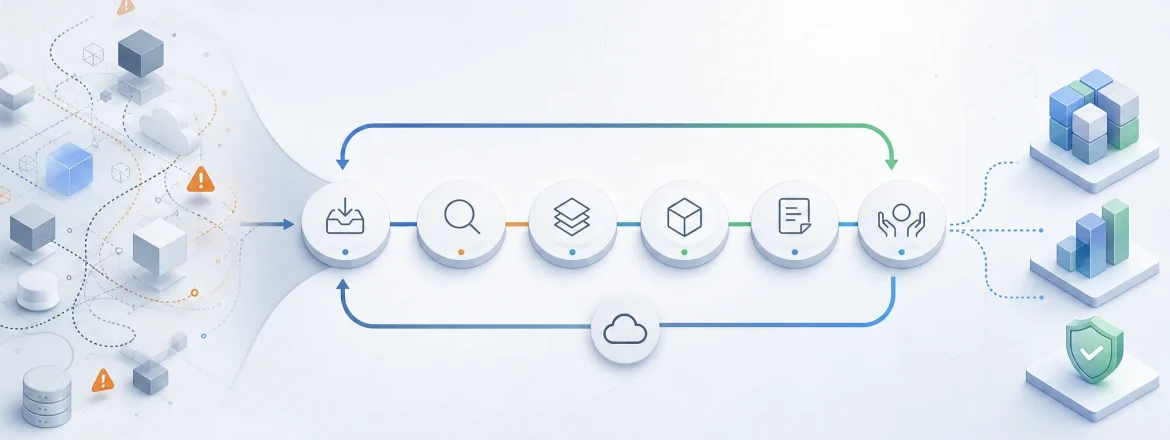
intake → cost-risk triage → architecture review → implementation unblock → decision log → handoff
Use it as a lightweight operating model for cloud economics reviews for platform teams. It is not a savings case study. The available evidence supports a framework-style guide, not a metrics-backed outcome story.

What this guide does and does not claim
This guide is intentionally cautious about outcomes.
| Safer claim | Do not claim without evidence |
|---|---|
| Cloud economics review often belongs closer to architecture and delivery decisions than after-the-fact spend reporting. | This model guarantees cloud savings. |
| Temporary platform engineering support is most credible when it improves intake, triage, architecture review, implementation unblock, decision logging, and handoff. | Temporary support will accelerate delivery by a specific amount. |
| Spend alone is noisy and should be evaluated with workflow and decision signals. | A lower bill proves the support loop worked. |
| Platform hiring gaps can create review and handoff risks when capacity is constrained. | Hiring timelines or applicant quality have declined by a specific amount. |
| The framework should be adapted and validated against each organization’s workflow, cloud provider, ownership model, and tagging quality. | The same staffing ratio, review SLA, or support scope works everywhere. |
If future baseline and post-intervention data become available, this framework could be turned into a measured case study. Until then, treat it as an operating model to adapt and validate.
Context: a platform hiring gap changes the cost of delayed decisions
When a platform team is under-capacity, the missing work is often review work.
Someone still has to decide whether a new service should use a managed database tier, whether data should be retained indefinitely, whether a workload needs multi-region deployment, whether telemetry cardinality is acceptable, whether environments should be duplicated, and whether unused infrastructure has a cleanup owner.
If platform capacity is constrained, those decisions may still happen—but with less review, less documentation, and fewer reusable platform patterns.
That is where cloud cost drift can start. Not necessarily because engineers are careless. More often, the team is optimizing for local delivery speed under real constraints. The risk is that short-term architecture defaults become long-term cost and operability drag.
Monthly cloud reports can identify that spend changed. They usually do not reconstruct why a technical decision became durable. That makes them useful but late.
For related framing on moving cloud economics upstream into system design, see Cloud Economics Belongs in Architecture Review, Not Just Finance Reports and Cost-Aware Architecture Review: Where Cloud Economics Belongs in System Design.
Problem: cloud cost drift often starts as an architecture review miss, not a finance variance
A finance variance can tell you that spend is higher than expected. It usually cannot tell you whether the root cause was:
- a retention default that no one revisited
- high-cardinality telemetry introduced during incident response
- overprovisioned always-on compute
- duplicated environments without lifecycle rules
- network egress from a data movement pattern
- a managed-service tier selected for speed and never revisited
- a multi-region reliability promise made before cost behavior was understood
- missing ownership tags that made cleanup hard
These are architecture and platform decisions first. Finance can provide spend context, budget governance, forecasting, procurement input, and escalation thresholds. But many of the tradeoffs are technical: reliability, operability, latency, compliance, delivery risk, team skill, reversibility, and cost behavior.
The better question is not:
How do we stop engineers from spending?
It is:
Which architecture choices need cost-risk review before they become expensive to reverse?
Lagging finance signal vs. engineering decision signal
| Signal type | What it can tell you | What it often misses | Where it belongs |
|---|---|---|---|
| Monthly spend report | Spend changed | Which design choice made the spend durable | Finance review, engineering follow-up |
| Budget alert | A threshold was crossed | Whether the threshold reflects a valid architecture tradeoff | Finance and engineering escalation |
| Cost anomaly | Usage changed unexpectedly | Whether the change is a bug, launch effect, retention issue, or ownership gap | Incident or operational review |
| Architecture review | Expected cost behavior before implementation | Real production usage, unless revisited | Design and platform workflow |
| Infrastructure-as-code review | Resource shape, ownership, lifecycle, boundaries | Runtime demand and unit economics | Delivery workflow |
| Service readiness review | Operability, ownership, scaling assumptions | Long-term spend trend | Pre-production engineering review |
Dashboard-only cost management is insufficient when visibility is not connected to decision ownership.
Constraints: temporary support cannot behave like a permanent platform team or a finance approval queue
Temporary platform engineering support is credible only if it respects several constraints.
| Anti-pattern | Why it fails | Better pattern |
|---|---|---|
| A replacement for the platform team | Permanent platform ownership must stay internal | Use support as a bridge during a delivery gap |
| A review gate for every cloud change | Creates queueing and encourages teams to route around review | Triage by cost risk and reversibility |
| A dashboard-producing function only | Reports do not implement architecture changes | Connect findings to backlog items and owners |
| A finance-owned approval process | Cost tradeoffs are often architecture tradeoffs | Keep review engineering-led, with finance as context provider |
| A source of undocumented fixes | Creates context loss when support ends | Require decision logs, ownership maps, and handoff artifacts |
The support function should operate inside engineering workflows:
- platform intake
- design review
- infrastructure-as-code review
- service readiness review
- incident follow-up
- migration planning
- decommissioning work
- platform backlog refinement
It should not create a parallel process that engineers experience as another approval queue.
Decision rights matter
| Decision area | Product/service team | Internal platform team | Temporary platform engineering support | Finance |
|---|---|---|---|---|
| Product requirements | Owns | Consulted when platform impact exists | Consulted when cost-risk review is needed | Informed when budget context matters |
| Platform standards | Uses and gives feedback | Owns | Recommends, implements, or pairs within agreed scope | Informed |
| Architecture tradeoffs | Owns service-level tradeoff | Reviews platform impact | Prepares options and identifies cost drivers | Provides spend context |
| Budget targets | Informed | Informed | Informed | Owns or coordinates |
| Infrastructure implementation | Owns service-specific changes | Owns shared platform changes | Implements or pairs where scoped | Not owner |
| Decision log and handoff | Contributes | Owns long-term record | Maintains during support period | May consume for context |
For related discussion of technical boundaries in infrastructure work, see Terraform Modules for Kubernetes: A Practical Boundary Guide and Boundaries are your friends.
Alternatives: common responses, and where each breaks down
A cost-aware platform support loop is not the only possible response to a hiring gap.
| Response | What it helps with | Where it breaks down |
|---|---|---|
| Freeze or defer platform requests | Protects a constrained platform team in the short term | Product teams may make one-off infrastructure choices to keep shipping. This is a practical inference, not a measured outcome. |
| Let finance handle cost review after deployment | Surfaces spend anomalies and budget variance | Often arrives too late to influence architecture choices before they harden |
| Add dashboards and alerts only | Improves visibility | Does not assign engineering ownership for changing design or implementation patterns |
| Add temporary platform engineering support focused on the decision loop | Adds capacity to triage, review, unblock, document, and hand off | Requires onboarding, scope control, and clear ownership to avoid dependency |
The recommended path is not “add external people and hope.” It is narrower: add temporary platform engineering support only where it improves the engineering decision loop.
Framework: the cost-aware platform support loop
The loop is:
- Intake — capture enough context to identify cost-risk decisions early.
- Cost-risk triage — decide which requests deserve deeper review.
- Architecture review — evaluate expected cost behavior beside reliability and operability.
- Implementation unblock — turn review outcomes into working platform changes.
- Decision log — preserve why decisions were made.
- Handoff — make the support period temporary by design.

The loop is intentionally lightweight. Not every request needs formal review. Routine paved-path requests should keep moving.
The goal is to move cloud economics upstream into engineering decisions while avoiding a blocking finance process.
Step 1 — Intake: route platform requests by decision risk, not requester seniority
Intake should not be a budget approval form.
Its purpose is to reveal whether a platform request contains a cost-sensitive architecture decision.
A lightweight intake form might capture:
| Field | Why it matters |
|---|---|
| Service or system owner | Someone must own follow-up and cleanup |
| Requesting team | Helps map cost and operational responsibility |
| Environment | Production, staging, ephemeral, development, and test environments have different lifecycle expectations |
| Expected usage driver | Cost behavior depends on traffic, storage, users, events, queries, jobs, tokens, or another scaling variable |
| Data retention requirement | Retention choices can become durable and expensive to reverse |
| Scaling assumption | Reveals whether the request assumes fixed capacity, autoscaling, burst behavior, or specialized compute |
| Managed-service dependency | Tier, region, replication, and feature choices can influence cost behavior |
| Reversibility | Helps determine whether review should happen before implementation |
| Ownership tags or metadata | Supports later attribution, cleanup, and anomaly investigation |
| Follow-up trigger | Defines when to revisit the decision |
Temporary platform engineering support can help by:
- classifying requests
- asking missing design questions
- routing routine requests through paved paths
- escalating only high-risk or hard-to-reverse decisions
- keeping the queue from turning into an undifferentiated backlog
Intake decision tree
Does the request use an existing paved path?
├── Yes
│   ├── Is ownership, environment, and lifecycle clear?
│   │   ├── Yes → Proceed without formal cost-risk review
│   │   └── No → Fix metadata or lifecycle gap
└── No
    ├── Does it introduce a new architecture pattern?
    │   ├── Yes → Cost-risk triage
    │   └── No
    ├── Does it affect durable cost drivers?
    │   ├── Yes → Cost-risk triage
    │   └── No → Proceed with lightweight review
These fields are recommendations, not validated requirements. Adapt them to your cloud provider, ownership model, tagging conventions, and platform workflow.
Step 2 — Cost-risk triage: review the decisions that are expensive to reverse
The triage lens is simple:
Spend review should focus on decisions with durable cost impact and low reversibility.
Examples worth reviewing early include:
- data retention defaults
- data movement and network egress paths
- multi-region or active-active design
- high-cardinality telemetry
- always-on compute
- GPU or specialized compute
- managed-service tier selection
- environment duplication
- backup and restore policy
- storage class and lifecycle policy
- ownership and tagging boundaries
This is a recommended review taxonomy, not evidence from internal customer incidents. The right list depends on workload, reliability requirements, regulatory constraints, team skill, and provider pricing.

Cost-risk triage matrix
| Cost risk | Reversibility | Review posture | Examples |
|---|---|---|---|
| High | Hard to reverse | Review early | Multi-region commitment, long retention default, data movement path, always-on specialized compute |
| High | Easier to reverse | Monitor after release or run a short experiment | Managed-service tier adjustment, autoscaling policy, some observability settings |
| Low | Hard to reverse | Document and proceed carefully | Ownership boundary, naming convention, lifecycle metadata pattern |
| Low | Easier to reverse | Use paved path | Standard module adoption, tagging fix, temporary test environment |
Rule of thumb: formal review belongs where cost impact is durable and the rollback path is unclear or expensive.
If the team can change a decision cheaply later, do not block delivery. If the decision becomes embedded in data, traffic, compliance posture, or customer-facing reliability promises, review it earlier.
Security, privacy, compliance, and regulated-data retention examples need organization-specific review before operational reuse.
Step 3 — Architecture review: make cost a quality attribute beside reliability and operability
A useful cloud economics review does not ask:
What is the cheapest design?
It asks:
Is the expected cost behavior understood and acceptable given reliability, delivery, and operability goals?
Cost minimization can be the wrong optimization target. A cheaper design that increases incident risk, operational burden, or delivery complexity may be more expensive in practice. That is a tradeoff judgment, not a universal rule.
Review the tradeoffs explicitly
| Architecture choice | Cost question | Reliability question | Operability question |
|---|---|---|---|
| Managed service vs. self-managed | What tier, feature set, and usage dimension drive spend? | What failure modes does the provider absorb or expose? | Who debugs and upgrades it? |
| Pre-provisioned vs. autoscaled | What capacity sits idle? | How does scaling behave under burst? | Who tunes scaling policy? |
| Regional vs. multi-region | What duplication and data transfer are introduced? | What failure scenario is being addressed? | Can the team operate the added complexity? |
| Retention depth | What storage and query costs grow over time? | What recovery or audit need does retention serve? | Who owns lifecycle policy? |
| Observability detail | What cardinality or ingestion cost is introduced? | What signal is required for detection and debugging? | Can engineers find the signal during incidents? |
| Environment duplication | Which environments need production-like resources? | What test confidence is required? | Who cleans up unused environments? |
Architecture review questions for cloud economics
Cost behavior
- What is the scaling variable: traffic, storage, users, events, queries, jobs, tokens, or another driver?
- What happens when usage doubles?
- Is cost growth linear, stepwise, bursty, or difficult to predict?
- Which resource becomes idle when demand drops?
- Is there a meaningful unit cost for this workload?
Reversibility
- What is the rollback path?
- What decision becomes embedded in the data model, traffic path, reliability promise, or compliance posture?
- What would make this decision expensive to undo later?
Reliability and operability
- What reliability requirement justifies the cost driver?
- What operational burden changes if the cheaper option is chosen?
- Who debugs, tunes, patches, or upgrades the chosen pattern?
Ownership and follow-up
- Who owns cleanup or revisiting the decision later?
- What trigger should cause review: launch, traffic change, storage growth, incident, anomaly, or date?
- Where will the decision and implementation links be recorded?
Bad cost questions vs. useful engineering questions
| Avoid asking only | Ask instead |
|---|---|
| “Why is this so expensive?” | “Which usage dimension drives this cost, and is it tied to product value?” |
| “Can we choose the cheaper service?” | “What reliability or operational burden changes if we choose the cheaper option?” |
| “Can finance approve this?” | “Who owns the tradeoff, and what guardrails make the decision safe enough?” |
| “Can we reduce logs?” | “Which telemetry is needed for debugging, and where is cardinality accidental?” |
| “Can we revisit this later?” | “What would make this decision hard to reverse later?” |
A good architecture review produces a decision, not an open-ended debate:
- accept
- accept with guardrails
- short experiment
- defer with owner
- reject because the risk is too high
Temporary platform engineering support can help by preparing options, identifying cost drivers, reviewing infrastructure-as-code boundaries, and translating spend concerns into architecture questions.
Do not publish provider-specific pricing examples unless they are verified against current public pricing or approved internal data.
Step 4 — Implementation unblock: turn review outcomes into working platform changes
A review loop fails if it stops at recommendations.
If the architecture review says “add lifecycle policy,” “separate environment ownership,” or “adjust autoscaling,” someone still has to convert that into code, configuration, documentation, or a backlog item.
Temporary platform engineering support can help with implementation work such as:
- refining Terraform or module boundaries
- adding tagging requirements
- setting storage lifecycle policies
- adjusting autoscaling configuration
- improving environment cleanup
- documenting service ownership
- preparing migration steps
- writing rollback notes
- creating runbook updates
- pairing with service teams on infrastructure changes
These are examples of possible support activities, not guaranteed deliverables. The exact scope depends on the organization and support agreement.
From review finding to implementation task
| Review finding | Implementation task | Likely owner | Follow-up trigger |
|---|---|---|---|
| Retention default is undefined | Add lifecycle policy and document retention owner | Platform or service owner | Revisit after usage pattern is known |
| Environment has no cleanup path | Add expiration metadata or cleanup workflow | Platform team | Review orphaned resources periodically |
| Autoscaling policy assumes steady load | Tune scaling thresholds and add load-test note | Service team with platform support | Revisit after launch or traffic change |
| Telemetry cardinality is unbounded | Add label/cardinality guidance and dashboard review | Service team | Revisit after incident or ingestion anomaly |
| Managed-service tier chosen for speed | Record tier choice and downgrade/upgrade criteria | Service owner | Revisit at defined usage threshold |
Long-term ownership should remain with the internal platform or service team. Temporary support can implement, pair, or unblock, but it should not become the permanent owner of core platform decisions.
Do not include confidential implementation details, internal hostnames, cloud account structures, customer architectures, credentials, or security-sensitive configuration in public material.
Step 5 — Decision log: preserve context so the future hire is not reconstructing history
Temporary support creates risk if it leaves behind undocumented changes.
The antidote is a decision log that captures why a choice was made under the constraints at the time—not only what changed.
Decision log template
## Decision: <short decision name>

Date: YYYY-MM-DD
Service/team: <service or team name>

Decision:
<What was chosen?>

Options considered:
- <Option 1>
- <Option 2>
- <Option 3>

Cost driver:
- <Usage dimension or resource behavior>

Reliability tradeoff:
- <Reliability requirement or failure mode considered>

Operability tradeoff:
- <Operational burden, ownership, debugging, maintenance, or skill requirement>

Outcome:
- Accept | Accept with guardrails | Short experiment | Defer with owner | Reject

Guardrails:
- <Guardrail 1>
- <Guardrail 2>

Owner:
- <Role or team>

Follow-up trigger:
- <Launch, usage threshold, incident, anomaly, migration milestone, or date>

Revisit date:
- YYYY-MM-DD

Implementation links:
- <Ticket, design doc, code reference, runbook, or sanitized link>
Publication note: sanitize customer names, private URLs, internal systems, cloud bill data, credentials, and security-sensitive architecture details before sharing outside the approved audience. Internal links should follow the organization’s access-control policy; public versions should use redacted identifiers only.
For broader thinking on decision rights and operating models, see Agentic AI Operating Model: Assign Decision Rights Before You Add Autonomy. The domain is different, but the same principle applies: unclear decision ownership creates operational ambiguity.
Step 6 — Handoff: design the end of temporary support from the beginning
Temporary platform engineering support should be a bridge, not a dependency.
Define the handoff package at the start:
| Handoff artifact | Why it matters |
|---|---|
| Platform backlog state | Shows what is done, active, deferred, or blocked |
| Decision log | Preserves architecture and cost-risk rationale |
| Open risks | Makes unresolved tradeoffs visible |
| Ownership map | Shows which team owns which resource, service, or follow-up |
| Runbooks | Helps internal owners operate what changed |
| Review criteria | Allows the internal team to continue the loop |
| Unresolved cost anomalies | Separates known issues from unknown issues |
| Recommended next reviews | Gives the future hire a starting point |
| Implementation notes | Connects rationale to code and configuration |
Do not wait until the eventual hire’s first week to create this material. Schedule handoff checkpoints during the support period.
A useful exit criterion is not:
All cost problems are solved.
It is:
The internal owner can continue the review loop with enough context to make informed decisions.
This distinction matters because no temporary support model can responsibly promise full continuity, faster onboarding, or resolved cost issues without evidence.
When not to use temporary platform support
Temporary support is not the right answer for every platform constraint.
Consider a different response when:
- there is no internal owner for platform standards or handoff
- the work is mostly routine requests that can move through existing paved paths
- the real blocker is budget approval, procurement, or vendor governance rather than platform capacity
- leadership wants external support to become the permanent owner of core architecture decisions
- teams are unwilling to document decisions, ownership, and follow-up triggers
- security, privacy, or compliance constraints require internal-only handling of the work
In those cases, adding temporary support may create more ambiguity rather than less.
Validation: measure the loop before claiming impact
Because no results data is available, this post recommends measurement rather than claiming outcomes.
Spend alone is noisy. It can move because of product growth, customer behavior, launches, provider pricing changes, migrations, incidents, seasonality, or cleanup. If you want to evaluate whether a cost-aware platform support loop is working, measure cloud economics signals and workflow signals together.
Minimum viable measurement
If the team is already capacity-constrained, start with a small set of signals:
- Number of cost-risk decisions logged — shows whether review context is being captured.
- Reviewed decisions with named owners — prevents cost findings from becoming orphaned recommendations.
- Implementation follow-through — tracks whether review outcomes became tickets, pull requests, configuration changes, runbooks, or backlog items.
- Lifecycle and ownership coverage — tracks whether resources have owners, environments, and cleanup expectations.
- Spend by service/team/environment — useful as context, but not proof of impact on its own.
Measurement plan template
Baseline
- Baseline period:
<dates> - Services or teams included:
<scope> - Known confounders:
<launches, migrations, incidents, seasonality, pricing changes, product growth>
Interventions tracked
- Intake changes introduced:
<fields, workflow, routing rules> - Reviews performed:
<decision IDs or links> - Implementation work completed:
<tickets, PRs, runbooks, config changes> - Handoff artifacts created:
<decision log, ownership map, backlog state, runbooks>
Cloud economics signals
- Spend by service/team/environment
- Unit cost where meaningful
- Cost anomaly frequency
- Idle or overprovisioned resources
- Resource ownership coverage
- Lifecycle policy coverage
Workflow signals
- Platform request lead time, segmented by routine vs. high-risk requests
- Architecture review cycle time
- Cost-risk decisions logged
- Reviewed decisions with owners
- Implementation follow-through
- Handoff completeness
Attribution guardrails
- Do not attribute spend changes to the support loop unless the causal path is documented.
- Separate product growth from architecture or cleanup changes where possible.
- Treat lower spend as a signal to investigate, not automatic proof of better architecture.
- Treat higher spend as a signal to investigate, not automatic proof of waste.
Before claiming impact, define a baseline period, document the support interventions, record which decisions were reviewed, link review outcomes to implementation work, and track follow-up triggers.
Tradeoffs: the loop reduces ambiguity, but it still costs attention
The cost-aware platform support loop is not free.
| Tradeoff | Risk | Mitigation |
|---|---|---|
| More review can reduce ambiguity | Too much review creates queueing | Use triage; route routine paved-path work around formal review |
| Temporary support adds capacity | Support still requires onboarding | Scope the work to high-leverage workflows and require decision logs |
| Cost-aware review improves design clarity | Blind cost minimization can harm reliability or operability | Treat cost as one quality attribute, not the only objective |
| Dashboards improve visibility | Reports without owners rarely change systems | Link findings to decisions, backlog items, and implementation owners |
| External support can bridge a delivery gap | Ownership can drift outside the team | Keep permanent ownership internal and define handoff artifacts early |
| Decision logs preserve context | Logging can become bureaucratic | Capture only fields needed for future engineering decisions |
The loop should make the engineering system clearer. If it becomes a meeting-heavy approval process, it is failing.
Failure modes to watch for
| Failure mode | Symptom | Fix |
|---|---|---|
| Every request gets the same review | A tagging cleanup and a multi-region design go through the same path | Classify by cost risk and reversibility |
| Cost review happens after implementation | The first cost question appears after deployment | Add cost-risk fields to intake and architecture review |
| Finance owns the question, but engineering owns the tradeoff | Spend variance is visible, but no one can decide whether the architecture is justified | Keep finance as context provider and engineering as tradeoff owner |
| Temporary support creates undocumented changes | Future platform hires inherit unexplained tickets and infrastructure changes | Require decision logs and handoff packages |
| Dashboards become the deliverable | Reports exist, but no architecture or implementation changes follow | Link findings to decisions, backlog items, and owners |
| Review becomes a queue | Teams route around the process to keep shipping | Use paved paths for routine work and review only durable, hard-to-reverse choices |
Cost-aware platform support loop checklist
Use this checklist if your platform team is carrying open roles or a temporary delivery gap.
Intake
- Capture service owner, requesting team, environment, expected usage driver, retention requirement, scaling assumption, managed-service dependency, reversibility, ownership metadata, and follow-up trigger.
- Separate routine paved-path requests from new or unusual architecture patterns.
- Avoid turning intake into a budget approval form.
Cost-risk triage
- Prioritize decisions with durable cost impact and low reversibility.
- Review data retention, data movement, compute shape, region strategy, telemetry cardinality, managed-service tiers, environment duplication, and ownership boundaries.
- Let low-risk, reversible changes proceed without formal review.
Architecture review
- Ask whether expected cost behavior is understood and acceptable beside reliability, operability, and delivery goals.
- Identify the scaling variable and unit cost driver where meaningful.
- Produce a clear outcome: accept, accept with guardrails, short experiment, defer with owner, or reject.
Implementation unblock
- Convert review findings into code, configuration, runbooks, documentation, or backlog items.
- Prefer repeatable platform patterns over one-off fixes.
- Keep long-term ownership with the internal platform or service team.
Decision log
- Record the decision, options considered, cost driver, reliability tradeoff, operability tradeoff, owner, outcome, follow-up trigger, and revisit date.
- Link the decision to implementation work.
- Sanitize records before public or broad cross-team sharing.
Handoff
- Define handoff artifacts at the start of the support period.
- Maintain backlog state, decision log, open risks, ownership map, runbooks, review criteria, and recommended next reviews.
- Make the exit criterion continuity of the review loop, not “all cost problems solved.”
Measurement
- Measure cloud economics signals and workflow signals together.
- Establish a baseline before claiming impact.
- Link observed changes to specific reviewed decisions and implementation work where possible.
Three things to remember
- Review by reversibility, not by spend anxiety. The decisions that deserve early review are the ones with durable cost impact and unclear rollback paths.
- Cost is a quality attribute, not a finance gate. Evaluate cost behavior beside reliability, operability, delivery risk, and ownership.
- Temporary support should leave an operating system behind. The useful output is not only fixed infrastructure; it is intake clarity, logged decisions, implementation links, ownership, and handoff context.
Conclusion: temporary support is useful when it leaves a better operating system behind
A platform hiring gap is not only a staffing issue. It can become a decision-quality issue if architecture review, implementation support, and cost awareness fall out of the delivery workflow.
Cloud economics belongs in the engineering loop because many durable cloud cost decisions are technical decisions first: data retention, compute shape, region strategy, telemetry design, managed-service choices, ownership boundaries, and lifecycle policy.
Temporary platform engineering support should be judged by whether it improves the loop:
intake → cost-risk triage → architecture review → implementation unblock → decision log → handoff
If your platform team is carrying open roles or a temporary delivery gap, start with an audit:
- Where do cost-risk decisions enter the workflow today?
- Which architecture choices are being decided by default?
- Which reviews are delayed because platform capacity is constrained?
- Which cloud cost signals arrive too late to change the design?
- What context would a future platform hire need to inherit?
The goal is not to add another approval process. The goal is to keep platform work moving while making cost-aware platform decisions explicit, reviewable, implemented, and handed off.