

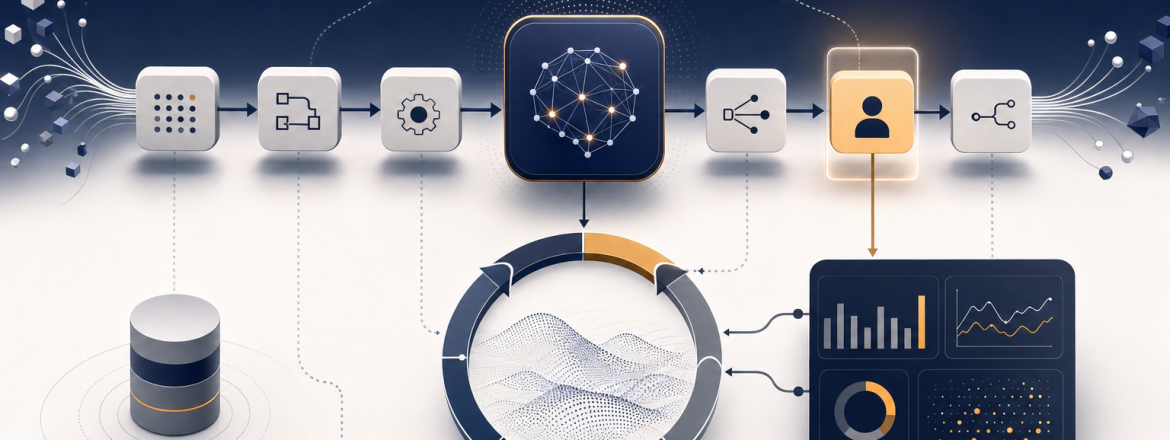
Direct answer: The agent loop ceiling is the point where a simple LLM-driven loop (prompt → tool calls → observations → repeat) stops acting like a prototype and starts silently absorbing production responsibilities—durable state, bounded execution, policy, evaluation, observability, and failure recovery. When those responsibilities become implicit, debugging, safety, and reliability degrade.
This guide is written for engineering and AI platform teams that already know how to build “agent loops,” but need a production-ready way to decide when to keep it simple—and when to add an orchestrated, auditable system around the agent.
TL;DR (featured-snippet style)
- Prototype loop is fine when the workflow is read-only, low risk, short-lived, and failure doesn’t create durable side effects.
- Agent loop ceiling appears when the workflow needs durable state, bounded budgets, safe side effects, reproducible evaluation, trace-level observability, explicit operator control, and defined recovery.
- Fix: treat the LLM agent as a component, not the runtime. Add orchestration, state storage, typed tool boundaries, policy/eval gates, traces, and recovery mechanisms.
What this post covers (and what it does not)
Direct answer: This post gives design heuristics to recognize the agent loop ceiling and shows architecture patterns to replace implicit loop behavior with explicit runtime contracts.
What this post is
- A production engineering guide for deciding when a simple LLM agent loop is still an acceptable abstraction.
- A checklist-style approach to make production requirements explicit in code and system design.
- An explanation of common failure modes caused by implicit control flow.
- A vendor-neutral reference architecture you can adapt to your stack.
What this post is not claiming
- No benchmark data is included. This is not a measured comparison of loop vs structured systems.
- No vendor “product architecture” is claimed. The patterns below are conceptual and implementation-agnostic.
- It’s not claiming agents are universally bad. It’s claiming that a hidden loop runtime is a weak boundary in production once durability, side effects, and operational controls matter.
Key definitions: agent loop, runtime boundary, and the “ceiling”
What is an LLM agent loop?
Direct answer: A simple LLM agent loop is a control pattern where the system repeatedly:
- Provides the model with task context.
- Provides a list of available tools.
- Asks the model what to do next.
- Executes the selected tool call.
- Appends the tool result to context.
- Repeats until the model stops or a stop condition triggers.
User/task
   ↓
Prompt + context + tool list
   ↓
Model chooses next action
   ↓
Tool call
   ↓
Observation/result
   ↓
Append to context
   ↓
Repeat until done / stopped
What is the runtime boundary?
Direct answer: The runtime boundary is the point where you, the system, enforce behavioral guarantees—limits, contracts, state transitions, auditability, and recovery—rather than relying on instructions inside prompts.
So what is the agent loop ceiling?
Direct answer: The agent loop ceiling is the threshold where the loop starts carrying responsibilities that production systems usually make explicit—because the workflow now requires durable state, safe side effects, bounded budgets, evaluation gates, observability, policy, operator control, and failure recovery.
At that point, the “while loop” becomes a hidden runtime engine. And hidden runtime is where teams struggle to test, inspect, and safely change behavior.
Why the loop is attractive—and why it stops working
Why agent loops work well early
A loop is attractive because it’s fast to prototype and flexible for unknown paths:
- Low upfront architecture cost (you can ship quickly).
- Fast iteration (prompt + tool set adjustments are immediate).
- Good for exploration when you don’t yet know the exact sequence.
- Adaptive behavior when tasks mutate externally.
Why the ceiling appears
The ceiling appears when production requirements can no longer be treated as “prompt hygiene.” Instead, they must be enforced by the runtime:
- State must persist across retries and restarts.
- Execution must obey budgets and hard stop rules.
- Side effects must be validated, authorized, and made idempotent or compensatable.
- Evaluation must cover tools and trajectories, not only final text.
- Observability must show what happened, not just what was output.
- Operators must be able to pause, approve, reject, override, replay, or quarantine.
When these responsibilities remain implicit, teams end up debugging by reconstructing transcripts—often too late to fix root causes.
When a simple agent loop may still be enough
Direct answer: A simple loop is often reasonable for workflows that are read-only, short-lived, and low-risk—especially during prototyping or supervised operations.
| Workflow category | Why the loop may be enough |
|---|---|
| Read-only research | Failures usually do not mutate external systems. |
| Internal prototypes | The goal is learning, not production guarantees. |
| Reversible single-user actions | Mistakes can be inspected and undone. |
| Human-supervised workflows | A person remains responsible for consequential decisions. |
| Short-lived tasks with small state | Less need for durable orchestration beyond the immediate context. |
As you move from “can the model do it?” to “can the system behave predictably when it fails?”, your design needs evolve.
The agent loop ceiling: the responsibilities that must not stay implicit
Direct answer: The loop becomes a weak production boundary when it absorbs these runtime responsibilities without enforceable contracts:
- Planning and routing of steps
- Scheduling and stage progression
- State transitions
- Retry policy
- Authorization boundaries
- Idempotency behavior
- Compensation and rollback options
- Tool validation and contract enforcement
- Cost/latency bounds and budget enforcement
- Observability and trace generation
- Human escalation and wait states
- Failure recovery and resume behavior
At first, you might encode these as prompt instructions. In production, that approach tends to fail because:
- It’s hard to inspect whether the system truly followed the intended policy.
- It’s hard to test systematically across model, prompt, tool, and policy changes.
- It’s hard to enforce uniformly when the model changes behavior or tools evolve.
Failure modes you’ll recognize in production
Direct answer: The agent loop ceiling shows up as recurring failure symptoms: late tool calls, duplicate side effects, untraceable execution, lost progress after restarts, unsafe tool arguments, missing approval records, and trajectory regressions after prompt changes.
Debugging lens: “hidden responsibility” inside the loop
When something “almost works” but breaks in production-shaped ways, the loop is usually performing a production task implicitly. Make that responsibility explicit in the runtime.
| Symptom in production | Hidden responsibility inside the loop | Explicit control to add |
|---|---|---|
| The agent keeps calling tools after enough information is available | Termination policy | Runtime-owned step/tool/time/cost limits and escalation |
| A retry duplicates a side effect | Retry and idempotency policy | Idempotency keys + persisted operation records |
| Operators cannot tell what happened | Observability and state tracking | Structured traces + persisted state transitions |
| A process restart loses the workflow | Durable execution | State store outside model context |
| Tool arguments are malformed or unsafe | Tool contract enforcement | Typed schemas + validation before execution |
| The model chooses a write tool too early | Risk policy and sequencing | Read/write separation + policy gates + approval states |
| Human approval happens in chat but is not recorded | Approval state management | Persisted workflow state for approvals/rejections |
| A final answer looks correct but followed an unsafe path | Trajectory evaluation | Trace-level evaluation and tool-order checks |
| A prompt change breaks behavior unexpectedly | Deployment/version control | Version prompts/tools/policies/evaluators/models together |
Design implication: the loop is a control pattern. Production needs runtime guarantees. A transcript is useful evidence, but it should not be the only place where system truth lives.
Production constraints that expose the ceiling
Direct answer: The agent loop ceiling tends to appear when any of these constraints become real in your workflow:
1) Durable state
A production workflow needs to know:
- What happened
- What is pending
- What has been approved
- What failed
- What can be retried
- What must not be repeated
- Which model/prompt/policy/schema/tool versions produced each result
The model context window is an input to the model—not a durable state store. Treat it like a transient workspace, not your system-of-record.
2) Bounded execution
A production system needs explicit limits for:
- Maximum steps
- Maximum wall-clock time
- Maximum tool calls
- Maximum retries
- Maximum cost
- Maximum recursion depth
- Escalation conditions
- Termination conditions
Some of these can be described in prompts, but the runtime should enforce where possible. A prompt-level stop condition is a request; a runtime stop condition is a boundary.
3) Side-effecting tools
Tool calls that mutate external systems need stronger contracts than “the model decided.” Side effects may require:
- Authorization
- Preconditions
- Argument validation
- Idempotency keys
- Operation records
- Audit records
- Approval gates
- Compensation behavior
- Clear separation between read-only and write capabilities
Reference reading: function calling and structured outputs (useful for thinking about structured tool invocation).
Important: typed schemas help, but security and safety require more than schema typing—least privilege, authorization checks outside the prompt, scoping, input/output sanitization, and prompt-injection defenses are typically part of real production hardening.
4) Reproducible evaluation
For production workflows, evaluating only the final message is often insufficient. Teams typically need to evaluate:
- Tool selection
- Tool-call arguments
- Tool-call ordering
- Retry behavior
- Refusal behavior
- Escalation behavior
- Human approval behavior
- Recovery after tool failure
- Final output quality
Reference reading (conceptual): agent evaluations, trace grading, and evaluating agent trajectories.
5) Observability (trace-level)
Operators need to inspect the execution path, not only the answer. A useful trace often connects:
request
  → model input
  → model decision
  → tool call
  → tool result
  → state transition
  → evaluator/policy decision
  → human intervention, if any
  → final outcome
Depending on your system, traces may also include latency, cost/tokens, retry count, error class, model version, prompt version, tool version, and policy version.
Privacy/security note: log only necessary fields, redact sensitive data, define retention periods, restrict access, and avoid storing secrets or unnecessary raw payloads unless there’s a reviewed reason.
6) Failure recovery
Production workflows need defined behavior for partial completion. Examples of questions your runtime should answer:
| Failure condition | System decision required |
|---|---|
| Tool timeout | Retry, pause, fail, or escalate? |
| Invalid tool output | Repair, reject, or call another tool? |
| Process restart | Resume from which state? |
| Human rejection | Revise, terminate, or escalate? |
| Partial side effect | Compensate, verify, or quarantine? |
| Stale context | Refresh state or block execution? |
| Policy conflict | Refuse, escalate, or request approval? |
A simple loop can try to “reason through” some of these cases. A production system should make recovery policy explicit so it’s testable and repeatable.
7) Operator control
Workflows with business impact often need operator controls such as:
- Pause
- Resume
- Approve
- Reject
- Override
- Replay
- Roll back where possible
- Terminate
- Escalate
- Quarantine
This doesn’t mean every workflow needs a human approval step. It means the system has an explicit answer for who (or what) intervenes when execution is no longer safe to continue automatically.
If you want a deeper companion read, consider: Human Review in AI Workflows: When to Decide, Escalate, or Stop.
Decision tree: is the agent loop still the right boundary?
Direct answer: Use this during design review before adding another prompt instruction, retry rule, or tool call.
Start
 |
 |-- Is the workflow read-only?
 |     |-- Yes --> Is it short-lived and low-risk?
 |     |             |-- Yes --> Simple loop may be enough.
 |     |             |-- No  --> Add runtime bounds, tracing, and evals.
 |
 |-- Does it mutate external, customer, or business state?
 |     |-- Yes --> Do not treat the loop as the system boundary.
 |                 Add validation, authorization, operation records,
 |                 idempotency, audit, and recovery paths.
 |
 |-- Must it survive restarts, human delays, or tool failures?
 |     |-- Yes --> Persist workflow state outside model context.
 |
 |-- Are there hard budgets for steps, latency, cost, or retries?
 |     |-- Yes --> Enforce bounds in the runtime.
 |
 |-- Can failures be diagnosed from traces and state transitions?
 |     |-- No --> Add structured observability before production use.
 |
 |-- Do any steps require approval, policy enforcement, or audit evidence?
 |     |-- Yes --> Make policy and human-control boundaries explicit.
 |
 `-- If several answers require durability, boundedness, auditability,
     or operator control, the agent is a component, not the runtime.
Reminder: This is a heuristic for engineering judgment—not an empirically validated scoring model.
Architecture shapes: pick the smallest one that satisfies the production constraints
Direct answer: You generally want the simplest architecture that can explicitly enforce the requirements that matter. These are four common shapes.
| Workflow properties | Reasonable architecture shape | What must be explicit |
|---|---|---|
| Read-only, exploratory, short-lived, internally supervised | Simple loop | Basic tracing, stop conditions, error handling |
| Tool use is common, but actions are low-risk or reversible | Tool-calling agent with typed interfaces | Tool schemas, argument validation, read/write separation |
| Workflow has known stages and failure paths | Workflow graph with LLM steps | State transitions, routing, retries, escalation, recovery |
| Long-running, side-effecting, audited, budgeted, business-critical | Structured AI system around the agent | Orchestration, durable state, policy/eval gates, observability, operator control, versioning |
Shape 1: Simple loop
prompt → model → tool → observation → model → ...
Best fit: exploratory tasks, read-only tasks, low-risk internal prototypes, short-lived workflows, reversible actions, and human-supervised use.
Main risk: production responsibilities remain implicit in prompt text and model behavior.
Shape 2: Tool-calling agent with typed interfaces
prompt → model → typed tool request → validation → tool execution → observation
Adds: tool schemas, argument validation, structured outputs, clearer tool contracts, better separation between model decision and tool execution.
Main risk: control flow may still be implicit if the model chooses the entire sequence end-to-end.
Shape 3: Workflow graph with LLM steps
start
  → classify
  → retrieve
  → extract
  → validate
  → decide
  → human approval?
  → execute
  → verify
  → complete / recover
Adds: explicit stages, explicit routing, runtime-owned stop conditions, known transitions, bounded responsibilities for LLM steps.
Main risk: the graph may become too rigid for genuinely open-ended tasks.
Shape 4: Structured AI system around the agent
User request
  → Orchestrator
  → State store
  → LLM/agent for bounded decisions
  → Tool boundary
  → Policy/eval gates
  → Observability
  → Recovery and operator controls
Adds: durable state, explicit orchestration, typed tool boundaries, policy gates, evaluation gates, human review hooks, observability, recovery paths, and deployment/version controls.
Main risk: more engineering surface area—design, test, deploy, and operate additional components.
Reference architecture: what a structured system adds around the agent
Direct answer: A structured AI system moves production responsibilities out of prompt text and into explicit components that enforce, inspect, and test behavior.
Below is vendor-neutral and concept-first.
| Component | Production responsibility | Failure mode if missing |
|---|---|---|
| Orchestrator | Owns control flow and lifecycle | Model context becomes the workflow engine |
| State store | Persists workflow facts | Recovery depends on transcript reconstruction |
| Tool boundary | Validates and controls actions | Malformed or unauthorized actions can reach tools |
| Policy/eval gates | Blocks invalid or risky transitions | Risk handling stays prompt-dependent |
| Human controls | Supports approval and intervention | Operators cannot safely pause or correct execution |
| Observability | Makes trajectories inspectable | Failures are hard to diagnose |
| Recovery mechanism | Handles partial failure | Retries may duplicate work or abandon state |
| Deployment controls | Makes changes testable and attributable | Regressions are hard to attribute |
Orchestration layer
The orchestrator owns workflow stages, routing, timeouts, retries, cancellation, escalation, human wait states, and termination. Without it, the model is often responsible for what state the workflow is in and what happens next.
If you want to align your design thinking to explicit control responsibilities, see: Control Plane vs Agent Loop: Safe Architecture for Production Agentic Systems.
State store
Persist workflow state, versioned inputs, tool calls, tool results, model outputs (as appropriate), evaluator decisions, policy decisions, human approvals/rejections, errors, recovery attempts, and the final outcome.
Design goal: the system can answer:
What happened, why did it happen, what version produced it, and what can safely happen next?
Tool boundary
Expose typed schemas, argument validation, permission checks, preconditions, idempotency behavior, read/write separation, risk classification, and side-effect records.
A useful tool boundary treats model output as a request, not an instruction that must be executed.
Policy and evaluation gates
Check output validity, tool request validity, data access rules, risk level, business rules, required approvals, and refusal conditions.
Evaluators themselves need tests and versioning; otherwise, you can’t trust evaluation results as you change systems.
Human-in-the-loop controls
Allow approval, correction, rejection, escalation, termination, and manual recovery. Human review should attach to defined workflow states, not be bolted on as an afterthought.
Companion read: Agent Autonomy Boundaries: Decide, Escalate, Stop, and Review.
Observability pipeline
Capture traces, state transitions, safe tool-call arguments, safe tool responses, safe model outputs, errors, latency, cost signals, retry counts, evaluation results, and human interventions.
Recovery mechanism
Define retry, resume, compensate, quarantine, replay, escalate, fail-closed, and manual intervention behavior. Recovery should be part of workflow design, not “best effort reasoning” after failure.
Deployment controls
Version prompts, tool schemas, policies, evaluators, models, workflow graphs, retrieval configuration, and context construction logic.
Versioning isn’t about making outputs deterministic; it’s about making failures attributable enough to investigate.
Implementation patterns: replace implicit loop behavior with explicit contracts
Direct answer: The implementation goal is to move production responsibilities out of prompt text and into runtime contracts that can be enforced, inspected, and tested.
| Do not rely only on this | Prefer this boundary |
|---|---|
| Do not call more than five tools. | Runtime-enforced max tool-call count with escalation on breach. |
| Be careful before using write tools. | Tool risk classes, authorization checks, and approval states. |
| Retry if the tool fails. | Retry policy with max attempts, error classes, and idempotency keys. |
| Ask the user before doing anything risky. | Explicit human-review workflow state before high-impact side effects. |
| Stop when you have enough information. | Termination conditions owned by the orchestrator. |
| Remember what you already did. | Persisted workflow state and operation records. |
| Return valid JSON. | Schema-constrained outputs plus validation before execution. |
| Explain what happened if something fails. | Structured traces with model, prompt, tool, policy, evaluator, and workflow versions. |
Step-by-step: how to refactor an agent loop into production contracts
Direct answer: Use this as a practical migration path.
- Inventory responsibilities currently “handled by the loop” (timeouts, retries, tool validation, approvals, state tracking).
- Define explicit workflow states (e.g., started, awaiting_tool_result, awaiting_approval, executing_write, completed, failed, quarantined).
- Extract an orchestrator that owns routing, stop conditions, and lifecycle transitions.
- Add a state store as the source of truth for workflow facts and versioning metadata.
- Implement a tool boundary that validates tool arguments and enforces permissions and read/write separation.
- Add policy and evaluation gates before high-impact transitions and before accepting outputs.
- Instrument traces for request → model decision → tool call → tool result → state transition → evaluation/policy decision.
- Implement recovery rules for timeouts, invalid outputs, restart resumption, and human rejection.
- Run an eval suite that covers failure paths and trajectory evidence—not only final text.
This is a design migration checklist. Actual implementation details depend on your system and risk level.
Use typed tool schemas and validate arguments before execution
A model-selected tool call should pass through validation before execution.
tool: create_internal_case
risk_class: reversible_write
input_schema:
  type: object
  required:
    - subject
    - reason
    - idempotency_key
  properties:
    subject:
      type: string
    reason:
      type: string
      enum:
        - missing_information
        - needs_review
        - user_request
        - other
    idempotency_key:
      type: string
permissions:
  required_role: case_writer
preconditions:
  - request_is_in_scope
  - no_existing_open_case_for_idempotency_key
side_effects:
  - creates_internal_case_record
audit:
  record_arguments: minimized
  record_result: minimized
Note: This is illustrative pseudocode, not an approved implementation. If you’re dealing with customer data, financial operations, permissions, or regulated workflows, you’ll need security, privacy, and legal review.
Separate planning from execution for side effects
For higher-impact workflows, require an inspectable plan before write operations.
1. Gather read-only context.
2. Produce proposed plan.
3. Validate plan.
4. Classify risk.
5. Request approval if required.
6. Execute write tools.
7. Verify side effects.
8. Complete or recover.
The plan should include intended actions, required tools, preconditions, expected side effects, rollback/compensation options, and approval requirements. The model can draft the plan; the runtime decides whether and how to execute.
Classify tools by risk (a practical taxonomy)
Use tool classes to drive default controls.
| Tool class | Examples | Default control |
|---|---|---|
| Read-only | Search, retrieve, inspect status | Allow with validation and rate limits |
| Reversible write | Create draft, open internal case | Allow with idempotency and audit |
| Irreversible write | Delete, submit, finalize | Require stronger approval and verification |
| External communication | Email, message, ticket response | Require policy checks and possibly human review |
| Financial or business-critical operation | Refund, purchase, contract approval | Require explicit authorization and audit |
Reminder: This is an engineering taxonomy example, not compliance guidance.
Add idempotency keys and operation records
For side-effecting tools, retries should not duplicate external actions. The key is that the system can answer: “Did we already attempt this operation, and what happened?”
operation_id: op_...
workflow_id: wf_...
tool_name: create_internal_case
idempotency_key: wf_...:create_internal_case:request_...
status: pending | succeeded | failed | compensated
created_by: model_decision_id or human_approval_id
created_at: timestamp
result_ref: ...
Best practice pattern: persist the operation record before executing the side effect, then persist the result after execution. Many teams implement this with an operation-log or outbox-style pattern so retries can resume from recorded intent instead of inferring from a transcript.
Move stop conditions out of the prompt where possible
Prompt instructions are helpful, but runtime enforcement is the boundary.
Prompt instruction:
Do not take more than five steps.

Runtime enforcement:
if step_count >= max_steps:
  transition_to: escalated_max_steps_exceeded
Persist workflow state outside model context
Direct answer: Build model context from durable state, not treat the transcript as truth.
Durable state → context builder → model input
Not: Model transcript → source of truth.
Version prompts, tools, policies, evaluators, and model configuration together
A failure is difficult to reproduce if your team can’t answer:
- Which prompt version ran?
- Which model version ran?
- Which tool schema was active?
- Which policy rules were active?
- Which evaluator version made the decision?
- Which workflow graph version routed execution?
Versioning doesn’t automatically make behavior deterministic. It makes investigation possible.
Treat human approval as a persisted wait state
Direct answer: Don’t model approval as a blocking chat exchange hidden inside the loop. Persist the state and resume from an external event.
state: awaiting_human_approval
approval_request_id: approval_...
proposed_action_ref: plan_...
allowed_transitions:
  - approved → execute
  - rejected → revise_or_terminate
  - expired → escalate
This makes approval auditable, recoverable after process restart, and separable from the model’s next-token behavior.
Validation: evaluate the workflow, not just the final answer
Direct answer: A production evaluation strategy should cover both outputs and trajectories—tool choices, argument validity, ordering, retry behavior, stop/budget enforcement, and recovery outcomes.
Why “final answer only” often misses regressions
- A model can still produce a correct-looking final message while following an unsafe or invalid path.
- Runtime rules might silently change (timeouts, retry policies, policy gates).
- Tool call ordering can shift under prompt or model changes.
- Recovery behavior might degrade while end results look unchanged in a small test set.
Eval template: scenario-based trajectory evaluation
Use this rubric as a starting point for scenario-based workflow evaluation.
| Scenario | Expected behavior | Evidence to inspect | Pass/fail question |
|---|---|---|---|
| Happy path | Completes with expected tool sequence | Trace, final output, state transitions | Did it complete correctly within bounds? |
| Ambiguous request | Clarifies, refuses, or takes safe default path | Model decision, policy gate | Did it avoid unsafe assumptions? |
| Missing data | Retrieves more context or blocks execution | Tool calls, state transition | Did it avoid acting on incomplete state? |
| Invalid tool output | Rejects, repairs, retries, or escalates | Validation result, recovery event | Was invalid data prevented from driving unsafe action? |
| Tool timeout | Retries, pauses, or escalates according to policy | Retry count, error class, recovery state | Did retry behavior follow policy and bounds? |
| Policy conflict | Blocks or requests approval | Policy decision record | Did policy enforcement happen outside the prompt? |
| Human rejection | Revises, terminates, or escalates | Approval/rejection event | Was rejection persisted and respected? |
| Partial side effect | Verifies, compensates, quarantines, or escalates | Operation record, recovery event | Did the system avoid duplicate or orphaned work? |
| Budget exhaustion | Stops or escalates | Runtime bound event | Was the limit enforced by runtime logic? |
Minimum fields to capture per eval case (example):
case_id:
workflow_version:
model_config_version:
prompt_version:
tool_schema_versions:
policy_version:
input:
expected_trajectory:
expected_final_state:
allowed_tools:
forbidden_tools:
runtime_bounds:
pass_fail_rubric:
observed_trace_ref:
outcome:
review_notes:
Track regressions across changes to the model, prompt, tool implementation, tool schema, retrieval configuration, context construction, policy rules, evaluator logic, orchestrator logic, or workflow routing.
If your evaluation suite only tests final answers, it may miss regressions in tool use, recovery, and boundedness.
If you’re actively building an eval harness, you may find useful: Agent Eval Harness: How to Build One That Survives Workflow Drift.
Rollout template: what to verify before production exposure
Direct answer: Treat rollout as a release-readiness process, not a compliance checklist. Verify that the runtime enforces the contracts your workflow requires.
| Phase | Goal | Required evidence before moving on |
|---|---|---|
| Prototype | Learn whether the model can perform the task | Example transcripts, failure notes, task definition |
| Internal test | Make behavior inspectable | Structured traces, tool-call records, scenario suite (including failures) |
| Controlled pilot | Bound risk and operator burden | Runtime limits, approval flow, recovery policy, escalation path |
| Production candidate | Prove operational readiness | Versioned prompts/tools/policies/evals, regression suite, incident playbook |
| Production operation | Detect regressions and failures | Monitoring, eval deltas, failure taxonomy, review process |
Release questions that map directly to the agent loop ceiling:
- What external state can this workflow mutate?
- What is the maximum blast radius of a bad tool call?
- Which runtime limits are enforced in code?
- What happens after a process restart?
- What happens after a tool timeout?
- Which side effects are idempotent?
- Which actions require approval?
- What data is logged, redacted, retained, and access-controlled?
- Can an operator pause, terminate, replay, or quarantine execution?
- Can a failed run be investigated after prompt/model/policy/tool changes?
Tradeoffs: structured systems buy control by adding engineering surface area
Direct answer: Structured systems aren’t “free.” They add components that must be designed, tested, deployed, monitored, and maintained.
| Added structure | What it buys | What it costs |
|---|---|---|
| Explicit orchestration | Predictable stages and recovery points | Less flexibility for open-ended tasks |
| Typed tools | Better validation and contracts | Schema design, migrations, compatibility handling |
| Durable state | Recovery, replay, auditability | Storage, retention, access-control decisions |
| Policy gates | Explicit risk boundaries | Policy design and false positives/negatives |
| Evaluation gates | Regression detection | Evaluator maintenance and validation |
| Human approval | Operator control | Latency and operational burden |
| Structured traces | Debuggability | Data handling, redaction, retention work |
| Versioned workflows | Reproducibility | Release management overhead |
Practical guidance: For low-risk, read-only, short-lived workflows, a simple loop may remain the better engineering choice. For business-critical and side-effecting workflows, adding explicit orchestration is often the difference between “demo” and “production system.”
Cost-aware design note (because budgets matter)
Direct answer: The agent loop ceiling includes budget and cost enforcement. You should decide where cost control lives: the runtime, not only the prompt.
If you’re formalizing cost into architecture review, see:
- Cost-Aware Architecture Review: Where Cloud Economics Belongs in System Design
- Cloud Economics in Architecture Review: A Practical Framework for Cost-Aware Design
Compact shipping checklist (use during design review)
Direct answer: Use this checklist to confirm whether you’ve passed the agent loop ceiling—or whether you’re about to ship a hidden runtime by accident.
- Workflow state is persisted outside model context.
- Runtime enforces step, retry, tool-call, latency, or cost bounds where relevant.
- Tools have typed schemas and validation before execution.
- Read and write tools are separated by risk.
- Side-effecting tools use idempotency keys or operation records.
- Policy gates and approval states are explicit where needed.
- Traces connect request, model decision, tool call, result, state transition, evaluator/policy decision, and final outcome.
- Prompt, model, tool schema, workflow graph, policy, and evaluator versions are recorded.
- Eval scenarios cover failure paths, not only happy paths.
- Operators can pause, terminate, escalate, quarantine, or inspect failed executions where required.
If several items are missing, you may still have a useful prototype—but it’s probably not ready to treat the agent loop as your production boundary.
Practical next steps: what to do after reading this
Step 1: Name the responsibilities your loop is carrying
Write down what you currently rely on the loop to handle (timeouts? retries? approvals? state?). Treat that list as your migration backlog.
Step 2: Add runtime-owned boundaries first
- Hard budgets: step limits, timeouts, retry caps.
- Tool validation: schema checks and permission enforcement outside the prompt.
- Stop conditions owned by the orchestrator.
Step 3: Make approval and recovery auditable
- Persist approval wait states.
- Persist operation records for side effects.
- Define recovery transitions for partial completion.
Step 4: Evaluate trajectories
- Test tool selection and ordering.
- Test refusal and escalation behavior.
- Test stop/budget enforcement.
- Test restart/resume behavior.
Suggested images (captions + alt text + filename recommendations)
Direct answer: Since no images were provided with the original article, here are safe, SEO-friendly image suggestions you can add later.
- Filename recommendation: agent-loop-ceiling-diagram.png
Suggested caption: “How the agent loop ceiling appears when runtime responsibilities move out of prompts into explicit orchestration.”
Alt text: “Diagram explaining the agent loop ceiling for LLM agent loops and when production orchestration is required.” - Filename recommendation: agent-ceiling-failure-modes-table.png
Suggested caption: “Failure symptoms caused by implicit loop control flow.”
Alt text: “Table mapping production symptoms to hidden responsibilities inside an LLM agent loop.” - Filename recommendation: structured-ai-reference-architecture.png
Suggested caption: “Reference architecture components for a structured AI system around an agent.”
Alt text: “Reference architecture for a structured AI system with orchestrator, state store, tool boundary, policy gates, observability, and recovery.”
Conclusion: keep the agent, move the boundary
Direct answer: The useful conclusion is not that agents are bad. The useful conclusion is that an opaque agent loop becomes a poor production boundary once you require durable state, side effects, budgets, auditability, operator controls, and recovery requirements.
The agent can still be valuable as:
- a planner
- a classifier
- a tool selector
- an extractor
- a summarizer
- a decision-support component
- a repair or recovery assistant
But the system around it should make production responsibilities explicit:
- Orchestration
- State
- Tool contracts
- Evaluation
- Observability
- Policy
- Human control
- Recovery
- Deployment/versioning
That mental model is the agent loop ceiling. When the loop becomes responsible for everything, it becomes responsible for too much.
FAQs
1) What is the agent loop ceiling in one sentence?
The agent loop ceiling is when a simple LLM while-loop stops being a safe production boundary because production requirements (durable state, side-effect safety, budgets, evaluation, observability, and recovery) become implicit in prompt text and control flow.
2) Does the agent loop ceiling mean “agents are bad”?
No. Agents are useful components. The point is that the runtime boundary in production should be explicit—so you can enforce limits, validate tool calls, audit decisions, and recover safely.
3) How do I know if my workflow is past the ceiling?
Look for signs like: you need durable state across restarts, you call tools that produce side effects, you must enforce hard budgets, you need trace-level debugging, approvals and policy enforcement must be auditable, or failures must be recovered deterministically.
4) What’s the first thing to add when you hit the ceiling?
Typically: runtime-owned stop conditions and budgets, plus a tool boundary that validates arguments and enforces permissions outside the prompt. Then add persisted state and traces so failures are diagnosable and recovery is possible.
5) Should evaluation include tool calls and trajectories?
For production workflows, yes. Evaluating only the final answer can miss regressions in tool selection, ordering, retry behavior, stop/budget enforcement, and recovery outcomes.
6) Can I keep a simple loop and still ship safely?
Sometimes—especially for read-only, low-risk, short-lived workflows. But if your system needs durable state, safe side effects, audits, operator control, or robust recovery, you should treat the loop as a component inside a structured runtime.