

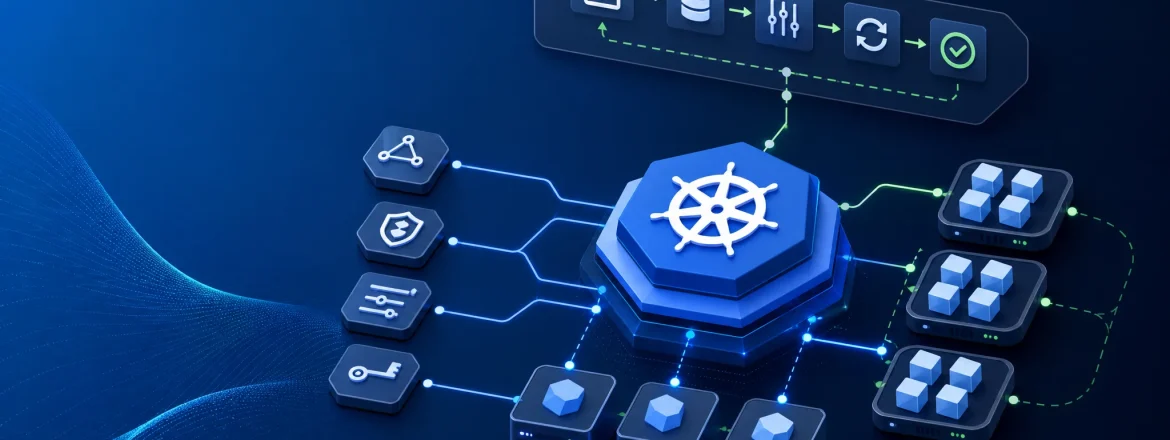
Kubernetes Explained: Core Concepts Every Engineering Team Should Know
Short answer: Kubernetes is a desired-state control system for containerized applications. You tell it what you want to run, how many copies you need, how traffic should reach the app, and how the workload should be configured. Kubernetes then keeps reconciling the cluster toward that desired state.
That idea is more useful than memorizing object names first. If you understand the control loop, the major Kubernetes concepts stop feeling arbitrary. Pods, Deployments, Services, Ingress, ConfigMaps, Secrets, namespaces, and autoscaling all fit into one operating model.
This article explains Kubernetes in practical terms. It focuses on the concepts engineering teams actually use, the boundaries Kubernetes enforces, and the things Kubernetes does not solve for you. It also includes a simple mental model, a few concrete examples, and a checklist you can use to test whether your team understands a workload end to end.

kubernetes-desired-state-control-loop.svg. Alt text should describe the control loop clearly: you declare desired state, Kubernetes schedules workloads, and controllers reconcile the cluster over time.What Kubernetes is, in one sentence
Kubernetes is a system for declaring, running, and continuously reconciling containerized workloads.
That sentence matters because it captures three parts of the platform:
- Declaration: you describe what should exist.
- Execution: Kubernetes places and runs workloads on nodes.
- Reconciliation: Kubernetes keeps checking actual state against desired state and takes action when they differ.
If you only think of Kubernetes as “a place to run containers,” you miss the important part. Containers package software, but they do not schedule themselves, replace themselves after failure, create stable service endpoints, or coordinate rollout behavior across many instances.
Kubernetes fills those gaps. It is an orchestration and control platform, not just a runtime.
The Kubernetes mental model: desired state and reconciliation
The easiest way to understand Kubernetes is to think in terms of a control loop.
- You write a manifest that declares the desired state.
- You submit that manifest to the API server.
- The control plane records that intent.
- Controllers compare desired state with actual state.
- The scheduler places Pods on nodes.
- Node agents on the workers carry out the work.
- Kubernetes keeps reconciling the system until actual state matches the desired target as closely as possible.
This is why Kubernetes feels declarative. You do not usually tell it every step to perform manually. Instead, you describe the outcome and let the platform converge on that outcome.
A simple analogy is a thermostat. You set the target temperature, and the thermostat continuously compares the room to that target and turns the system on or off as needed. Kubernetes does something similar for workloads, replicas, traffic routing, and other cluster resources.
That analogy is not perfect, but it is helpful. The important idea is that Kubernetes is not a one-time deployment script. It is a continuous state manager.
The core Kubernetes architecture
Kubernetes is usually described in terms of the control plane and worker nodes.
Control plane
The control plane makes decisions. It stores desired state, runs controllers, schedules workloads, and coordinates cluster behavior. You can think of it as the brain of the cluster.
Typical control plane responsibilities include:
- accepting API requests,
- persisting cluster state,
- running reconciliation loops,
- choosing nodes for new Pods,
- tracking cluster health and object status.
Worker nodes
Worker nodes run the actual application workloads. They are the machines where Pods are started, stopped, restarted, and isolated. If the control plane is the brain, the nodes are the hands and feet.
Node-level components ensure the declared work happens locally on the machine. If a node fails, Kubernetes can usually recreate the workload elsewhere, depending on configuration and available capacity.
Why the split matters
This split explains a lot of Kubernetes behavior:
- The control plane decides what should happen.
- The worker nodes execute how it happens in practice.
- The control loop keeps checking whether the cluster still matches the declared intent.
When people are new to Kubernetes, they often expect a single place where everything runs. Instead, Kubernetes is a distributed system with separate responsibilities. That is one reason it is powerful, and also one reason it adds complexity.
Why engineering teams use Kubernetes
Teams adopt Kubernetes when they need a standard way to run containerized services across environments and teams. The platform becomes valuable when repeatability matters more than simplicity.
Common reasons teams choose Kubernetes include:
- scaling: running more or fewer copies of an app as demand changes,
- resilience: recreating workloads after failure,
- service discovery: giving apps a stable way to find each other,
- rollouts: updating versions in a controlled way,
- portability: using a shared operational model across clusters or environments,
- standardization: giving teams a common deployment and runtime pattern.
Those benefits are real, but they come with a tradeoff. Kubernetes introduces a new abstraction layer and a new operating surface. That means more concepts to learn, more cluster components to own, and more day-2 work to handle.
If a simpler platform solves the problem well enough, Kubernetes can be unnecessary overhead. If you need the flexibility and standardization, it can be a strong fit.
How Kubernetes objects fit together
Kubernetes is easier to learn when you understand how its objects relate to each other.
The main connection mechanisms are:
- labels: key-value metadata attached to objects,
- selectors: queries that match objects by label,
- templates: blueprints that create repeatable instances,
- manifests: the YAML or JSON documents that declare the desired state.
These are not just implementation details. They are the wiring system that makes Kubernetes declarative.
For example, a Deployment does not manage arbitrary random Pods. It manages Pods created from a template. A Service does not route to every Pod in the cluster. It routes only to the Pods that match its selector. A ConfigMap or Secret does not automatically change your application on its own. It becomes useful when the Pod spec references it.
The result is a graph of relationships instead of a list of disconnected resources.

deployment-service-config-secrets-wiring.svg. The alt text should explain the relationship chain: Deployment to ReplicaSet to Pods, with Service selection and configuration injection.Pods: the smallest schedulable unit
A Pod is the smallest unit Kubernetes schedules. It represents one or more tightly coupled containers that share a network namespace and storage context.
For many teams, the Pod contains one primary application container. In some cases, it also includes sidecars that handle logging, proxying, or other supporting functions.
Key Pod characteristics:
- Pods are the basic unit of scheduling.
- Pods are designed to be ephemeral.
- Pods do not usually represent a permanent identity.
- Pods can be recreated, moved, and replaced.
This ephemerality is an important design choice. Kubernetes expects workloads to be replaceable. If a Pod disappears, the platform can start another one, assuming the workload is defined properly and the cluster has room.
That means an application running in Kubernetes must be built to tolerate replacement. If your service depends on one exact instance surviving forever, Kubernetes will not make that assumption for you.
Pods are essential, but they are rarely managed directly in production. Most teams use a controller such as a Deployment.
Deployments: how Kubernetes manages replicas and rollouts
A Deployment is one of the most important objects in Kubernetes for stateless application workloads. It manages a set of Pod replicas and coordinates changes over time.
A Deployment helps with:
- replica management: keeping the desired number of Pods running,
- rollouts: gradually replacing old Pods with new ones,
- rollbacks: moving back to a previous version if needed,
- template inheritance: creating Pods from a shared specification.
The Deployment does not run your code itself. It describes the pattern Kubernetes should maintain for that code.
A useful practical rule is this: if you want multiple copies of the same app, and you want Kubernetes to replace them safely when the image changes, a Deployment is usually the right starting point.
ReplicaSets and why you usually do not manage them directly
Behind the scenes, Deployments create ReplicaSets. A ReplicaSet is the lower-level controller that maintains a stable number of Pod replicas. The Deployment provides the rollout logic and higher-level update behavior, while the ReplicaSet provides the basic replication mechanism.
For most application teams, the important point is not to manage ReplicaSets by hand. It is to understand that the Deployment is the control layer you interact with most often.
A simple rollout example
Imagine a web API with three replicas. You update the container image to a new version.
- You apply the new Deployment spec.
- Kubernetes creates a new ReplicaSet for the updated template.
- It gradually starts new Pods while reducing old ones, according to rollout settings.
- Readiness checks determine when new Pods can receive traffic.
- If the new version fails, you can investigate or roll back to the previous version.
That is the practical payoff of a Deployment: controlled change rather than all-at-once replacement.
Services: stable endpoints for changing Pods
A Pod is temporary, but clients still need a stable way to reach the app. That is what a Service provides.
A Service gives a stable virtual endpoint in front of a dynamic set of Pods. It uses label selectors to find the correct Pods and route traffic to them.
Think of the flow like this:
client → exposure layer → Service → Pod
Services matter because Pods come and go, but application clients should not need to know individual Pod names. A Service gives them a stable address or name inside the cluster.
Important Service concepts include:
- service discovery: other workloads can find the app consistently,
- load distribution: traffic can be spread across matching Pods,
- decoupling: clients do not depend on one specific Pod.
A common beginner mistake is to think a Service is the same thing as a Pod or an Ingress. It is neither. A Service is the internal stable routing object that sits between clients and Pods.
Ingress: one common way external traffic reaches the cluster
Ingress is a common HTTP/HTTPS entry point into Kubernetes. It is one of the ways traffic from outside the cluster can reach a Service.
The basic pattern is:
external client → Ingress or gateway layer → Service → Pod
Ingress is usually used for web traffic. It can provide host-based routing, path-based routing, TLS termination, and a clean way to route multiple applications through a shared edge layer.
But Ingress is not the only exposure mechanism. Depending on the environment, teams may also use:
- Service type LoadBalancer for cloud-provider-backed load balancing,
- Service type NodePort for direct node exposure,
- Gateway API in environments that prefer a more expressive traffic model.
The key point is not to collapse all of this into “load balancing.” The distinction matters:
- Service handles stable in-cluster routing.
- Ingress or Gateway handles external entry and HTTP routing.
- Pods do the actual application work.
If you keep those layers separate in your head, Kubernetes networking becomes much easier to reason about.

external-traffic-ingress-service-pod.svg. The caption should reinforce the routing chain and the difference between external entry and internal service discovery.ConfigMaps: environment-specific configuration without rebuilding images
A ConfigMap holds non-sensitive configuration. It lets you separate application code from environment-specific values.
Examples of values that often belong in a ConfigMap:
- hostnames,
- feature flags,
- log levels,
- connection settings that are not secret,
- application tuning values.
The main advantage is flexibility. You can change configuration without rebuilding the image every time a non-code setting changes.
That said, ConfigMaps are not magic either. They are only useful when the Pod spec consumes them through environment variables, mounted files, or other references.
A practical best practice is to keep the image generic and inject environment-specific values at runtime.
Secrets: sensitive data with important caveats
A Secret is a Kubernetes object for sensitive values such as credentials, tokens, or private keys.
However, the word “Secret” should not be interpreted as complete protection. A Secret is a distribution mechanism, not a full security model.
To handle Secrets responsibly, teams need more than the object itself. They should think about:
- RBAC: who can read or mount the Secret,
- encryption at rest: whether stored data is protected in the cluster backend,
- network and runtime access: which workloads can see the value,
- CI/CD handling: whether secrets leak into logs or build artifacts,
- operator access: who can inspect cluster state.
In other words, a Secret is useful, but it should be part of a broader operational security strategy.
Good practice is to keep the boundary clear:
- code in the image,
- non-sensitive values in ConfigMaps,
- sensitive values in Secrets,
- access controlled by policy and process.
Labels and selectors: the glue that makes Kubernetes work
Labels are one of the simplest ideas in Kubernetes, but they are everywhere.
A label is metadata attached to a resource. A selector is a query that finds resources based on their labels.
Why this matters:
- Services use selectors to find Pods,
- Deployments use labels to organize the Pods they manage,
- administrators use labels to group workloads for policy, observability, and operations,
- automation can target subsets of resources without hard-coding names.
Labels make the system flexible. Without them, every object would need to know exact names of other objects, and the platform would be much less reusable.
A good labeling scheme is simple and consistent. Common label dimensions include application name, environment, version, component, team, and tier.
Namespaces: logical boundaries inside a cluster
Namespaces divide a cluster into logical partitions. They are useful for grouping resources by team, environment, project, or application.
Namespaces help with:
- organization,
- resource scoping,
- access control,
- quotas and limits,
- reducing accidental collisions between similarly named objects.
But namespaces are not the same as hard isolation. They are a boundary in the Kubernetes API and a useful operational partition, but they do not automatically provide strong multi-tenant security on their own.
That is an important distinction. A namespace helps you organize a cluster. It does not replace proper policy, network segmentation, or tenant design.
Autoscaling: changing the desired state as demand changes
Autoscaling is one of the most misunderstood Kubernetes features because people sometimes treat it like an automatic cure for performance problems.
In practice, autoscaling means Kubernetes adjusts some part of the desired state based on metrics or policy.
Horizontal Pod Autoscaling
The most common form is Horizontal Pod Autoscaling (HPA), which changes the number of Pod replicas. If traffic or load increases, HPA can raise the replica count. If demand drops, it can reduce the count.
This is useful, but it is not magic. Autoscaling works best when the app is designed for it and when the metrics used for scaling are meaningful.
Node autoscaling
Some clusters also autoscale nodes. That is a separate concern from Pod-level scaling. Pod autoscaling changes application replicas. Node autoscaling changes the pool of compute capacity available to host those Pods.
It helps to keep those two loops distinct in your mind because they solve different problems.
What autoscaling does not do
Autoscaling is not a substitute for:
- capacity planning,
- good application architecture,
- efficient startup behavior,
- memory management,
- load testing,
- graceful degradation.
If the app is slow to start or unstable under load, autoscaling can amplify the problem rather than solve it. Kubernetes can change the replica count, but it cannot correct poor system design.
Resource requests and limits: how Kubernetes thinks about capacity
To run workloads well, Kubernetes needs some idea of how much compute and memory a Pod expects.
That is where resource requests and limits come in.
- Requests help the scheduler decide where a Pod can fit.
- Limits define the upper bound a Pod should not exceed.
These values matter because they affect scheduling, reliability, and fairness. Underestimating them can lead to noisy-neighbor issues or eviction pressure. Overestimating them can waste cluster capacity.
For engineering teams, the practical goal is not to “set some numbers.” The goal is to model the workload honestly enough that the scheduler can make good placement decisions and the cluster can behave predictably.
Readiness, liveness, and startup probes
Health checks are one of the most important parts of a production Kubernetes deployment.
Kubernetes supports several probe types, and each one serves a different purpose:
- Readiness probe: tells Kubernetes whether the Pod should receive traffic.
- Liveness probe: tells Kubernetes whether the container appears stuck or unhealthy and may need restarting.
- Startup probe: gives slow-starting apps time to initialize before other probes take over.
These probes are not interchangeable.
Readiness is about traffic gating. Liveness is about restart behavior. Startup is about allowing the application to come up cleanly without being treated as failed too early.
If probes are configured badly, they can cause real trouble. Too aggressive a readiness probe can keep healthy Pods out of service. Too aggressive a liveness probe can create restart loops. Too-short timeouts can make healthy applications look broken.
Probes are a powerful interface between Kubernetes and the application, which means they need to reflect the application’s real startup and runtime behavior.
Rolling updates, rollbacks, and failure handling
One of Kubernetes’ strongest features is controlled rollout behavior.
When you publish a new version of an application, Kubernetes can shift traffic and replacement gradually rather than all at once. That reduces risk compared with manually replacing everything in one shot.
A rollout typically depends on:
- the Deployment strategy,
- readiness checks,
- resource availability,
- container startup behavior,
- application compatibility between versions.
If something goes wrong, Kubernetes can stop progressing the rollout or allow you to roll back to a previous version.
But Kubernetes cannot guarantee that the new release is correct. It can coordinate the transition and enforce the rules you gave it. It cannot validate business logic, data migrations, or hidden dependencies inside your app.
A practical example: one API from manifest to traffic
It helps to walk through a full example.
Suppose your team deploys an HTTP API.
- You define a Deployment that references a container image and sets the desired replica count.
- The Pod template includes labels, resource requests, environment variables, and probes.
- You reference a ConfigMap for non-sensitive settings and a Secret for credentials.
- You create a Service that selects the Pods by label.
- You create an Ingress rule that routes external HTTP traffic to the Service.
- Kubernetes schedules the Pods on nodes that have enough capacity.
- Readiness probes control when the Pods start receiving traffic.
- If load increases and autoscaling is enabled, Kubernetes increases replicas according to the HPA policy.
- If a node fails or a Pod dies, Kubernetes recreates the workload elsewhere if the cluster has room.
That end-to-end flow shows how the different concepts fit together. None of them is useful in isolation. The value comes from the full operating model.
Cluster operations: the part people underestimate
Once the object model makes sense, the next challenge is operations.
Running Kubernetes is not just “deploying apps on a platform.” It requires someone to care about cluster health and lifecycle:
- upgrades,
- node replacement,
- scheduling behavior,
- capacity and bin packing,
- observability,
- policy,
- incident response,
- access control,
- backup and recovery for supporting data services.
These are the day-2 realities that determine whether Kubernetes feels helpful or painful.
A team can understand Deployments and still struggle in production if it cannot diagnose a failed rollout, read events, interpret scheduling failures, or trace a traffic issue through the Service and Ingress layers.
That is why operational literacy matters as much as object knowledge.
Common operational failure modes
Here are a few examples of what can go wrong:
- Readiness never turns green: traffic never reaches the new Pods.
- Resource requests are too high: Pods stay pending because the scheduler cannot find space.
- Resource limits are too low: the app gets throttled or killed under load.
- Labels are inconsistent: Services no longer select the intended Pods.
- Secrets are handled poorly: sensitive values leak into logs or build output.
- Cluster capacity is tight: a rollout stalls because there is not enough room for both old and new Pods during replacement.
These are not unusual edge cases. They are the kinds of issues engineering teams encounter once the system is under real usage.
What Kubernetes does well
Kubernetes is good at several things, especially when used for the right workload.
- Reconciliation: it keeps trying to match actual state to desired state.
- Replacement: it can recreate Pods after failure.
- Scheduling: it decides where workloads should run.
- Service discovery: it provides stable internal endpoints for changing Pods.
- Rollouts: it manages version changes more safely than ad hoc scripts.
- Scaling: it can adjust replica counts based on policy and metrics.
- Standardization: it gives different teams a common runtime pattern.
Those are meaningful strengths. They are the reason Kubernetes became so widely used.
What Kubernetes does not do for you
Kubernetes also has clear limits. Understanding those limits is part of understanding Kubernetes well.
- It does not make broken application code safe.
- It does not replace application design.
- It does not eliminate the need for observability.
- It does not automatically secure your secrets.
- It does not guarantee strong isolation from namespaces alone.
- It does not remove platform ownership.
- It does not remove the need for capacity planning.
In other words, Kubernetes gives you a framework for running software well, but your team still has to make the software and the platform reliable.
When Kubernetes is a good fit
Kubernetes is often a good fit when a team needs a standard operational model for containerized services and is prepared to own the associated complexity.
It tends to make sense when you need:
- multiple services with consistent deployment patterns,
- repeatable rollouts across environments,
- resilient service discovery,
- scaling behavior that can be managed centrally,
- shared platform conventions across several engineering teams,
- an abstraction that is stronger than “run this container on a server.”
If those needs are present, Kubernetes can reduce drift and help teams standardize around a common operating model.
When Kubernetes is probably the wrong answer
Kubernetes is not automatically the best choice.
It may be too much if:
- your app is simple and rarely changes,
- you do not need orchestration or service discovery,
- your team does not want to own cluster operations,
- a simpler deployment platform already satisfies the use case,
- the platform overhead would distract from product work.
The best platform is the one that fits the problem and the team’s operating capacity. Kubernetes can be a great answer to the wrong question, which is why teams should evaluate it against actual needs rather than reputation alone.
A quick checklist for understanding one workload
If you want to know whether your team really understands Kubernetes, trace one app from end to end.
- What is declared in the manifest?
- Which object creates the Pods?
- Which labels do the Service and Deployment rely on?
- Where does configuration come from?
- What values are stored in ConfigMaps versus Secrets?
- How does external traffic enter the cluster?
- Which path does that traffic take to reach the Pod?
- What happens if the Pod fails?
- What happens if the node fails?
- What changes when autoscaling is triggered?
- Who owns the cluster and day-2 operations?
If any of those answers are fuzzy, the team may know the words but not the model.
Kubernetes concepts in a compact reference table
| Concept | What it does | What it does not do |
|---|---|---|
| Pod | Runs one or more containers as the smallest schedulable unit | Does not provide durable identity or long-term stability |
| Deployment | Manages replica count and rolling updates | Does not run containers directly |
| Service | Provides a stable endpoint for a dynamic set of Pods | Does not replace the Pods behind it |
| Ingress | Routes external HTTP/HTTPS traffic into the cluster | Does not run application code |
| ConfigMap | Stores non-sensitive configuration | Does not secure secrets |
| Secret | Stores sensitive values for controlled access | Does not replace RBAC, encryption, or process controls |
| Namespace | Partitions resources logically | Does not guarantee strong isolation by itself |
| Autoscaling | Adjusts desired replica counts or capacity | Does not fix poor application behavior |
The simplest way to explain Kubernetes to a teammate
If you need a plain-English explanation, use this:
Kubernetes keeps containerized applications running by comparing what you declared with what is actually running, then making adjustments to bring the cluster back in line.
That sentence is useful because it is short, accurate, and close to the actual operating model. It explains why Kubernetes uses manifests, controllers, labels, and selectors. It also explains why the platform cares about readiness, rescheduling, rollouts, and stable service endpoints.
How to read Kubernetes documentation more effectively
When you read Kubernetes docs or manifests, try to answer these questions in order:
- What object am I looking at?
- What desired state does it declare?
- What object is responsible for maintaining that state?
- What labels or selectors connect it to other objects?
- What is the failure behavior if part of the system breaks?
- What part of this is configuration versus execution?
This method helps reduce confusion because Kubernetes often describes the same workload from several angles. Once you know which layer is doing what, the rest is easier to follow.
Suggested image metadata improvements
For the diagrams already in this article, here are cleaner metadata suggestions:
- Image 1 filename:
kubernetes-desired-state-control-loop.svg - Image 1 alt text: Kubernetes desired-state control loop showing a manifest applied to the control plane, which schedules Pods onto worker nodes and continuously reconciles actual state toward desired state.
- Image 1 caption: Declare the desired state, and Kubernetes reconciles the cluster toward it.
- Image 2 filename:
deployment-service-config-secrets-wiring.svg - Image 2 alt text: Kubernetes workload wiring diagram showing a Deployment creating a ReplicaSet and Pods, with ConfigMap and Secret feeding the Pod template and a Service selecting the Pods by label.
- Image 2 caption: Deployment, Service, ConfigMap, and Secret are connected by labels, selectors, and Pod templates.
- Image 3 filename:
external-traffic-ingress-service-pod.svg - Image 3 alt text: Kubernetes request flow showing a client sending traffic to an Ingress, which routes to a Service, which selects one of several Pods by label.
- Image 3 caption: External traffic usually enters through Ingress or a gateway before reaching a Service and then a Pod.
Related reading
If you want to connect Kubernetes to the broader platform and operating-model discussion, these internal articles are helpful:
- Cloud-Native Development Operating Model: Paved Road + Explicit Exceptions
- Platform Engineering vs DevOps: Match the Operating Model to the Bottleneck
- Boundaries are your friends
Frequently asked questions about Kubernetes
Q: What is Kubernetes in simple terms?
A: Kubernetes is a system that keeps containerized applications running according to the desired state you declare. It schedules workloads, replaces failed Pods, and helps route traffic to the right place.
Q: What is the difference between a Pod and a Deployment?
A: A Pod is the smallest unit that runs containers. A Deployment manages Pods over time, including replica counts and rollouts. In production, teams usually manage Pods through Deployments rather than directly.
Q: What is the difference between a Service and an Ingress?
A: A Service gives a stable internal endpoint for a changing set of Pods. Ingress is one common way to bring external HTTP/HTTPS traffic into the cluster and route it to the right Service.
Q: Are ConfigMaps and Secrets the same thing?
A: No. ConfigMaps are for non-sensitive configuration. Secrets are for sensitive values, but they still need RBAC, encryption, and careful operational handling.
Q: Do namespaces provide security isolation?
A: Not by themselves. Namespaces are useful for organization and scoping, but they are not a complete security boundary on their own.
Q: Does Kubernetes automatically scale everything?
A: No. Autoscaling must be configured, and it usually applies to specific metrics and objects. Kubernetes will only scale what you have explicitly set up to scale.
Q: Is Kubernetes only for microservices?
A: No. Kubernetes is often used for microservices, but it can also run other containerized workloads. The main question is whether the workload benefits from orchestration and the operational model Kubernetes provides.
Q: What does Kubernetes not solve?
A: It does not solve application bugs, poor startup behavior, bad probes, missing observability, weak security practices, or the need for platform ownership.
Conclusion
Kubernetes explained in one practical sentence: it is a desired-state control system for containerized applications that helps teams schedule workloads, route traffic, manage configuration, scale replicas, and recover from failure.
The most important thing to understand is not the list of objects, but the operating model behind them. You declare the state you want. Kubernetes reconciles toward that state. Pods run the work, Deployments manage it, Services provide stable routing, Ingress or a gateway brings traffic in, ConfigMaps and Secrets feed configuration, namespaces organize the cluster, and autoscaling changes the desired shape over time.
Once that model clicks, Kubernetes is easier to reason about. It is not a pile of random features. It is a consistent system of tradeoffs built around reconciliation, abstraction, and repeatable operations.
That does not mean every team should use it. It means teams should choose it with open eyes. If your workloads need repeatability, scaling, rollout control, and shared operational patterns, Kubernetes can be a strong fit. If you do not need those things, a simpler platform may be the better engineering decision.
Either way, understanding the core concepts helps you make a better call.